
Disclosure: As an Amazon Associate we earn from qualifying purchases. We may receive a small commission when you buy through links on this page, at no extra cost to you. We only recommend products we genuinely believe offer value to home cooks.
As an Amazon Associate we earn from qualifying purchases at no extra cost to you.


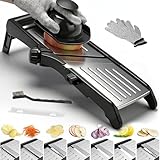

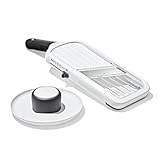

A mandoline slicer turns out paper-thin, perfectly even slices faster than any knife, which is exactly why it has a reputation as one of the most dangerous tools in the kitchen. Learning how to use a mandoline slicer safely is not optional; the blade is razor sharp and fixed, so the food does the moving and your fingers are always close to the edge. The good news is that with the right grip, the right guards, and a few simple habits, a mandoline is no riskier than a chef’s knife and far more consistent. This guide covers setup, safe technique, and care.
What a Mandoline Does Best
A mandoline excels at uniform thin cuts that are tedious by hand: potato slices for gratins and chips, cucumber rounds, radishes, fennel, and shingled vegetables for tarts. Many models also include julienne and waffle blades for matchsticks and crinkle cuts. The defining feature is consistency; because the blade height is fixed, every slice is identical, which means even cooking and a professional look. If your main goal is fast rough prep rather than precision, a chopper may suit you better; compare the approaches in our roundup of vegetable choppers.
Set Up Before You Slice
- Stabilize the base. Place the mandoline on a damp towel or a non-slip mat so it cannot skate across the counter. Folding models should be fully locked at your chosen thickness.
- Set the thickness deliberately. Start thin and adjust up; it is easier to take another pass than to ruin a slice that is too thick.
- Position a catch bowl. Slices should fall cleanly away from the blade so you are not tempted to clear them with bare fingers.
- Get your guards ready. Have the hand guard or a cut-resistant glove on before the food ever touches the blade.
The Golden Rule: Always Use a Guard
The single most important safety habit is to never let your bare hand touch the food once it is near the blade. Every mandoline comes with a hand guard, a holder with prongs that grip the food while keeping your palm clear of the edge. Use it from the first slice, not just the last few. The most common injuries happen at the end of a vegetable, when the piece gets too small for the guard to grip and people finish “just the last bit” by hand. Don’t. Either start a fresh piece on the guard prongs or simply set the stub aside for another use. A cut-resistant glove on your guiding hand is an excellent second line of defense and is cheap insurance for anyone who slices often. Safe-handling habits like these are part of the broader picture in our guide to safe kitchen utensils.
Proper Slicing Technique
Stand the mandoline at a slight angle, either propped on its legs or held at a slope over a bowl, so gravity helps the food glide. Press the vegetable onto the guard prongs, then move it down the runway in long, smooth strokes rather than short jabbing motions. Let the blade do the work; pushing harder does not slice better and only increases the risk of a slip. Keep your guiding hand directly above the guard, never reaching around the side. When the piece becomes too short to grip safely, stop. Maintaining a steady rhythm and a clear catch bowl keeps everything predictable, which is the heart of safe operation.
Cleaning a Mandoline Without Getting Cut
Cleaning is the second most likely moment for an injury, because the blade is hidden under wet food residue and suds. Never run a sponge straight down the blade in the slicing direction. Instead, rinse from behind the blade, brush along the edge rather than across it, and use a dish brush with a handle so your fingers stay back. Many mandolines disassemble for cleaning; do that when possible so you can rinse each part separately. If the model is dishwasher safe, the rack is the safest place for the blade plate. Dry thoroughly and store with the blade covered.
Storage and Blade Care
A mandoline’s blade stays sharp for a long time, which is a safety consideration as much as a performance one: store it with its cover or in a sheath so no one reaches into a drawer and meets the edge. Slotted drawer inserts or a dedicated bin keep it separated from other tools; see layouts in our guide to kitchen drawer organizers. A sharp blade is actually safer than a dull one because it cuts cleanly without forcing, so resist the urge to “save” a struggling blade; replace it if your model allows. Choosing tools that hold an edge and resist corrosion is part of picking the right utensil material overall.
Frequently Asked Questions
Do I really need the hand guard?
Yes, every single time. The fixed razor blade does not forgive a slip, and the guard is the difference between a thin slice of potato and a thin slice of fingertip. Pair it with a cut-resistant glove for the best protection.
What foods should I avoid slicing on a mandoline?
Very small, round, or hard items that won’t sit flat or grip the guard, such as tiny shallots or hard winter squash, are best handled with a knife. The mandoline is happiest with firm, flat-able vegetables like potatoes, cucumbers, and zucchini.
How thin can a mandoline slice?
Most adjust from roughly paper-thin up to several millimeters. Start at the thinnest useful setting for chips and gratins and increase as needed. Consistency, not extreme thinness, is the real advantage.
Why are my slices uneven?
Usually the food is being pushed at an angle or with varying pressure. Keep the piece flat on the guard, use long even strokes, and make sure the mandoline base is not rocking on the counter.
Is a mandoline better than a chopper?
They do different jobs. A mandoline gives uniform slices and matchsticks, while a chopper produces fast diced pieces. If you want quick dicing, the tools in our best vegetable choppers comparison may serve you better.




Write Your Review
No reviews yet. Be the first to share your experience!