
Disclosure: As an Amazon Associate we earn from qualifying purchases. We may receive a small commission when you buy through links on this page, at no extra cost to you. We only recommend products we genuinely believe offer value to home cooks.
- The Core Difference: Volume Ranges
- When to Use Measuring Cups
- When to Use Measuring Spoons
- How Cups and Spoons Relate
- Leveling: The Step Most People Skip
- When Neither Is Precise Enough
- Building Your Measuring Toolkit
- Reading Recipes Like a Pro
- Frequently Asked Questions
- Scaling Recipes Up or Down
- Related Articles
- Related Guides
As an Amazon Associate we earn from qualifying purchases at no extra cost to you. Product prices and availability are accurate as of the date shown and are subject to change.

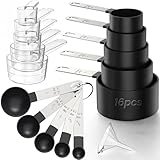


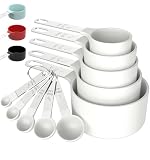


Every recipe assumes you know the difference between measuring cups vs spoons, but the two are not interchangeable, and using the wrong one is a quiet source of failed bakes. This guide explains exactly when each tool belongs in your hand, how their volumes relate, and how to convert between them when a recipe lists an amount your set does not cover.
The Core Difference: Volume Ranges
Measuring cups handle larger volumes, from 1/4 cup up to a full cup and beyond. Measuring spoons handle small volumes, from a pinch up to one tablespoon. The dividing line is roughly 1/4 cup: anything smaller is usually expressed in spoons, anything larger in cups. Knowing this instantly tells you which tool a recipe intends, even when it abbreviates units.
- Measuring cups: 1/4 cup, 1/3 cup, 1/2 cup, 1 cup
- Measuring spoons: 1/8 tsp, 1/4 tsp, 1/2 tsp, 1 tsp, 1/2 Tbsp, 1 Tbsp
When to Use Measuring Cups
Reach for cups when measuring the bulk of a recipe: flour, sugar, oats, rice, broth, milk, or chopped vegetables. Cups come in two types. Dry measuring cups nest and are leveled flat for solids, while liquid measuring cups are clear with a spout for pouring. The distinction is important enough that we dedicate a full guide to dry vs liquid measuring cups. When a recipe calls for an awkward amount like 3/4 cup, our guide on how to measure 3/4 cup shows the cleanest combinations.
When to Use Measuring Spoons
Use spoons for potent or small-quantity ingredients: salt, baking soda, baking powder, spices, vanilla extract, yeast, and oils. These ingredients have an outsized effect on a recipe, so a level spoonful matters far more than it might seem. A teaspoon too much baking soda can turn a cake bitter, and an extra tablespoon of salt can ruin a sauce. Precision here is non-negotiable.
How Cups and Spoons Relate
Cups and spoons share a clean mathematical relationship, which makes conversion easy once memorized:
- 1 cup = 16 tablespoons = 48 teaspoons
- 1/2 cup = 8 tablespoons
- 1/4 cup = 4 tablespoons
- 1 tablespoon = 3 teaspoons
This means if your set is missing a cup size, you can rebuild it with spoons. For example, 1/4 cup equals 4 tablespoons, and 3/4 cup equals 12 tablespoons. This overlap is also why our guide to measuring without measuring cups leans heavily on tablespoon counts.
Leveling: The Step Most People Skip
Both cups and spoons must be leveled for accuracy when measuring dry ingredients. Overfill slightly, then sweep the flat back of a knife across the rim to remove the excess. Never tap or pack the tool unless the recipe says “packed,” as with brown sugar. This single habit eliminates most measuring errors and is just as important as choosing the right tool.
When Neither Is Precise Enough
For serious baking, especially bread and pastry, volume measurement has inherent variability because flour can be packed or aerated. A digital scale removes that variability entirely. Our guide on converting cups to grams explains how to translate any cup or spoon amount into a precise weight, which is the standard professional bakers rely on.
Building Your Measuring Toolkit
A complete measuring setup is small and inexpensive yet covers nearly every recipe. The essentials are a nested set of dry measuring cups (1/4, 1/3, 1/2, and 1 cup), a clear liquid measuring cup with a spout, and a set of measuring spoons running from 1/8 teaspoon to one tablespoon. Many cooks add a second liquid cup in a larger size for stocks and a digital scale for baking. Look for cups and spoons with clearly stamped or engraved markings rather than printed ones, since printed labels wear off over time and leave you guessing. Stainless steel sets last longest and resist staining, a point we expand on in our guide to utensil materials.
Reading Recipes Like a Pro
Once you understand cups and spoons, recipe shorthand becomes clear. The abbreviation “c” means cup, “Tbsp” or “T” means tablespoon, and “tsp” or “t” means teaspoon. Be careful with capitalization, because a capital T usually signals tablespoon while a lowercase t signals teaspoon, and the difference is threefold. When a recipe lists an ingredient as “1 c flour, spooned and leveled,” it is telling you exactly how to fill the cup. International recipes may use metric units instead, which is where our guide to converting cups to grams helps you translate confidently. Reading these cues correctly prevents the small errors that compound into a failed dish.
Frequently Asked Questions
Can I use a measuring cup instead of a spoon?
For very small amounts, no. A teaspoon of salt measured in a cup would be nearly impossible to gauge accurately. Use spoons for anything a teaspoon or tablespoon in size.
How many tablespoons are in a cup?
There are 16 tablespoons in one cup, 8 in a half cup, and 4 in a quarter cup.
Are kitchen spoons the same as measuring spoons?
No. Everyday eating spoons vary widely in size and are not calibrated. Always use a labeled measuring spoon set for recipes.
Should I level liquid measurements too?
Liquids are read at the line at eye level rather than leveled with a knife. Only dry ingredients are leveled across the rim.
Why does my baking fail even when I measure carefully?
Often it is the cup-type mix-up or unleveled flour. Using dry cups for solids, leveling every scoop, and considering a scale for baking solves most issues.
Scaling Recipes Up or Down
Understanding cups and spoons pays off most when you resize a recipe. To double a recipe, multiply each amount by two; to halve it, divide by two. The clean relationships between units make this manageable: half of 1/2 cup is 1/4 cup, and half of one tablespoon is 1.5 teaspoons. When a halved amount lands on an awkward number, convert to the smaller unit first, since spoons divide more gracefully than cups. For example, halving 3/4 cup is easier as halving 12 tablespoons to get 6 tablespoons. Keeping the cup-to-spoon conversions in mind turns intimidating recipe math into simple arithmetic, and it is exactly why mastering both tools, rather than just one, makes you a more flexible cook.
Keep sharpening your skills with our Gadget Guides and learn the full lineup of kitchen utensils and their names to round out your toolkit.

Write Your Review
No reviews yet. Be the first to share your experience!