
- Top Pick: Mik-Nana Food Scale, 10kg/22lb Digital Kitchen Scale Weight Grams and Ounces for Baking Cooking Coffee Package Postage, 6 Units with Tare Function, LCD Display, Easy Clean Stainless Steel
- Best Value: Greater Goods Digital Food Scale for Kitchen & Baking, 22lb High Capacity
- Premium Choice: Escali Primo Digital Food Scale Multi-Functional Kitchen Scale and Baking Scale for Precise Weight Measuring and Portion Control, 8.5 x 6 x 1.5 inches, Chrome
Disclosure: As an Amazon Associate we earn from qualifying purchases. We may receive a small commission when you buy through links on this page, at no extra cost to you. We only recommend products we genuinely believe offer value to home cooks.
As an Amazon Associate we earn from qualifying purchases at no extra cost to you. Product prices and availability are accurate as of the date shown and are subject to change.

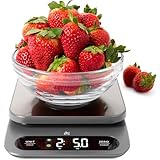


Weighing ingredients is the single biggest upgrade most home bakers can make, and a digital kitchen scale is the tool that makes it possible. Learning how to use a kitchen scale for baking means trading inconsistent cups and spoons for precise grams, which is why nearly every professional recipe is written by weight. A cup of flour can vary by a large margin depending on how it is scooped, but 120 grams of flour is always 120 grams. This guide covers the tare function, weighing techniques, converting recipes, and keeping your scale accurate.
Why Weighing Beats Measuring Cups
Volume measurements are imprecise for dry ingredients because the amount that fits in a cup depends on how packed or aerated it is. Scoop flour straight from the bag and you might pack in far more than a recipe intends, producing dense, dry baked goods. Weighing removes that variable entirely. It is also faster and cleaner, because you can add several ingredients to one bowl instead of dirtying a drawer full of cups. If you are coming from volume measuring, our guides on dry vs liquid measuring cups and measuring without measuring cups explain the pitfalls weighing solves.
Understanding the Tare Function
The tare (or zero) button is the heart of scale baking. Place your empty mixing bowl on the scale, press tare, and the display returns to zero, ignoring the bowl’s weight. Add your first ingredient until you hit the target, press tare again to re-zero, then add the next ingredient right into the same bowl. This “weigh, zero, weigh” rhythm lets you build an entire recipe in one bowl without any mental math. It is the feature that makes weighing genuinely faster than scooping once you get used to it.
Step by Step: Weighing Ingredients
- Place the scale on a hard, level surface. A soft or uneven surface throws off the reading; a counter is better than a cutting board on top of a towel.
- Choose your unit. Set the scale to grams for baking; grams give finer resolution than ounces for small quantities.
- Tare the empty bowl. Zero out the container before adding anything.
- Add ingredients gradually. Pour slowly as you approach the target so you don’t overshoot; sift or spoon in the last few grams.
- Re-tare between ingredients. Zero the scale after each addition to stack ingredients in one bowl.
Converting Cup Recipes to Weight
Many home recipes are still written in cups, so you will sometimes need to convert. Common baking staples have reliable gram equivalents (for example, all-purpose flour and granulated sugar each have standard per-cup weights), and a quick reference chart makes conversion painless. Our article on how to convert measuring cups to grams is a handy companion for this, and if you ever need to bridge between systems mid-recipe, measuring tricky fractions explains the relationships. Once you weigh a recipe a few times, jot the gram amounts in the margin so you never have to convert it again.
Weighing Liquids vs Dry Ingredients
A scale handles liquids just as well as dry goods, and for water and milk the weight in grams is very close to the volume in milliliters, which simplifies things. For thicker liquids like honey, oil, or syrup, weighing is actually cleaner than measuring, because you avoid sticky residue clinging to a cup. That said, knowing when volume still makes sense is useful; our comparison of measuring cups vs spoons covers cases where a cup or spoon remains the quicker choice for small amounts.
Choosing the Right Scale Features
Not every scale suits baking equally. Look for a model that reads in single-gram increments, since coarse 5-gram steps are useless for small amounts like yeast or salt. A capacity of several kilograms covers large bowls of flour and even a whole sheet of dough without maxing out. A flat, easy-to-wipe platform beats one with grooves that trap flour, and a display that stays visible when a wide bowl sits on top saves a lot of squinting; some scales solve this with a pull-out or remote display. An auto-off timer that is too aggressive is a nuisance mid-recipe, so a longer idle window helps. None of this needs to be expensive, but matching the scale to how you bake makes weighing a pleasure rather than a chore, the same principle behind picking the right kitchen tool for any task.
Keeping Your Scale Accurate
A scale is only useful if it is accurate. Check it occasionally with a known weight, such as a new, unopened item with the weight printed on the label, or a dedicated calibration weight. Keep the platform clean and dry, wipe up spills promptly, and replace the batteries when readings drift or the low-battery indicator appears. Store the scale flat where it won’t be crushed under heavier items; a dedicated spot in a drawer organizer, like those in our best kitchen drawer organizers guide, protects the sensor. Avoid overloading past its rated capacity, which can damage the load cell permanently.
Frequently Asked Questions
Why is weighing more accurate than measuring cups?
Because the weight of a cup of a dry ingredient changes with how it is packed, while a gram is always a gram. Weighing removes the packing variable, giving consistent results every bake.
What unit should I use, grams or ounces?
Grams. They offer finer resolution for the small quantities common in baking, so you can hit targets like 7 grams of yeast precisely, which is awkward in fractional ounces.
Can I weigh liquids on a kitchen scale?
Yes. Water and milk weigh almost exactly their volume in grams, and thick liquids like honey are easier and cleaner to weigh than to measure in a sticky cup.
How do I convert a cup recipe to weights?
Use standard per-cup gram weights for each ingredient from a reliable chart, then note the figures on the recipe. Our guide to converting measuring cups to grams walks through the common staples.
How do I know my scale is accurate?
Place a known weight on it, such as a sealed product with the mass on the label, and confirm the reading matches. If it drifts, change the batteries and check again before assuming the scale has failed.
Write Your Review
No reviews yet. Be the first to share your experience!