
Disclosure: As an Amazon Associate we earn from qualifying purchases. We may receive a small commission when you buy through links on this page, at no extra cost to you. We only recommend products we genuinely believe offer value to home cooks.
A meat thermometer is the most reliable way to know when food is cooked, far better than poking, timing, or cutting in to peek. Yet many cooks get inconsistent readings because of where and how they insert the probe. Learning how to use a meat thermometer correctly comes down to probe placement, knowing the right target temperatures, accounting for carryover cooking, and keeping the tool accurate. This guide walks through each step so your chicken comes out safe and your steak comes out exactly as you like it.
Types of Meat Thermometers
Instant-read thermometers give a fast temperature when you insert them, then come out; they are the everyday workhorse for checking doneness near the end of cooking. Leave-in probe thermometers stay in the food throughout cooking, with the display outside the oven, and often include an alarm at a set temperature. Dial (bimetal) thermometers are inexpensive but slower and less precise than digital models. For most home cooks, a quick digital instant-read is the single most useful version. Whichever you choose, it earns its place among your essential everyday kitchen tools.
Where to Insert the Probe
- Aim for the thickest part. The center of the thickest section is the slowest to cook and the true indicator of doneness.
- Avoid bone, fat, and gristle. Bone conducts heat differently and gives a falsely high reading; fat pockets read inconsistently.
- Go in from the side for thin cuts. For steaks, chops, and burgers, insert horizontally so the sensing tip sits in the middle.
- Check more than one spot. For large or irregular roasts and whole birds, test a couple of places, including the thickest part of the thigh on poultry.
Find the Sensing Point
Digital probes usually sense temperature right at the tip, while many dial thermometers sense along an inch or so of the stem. That matters for thin foods: if the sensing area sits partly outside the meat, the reading drops. For thin cuts, insert from the side so the full sensing zone is buried in the food. When in doubt, push the probe in until the tip reaches center, pause for the reading to stabilize, then withdraw slowly while watching for the lowest stable number, which marks the coolest interior point.
Safe Internal Temperatures
Cooking to a safe internal temperature, not a color or a clock, is what prevents both undercooked poultry and dry, overdone roasts. As general guidance: poultry should reach a higher finished temperature than red meat for safety; ground meats need a higher temperature than whole cuts because grinding spreads any surface bacteria throughout; and whole cuts of beef, pork, and lamb can be cooked to a range of doneness based on preference. Always confirm current recommended temperatures from a food-safety authority, since guidance is updated periodically and varies by meat type. The thermometer simply lets you hit those numbers reliably instead of guessing, the same way a scale takes the guesswork out of baking in our guide to everyday utensil set.
Account for Carryover Cooking
Food keeps cooking after it leaves the heat because the hot exterior continues to warm the center. This carryover can raise the internal temperature several degrees in a large roast as it rests. The practical takeaway is to pull meat off the heat a little before it reaches your final target, then let it rest while the temperature climbs the rest of the way. Resting also lets juices redistribute, so the meat is both more accurately cooked and juicier. Check the temperature again at the end of the rest to confirm.
Reading Different Foods Correctly
Different foods reward slightly different approaches. Whole poultry has two zones to confirm, the thickest part of the breast and the inner thigh near but not touching the bone, since the thigh runs cooler and finishes last. Thin steaks and chops give the truest reading from the side, with the probe parallel to the surface so the tip lands dead center. Burgers and meatballs, being ground, should always be checked because surface bacteria are mixed throughout; insert the probe into the center horizontally. Roasts and large cuts benefit from a leave-in probe so you can track the climb without opening the oven repeatedly, which drops the temperature and lengthens cooking. For casseroles and reheated leftovers, probe the densest center. Building this habit makes the thermometer feel less like a gadget and more like an essential, much like the dependable tools in our using a kitchen scale for baking.
Calibrating and Caring for Your Thermometer
An inaccurate thermometer is worse than none because it gives false confidence. Test accuracy with the ice-water method: fill a glass with crushed ice, top with cold water, stir, and the probe should read very close to the freezing point of water. The boiling-water method works too, adjusted for your altitude. Many digital models have a calibration reset; dial models often have a small nut under the dial to turn. Clean the probe with hot soapy water after every use to avoid cross-contamination, never submerge the digital housing unless it is rated waterproof, and store it where the tip won’t bend; a slotted insert from our kitchen drawer organizers guide keeps the probe straight and easy to find. Precise tools like this pair well with the accuracy mindset behind weighing ingredients accurately.
Top-Rated Picks
As an Amazon Associate we earn from qualifying purchases at no extra cost to you. Product prices and availability are accurate as of the date shown and are subject to change.


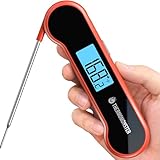

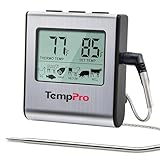

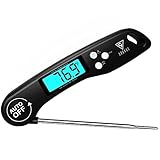

| Product | Brand | Rating | Reviews | Price |
|---|---|---|---|---|
| Etekcity Digital Food Kitchen Scale, Grams and Oz for… | Etekcity | ★ 4.6 | 175.1k | $29.99 |
| TempPro TP03B Digital Meat Thermometer for Cooking, I… | TempPro | ★ 4.6 | 136.6k | $9.99 |
| KitchenAid All Purpose Kitchen Shears with Protective… | — | ★ 4.8 | 71.5k | $7.59 |
| Spring Chef Stainless Steel Magnetic Measuring Spoons… | SpringChef | ★ 4.9 | 49.4k | $9.99 |
| Fullstar The Original Pro Chopper – Vegetable Chopper… | fullstar | ★ 4.5 | 127.9k | $26.99 |
Frequently Asked Questions
How far do I insert a meat thermometer?
Deep enough that the sensing tip reaches the center of the thickest part, avoiding bone and fat. For thin cuts, insert from the side so the tip sits in the middle rather than poking through.
Can I leave a thermometer in the oven while cooking?
Only leave-in probe thermometers are designed for that; their cable and display are oven-rated. Standard instant-read thermometers are for quick checks and should not stay in a hot oven.
Why does my thermometer give different readings in the same piece of meat?
Temperature varies throughout a cut. Spots near bone or the surface read higher, while the center reads lowest. Test the thickest center point and check a second location on large items.
How do I know if my thermometer is accurate?
Use the ice-water test: a properly calibrated probe reads right at water’s freezing point in an ice-and-water slurry. If it is off, recalibrate per the manufacturer’s instructions or replace it.
Do I need to account for resting time?
Yes. Carryover cooking raises the internal temperature during the rest, especially in large roasts, so pull the meat slightly early and confirm the final temperature after resting.
Ready to decide? Our #1 pick for 2026 is the Etekcity Digital Food Kitchen Scale, Grams and Oz for….
Live price & availability on Amazon.




Write Your Review
No reviews yet. Be the first to share your experience!