
The Short Answer
For most home cooks, an 11-pound digital kitchen scale is the right size. It is compact enough for everyday baking, portioning, coffee, meal prep, and weighing packages, while still handling a mixing bowl and several ingredients. If you regularly make large batches, use oversized bowls, or want extra flexibility, choose a 22-pound model. Commercial-style 110-pound scales are intended for unusually heavy loads, bulk ingredients, farmers-market goods, or price-by-weight work—not typical countertop cooking.
Capacity is only half the sizing decision. Check the scale’s platform dimensions, overall footprint, display location, bowl clearance, and minimum weighing increment. A scale marked “11 lb” may have a platform around 7 by 7 inches, while a high-capacity model may need a 10-by-10-inch or larger footprint. For baking, look for 1-gram or 0.1-ounce readability, a tare button, and a maximum capacity that exceeds your bowl plus ingredients by at least 2 to 3 pounds.
As an Amazon Associate we earn from qualifying purchases at no extra cost to you. Product prices and availability are accurate as of the date shown and are subject to change.


Standard Sizes
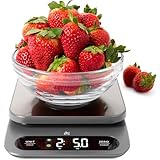
Digital kitchen scales generally fall into three practical capacity groups. The dimensions below are common size ranges, not a guarantee for every model. Always compare the manufacturer’s listed product dimensions before buying, especially if the scale must fit inside a drawer.
| Scale type | Typical capacity | Common platform size | Approximate overall size | Best for |
|---|---|---|---|---|
| Compact kitchen scale | 5–11 lb (2.3–5 kg) | 5.5–7 x 5.5–7 in (14–18 x 14–18 cm) | 6–8 x 6–8 x 0.75–1.25 in (15–20 x 15–20 x 2–3 cm) | Small kitchens, coffee, portions, everyday baking |
| Standard high-capacity scale | 11–22 lb (5–10 kg) | 7–9 x 7–9 in (18–23 x 18–23 cm) | 8–10 x 8–10 x 1–1.5 in (20–25 x 20–25 x 2.5–4 cm) | Large mixing bowls, meal prep, bread and batch cooking |
| Large commercial-style scale | 33–110 lb (15–50 kg) | 9–12 x 9–12 in (23–30 x 23–30 cm) | 10–14 x 10–14 x 2–5 in (25–36 x 25–36 x 5–13 cm) | Bulk goods, produce, market sales, heavy containers |
A standard 11-pound scale is enough for a bowl weighing 2 pounds plus up to 9 pounds of ingredients, although leaving a safety margin is wise. A 22-pound model gives more headroom for Dutch ovens, stockpot ingredients, sourdough batches, and holiday cooking. Remember that the stated capacity includes the container. If your empty bowl weighs 3 pounds, an 11-pound scale has only about 8 pounds of usable ingredient capacity.
Typical home scales weigh in grams, ounces, pounds, and sometimes milliliters. A 1-gram increment is suitable for most recipes. Coffee enthusiasts and highly precise bakers may prefer a separate 0.1-gram scale for small quantities; a large-capacity kitchen scale is not automatically more precise at very low weights.
How to Measure Your Space
- Measure the available countertop width and depth. Leave at least 1 inch of clearance on every side so the scale does not touch a wall, backsplash, appliance, or cabinet edge. For a 9-inch-wide model, plan on roughly 11 inches of clear width.
- Check the storage location. Measure the drawer’s interior width, depth, and height, not just its front opening. Many scales are 1 to 1.5 inches thick, but raised displays, feet, or a removable bowl can require more vertical space.
- Measure your largest container’s base. The bowl or pot should sit fully on the platform without covering the display or buttons. A container base that is 8 inches wide needs a platform close to that width for stable readings.
- Account for the display and controls. Some scales have a front display, while others place the display beneath the platform. Set a large bowl on the scale and confirm that you can still read the numbers and press tare.
- Calculate your real load. Weigh the empty container, then add the maximum ingredient amount you expect to use. Select a scale rated above that total. For example, a 2.5-pound bowl plus 7 pounds of dough calls for more than an 11-pound capacity if you want comfortable headroom.
- Consider the power setup. Battery models are convenient for drawers and occasional use. USB-rechargeable models reduce disposable battery use, but allow room near an outlet or charging cable. A kitchen scale normally draws very little power; check the included charging specifications rather than choosing by wattage alone.
By Room or Use Case
Everyday kitchen and baking
Choose an 11-pound scale with a platform about 7 by 7 inches or larger. This is the best fit for flour, sugar, pasta, meat portions, and standard mixing bowls. An affordable model in the roughly $13 to $25 range can provide grams and ounces, tare, auto-off, and a backlit display. The Etekcity 11-pound style is representative of this category.
Large-batch baking and meal prep
Choose a 22-pound scale when you make bread, pizza dough, preserves, freezer meals, or multiple servings at once. A 22-pound model commonly costs about $25 to $35 and may have an 8-by-8-inch or larger platform. The Greater Goods 22-pound style offers the extra capacity that a typical home baker needs without the footprint of commercial equipment.
Wet ingredients and messy cooking
If the scale will sit near a sink or handle splashes from sauces, fruit, or meat, prioritize a sealed surface and easy cleaning. An IPX6-rated model, such as the type represented by a 22-pound USB-rechargeable Etekcity scale, is designed for powerful water jets but should not be submerged unless the manufacturer specifically permits it. Expect to pay approximately $25 to $35 for this type of feature. Keep liquids away from the display seams and dry the platform after cleaning.
Coffee and small-quantity measuring
A compact 5- to 11-pound scale is usually sufficient for coffee brewing, tea, spices, and baking ingredients. Look for a footprint no larger than about 7 by 7 inches and a fast, readable display. Capacity matters less here than responsiveness, a timer if desired, and readability to 1 gram or finer. Do not pay for a 110-pound capacity when your heaviest load is a coffee carafe.
Farmers markets, bulk goods, and commercial use
A 33- to 110-pound platform scale makes sense for bulk produce, large containers, resale goods, or price computing. These scales are wider, taller, and heavier, often with a platform around 10 to 12 inches square. A 110-pound commercial-style model may cost roughly $35 to $60 in the consumer market, but confirm legal-for-trade certification if customers are charged by weight. The Atogou 110-pound style is aimed at this use rather than ordinary baking.
Common Sizing Mistakes
- Choosing capacity without checking platform size: A 22-pound rating does not guarantee that a large stockpot will fit securely.
- Using the maximum rating as the target load: A scale should not be operated at its limit for every batch. Leave at least 10 to 20 percent capacity when possible.
- Forgetting container weight: The scale measures the bowl, pot, and ingredients together before tare is used.
- Buying a commercial scale for a small counter: High-capacity models can consume several extra inches of depth and may block cabinets or outlets.
- Ignoring minimum weight: A large platform scale may be less convenient for tiny amounts. Check its minimum measurable load and increment.
- Assuming a removable bowl increases capacity: The bowl still counts toward the maximum weight, and its shape may reduce usable space.
- Overlooking cleanability: Crevices around buttons can be frustrating when weighing liquids, meat, or sticky ingredients.
FAQ
Is an 11-pound or 22-pound kitchen scale better?
An 11-pound scale is best for most recipes and takes less storage space. Choose 22 pounds if your bowl is heavy, your recipes are large, or you frequently prepare bread and meal-prep batches. The price difference is often modest, so the larger model can be worthwhile if the footprint fits.
What size digital kitchen scale do I need for baking?
For everyday baking, choose at least 11 pounds, 1-gram readability, and a platform about 7 by 7 inches. For bread, pizza, or multi-loaf batches, select 22 pounds and a platform around 8 by 8 inches or larger.
Can a kitchen scale weigh a stockpot?
Yes, if the pot’s base fits entirely on the platform and the combined weight stays below the scale’s capacity. A 22-pound model is generally more practical than an 11-pound model for a stockpot. Center the pot and make sure it does not rest against the counter or backsplash.
Does a higher weight capacity mean a more accurate scale?
No. Capacity describes the maximum load, not precision. Compare the smallest increment, minimum measurable weight, display readability, and stability. For most home cooking in 2026, a dependable 1-gram scale with an 11- or 22-pound capacity is the most useful combination.
Ready to decide? Our #1 pick for 2026 is the Compact kitchen scale.
Live price & availability on Amazon.





Write Your Review
No reviews yet. Be the first to share your experience!