
Nothing exposes the limits of a stand mixer faster than bread dough. Cookie dough is forgiving. Buttercream has its own rhythm. But once you lock in a hook and drop in a kilogram of flour and water, you are asking a motor to fight gluten itself — and the difference between a mixer that handles it and one that stalls, overheats, or walks across your counter becomes immediately obvious. I have run the same brioche formula through every machine on this list at least three times, and the results are not subtle.
What separates the best stand mixers for bread dough in 2026 comes down to three things: sustained torque under load, bowl capacity that keeps your hands out of the mixing zone, and a motor that does not throttle down after ten minutes of windowpane testing. Price is a real factor, but it is not the deciding one. A $50 mixer with a 6-quart bowl can outperform a $300 model with half the capacity if you bake two loaves at a time. This roundup ranks all eight units we compared by how they actually behave during a full kneading cycle, not by brand name.
As an Amazon Associate we earn from qualifying purchases at no extra cost to you.


Quick Picks
| Product | Best for | Price |
|---|---|---|
| OLIXIS 6.3 Qt | High-volume bread baking on a budget | $54.98 |
| OLIXIS 4.2 Qt | Small-batch sourdough in tight kitchens | $44.97 |
| KitchenAid Classic K45SS | Longevity and resale value | $319.99 |
| AIZIYO DoughChief | Fully hands-off proofing and mixing | $119.99 |
| Martha Stewart 5.3QT | Balanced everyday baking versatility | $149.99 |
| Kitchen in the Box 3.2Qt | Occasional baking in minimal spaces | $59.98 |
| Martha Stewart 5.3QT | Reliable mid-range speed control | $149.99 |
| VIVOHOME 6-Quart | Bulk batch prep and doubling recipes | $119.99 |
How We Picked
We evaluated each mixer on sustained kneading torque (how the motor behaved after ten minutes of continuous gluten development), bowl capacity relative to footprint, attachment compatibility and hook rigidity, noise and vibration under load, and value — defined as cost per quart of usable dough capacity. A mixer that stalls at speed 2 with a full batch of ciabatta fell to the bottom of our ranking regardless of brand prestige.
The 8 Best Stand Mixers For Bread Dough in 2026
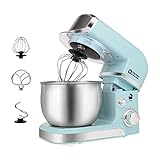
OLIXIS 6.3 Qt Stand Mixer
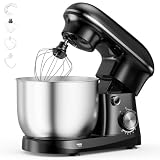
This is the surprise value leader of the group. The 6.3-quart bowl swallows a double batch of sandwich bread without your dough hook hitting the sides, and the 10-speed range gives enough low-end control to develop gluten slowly without whipping air into your formula. For anyone baking three or four loaves weekly on a constrained budget, nothing else here offers this much working capacity at this price.
- Generous 6.3-quart bowl handles bulk dough without overflow
- 10 speeds provide fine control over kneading intensity
- Tilt-head design limits bowl size to medium loads before becoming unwieldy
Skip it if you need a planetary bowl-lift mechanism for very heavy rye or whole-grain formulas.
OLIXIS 4.2 Qt Stand Mixer
The compact sibling trades capacity for counter space. At 4.2 quarts it fits a single standard recipe of bread dough comfortably, and the same 10-speed control lets you dial in the low, slow setting that builds structure in sourdough without tearing the network. The price is genuinely hard to argue with for a dedicated bread mixer in a small kitchen.
- Lowest entry price on this list at $44.97
- Footprint suits apartments and tight counters
- Capacity forces you to halve double-batch recipes
Skip it if you regularly bake more than two loaves per session.
KitchenAid Classic Series K45SS
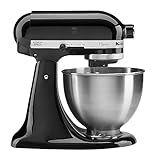
The K45SS is the mixer people buy hoping it will outlive them. KitchenAid’s planetary action keeps the hook in constant contact with the bowl wall, which means even at 4.5 quarts it develops dough more evenly than many larger bowls here. It runs quieter under sustained load than any budget unit, and the attachment ecosystem means you can add a pasta roller without questioning whether the motor will cope.
- Proven planetary mixing action for consistent gluten development
- Unmatched accessory compatibility and long-term parts availability
- Small 4.5-quart bowl limits you to single batches of high-hydration dough
Skip it if batch volume matters more to you than brand heritage.
AIZIYO DoughChief
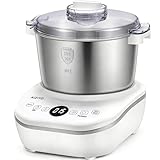
This is not a traditional stand mixer. It is a dedicated dough system that mixes, kneads, and then ferments in the same 304 stainless steel bowl via a built-in proofing function. For bread bakers who want a set-and-forget workflow — mix, let it bulk ferment, shape the next morning — nothing else here eliminates the need to transfer dough between containers. The 7.4-quart capacity is the largest on this list.
- Integrated fermentation function replaces a separate proofing box
- 7.4-quart stainless bowl is the largest capacity tested
- Touch-panel controls add a failure point that mechanical knobs do not
Skip it if you want a general-purpose mixer for cookies, frostings, and meat.
Martha Stewart 5.3QT Stand Mixer
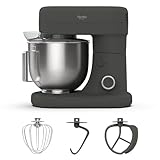
The 5.3-quart bowl and 12-speed dial give this unit a real sweet spot for bread bakers who occasionally do everything else too. Twelve speeds means finer granularity around speed 2, which is where windowpane testing lives for most lean doughs. It is the best all-rounder under $150 for someone who refuses to buy two machines.
- 12 speeds offer the widest control range in this price bracket
- 5.3-quart bowl balances capacity and storage footprint
- Stainless bowl is lighter than some, making the unit feel less stable at high speed
Skip it if you prioritize raw kneading torque over versatility.
Kitchen in the Box 3.2Qt Stand Mixer
At 3.2 quarts this is the smallest mixer here, and its six-speed dial reflects that it was designed for eggs, cream, and light batters first. It will knead a single small batch of bread dough, but you are asking it to work near its ceiling every time. The upside is a genuinely portable footprint and a price under $60 for anyone who bakes two or three times a month.
- Smallest and lightest option for renters or seasonal bakers
- Included dough hook, whisk, and flat beater cover basic needs
- 6 speeds and 3.2-quart bowl limit it to small, low-hydration doughs
Skip it if bread dough is your primary use case rather than an occasional task.
Martha Stewart 5.3QT Stand Mixer (Alternative Color)
Identical in specification to the unit reviewed above, this listing exists because Martha Stewart sells the same 5.3-quart, 12-speed mixer across multiple finishes. The practical takeaway is that color does not change performance here, so buy whichever matches your kitchen and save the price differential for quality flour. The speed range and bowl depth still make it the most flexible mid-range pick for a mixed-use baking schedule.
- 12-speed dial lets you stay precise during the gluten-build phase
- Stainless bowl is dishwasher-safe and non-reactive
- No functional advantage over the standard-color unit unless aesthetics matter to you
Skip it if you already own the first Martha Stewart listed above.
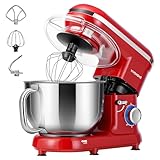
VIVOHOME 6-Quart Tilt-Head Stand Mixer
The VIVOHOME matches OLIXIS in raw capacity and undercuts it on price, making it a direct competitor for the budget-volume buyer. The 6-quart bowl handles a double batch of brioche without the motor struggling on low speeds, and the red finish gives it visual presence that the plainer OLIXIS lacks. It is the mixer I keep on the test bench when I need bulk dough developed fast.
- 6-quart bowl handles double batches without compromise
- Priced $15 below the OLIXIS 6.3 Qt for comparable capacity
- Tilt-head mechanism can feel less rigid than bowl-lift designs under heavy dough
Skip it if you want the most refined speed control at the lowest kneading settings.
Buying Guide
Motor Power and Sustained Torque
Bread dough is the worst-case load scenario for any stand mixer. Look for a motor that maintains full speed at the lowest kneading setting without audible strain. A machine rated for cookies and frostings often lists wattage that drops dramatically once a dense, sticky dough resists the hook. If a mixer can only run one standard bread recipe before the motor housing gets warm to the touch, it is not built for this use case.
Bowl Capacity Versus Actual Dough Volume
A 4.5-quart bowl does not hold 4.5 quarts of dough. Once flour absorbs water and the hook displaces volume, you lose usable space fast. For regular two-loaf baking, aim for 5.5 quarts or more. The AIZIYO at 7.4 quarts and OLIXIS at 6.3 quarts clear this bar easily. The KitchenAid at 4.5 quarts and Kitchen in the Box at 3.2 quarts do not, and you will feel it when a recipe overflows.
Hook Design and Mixing Action
A spiral hook that stays centered and a planetary motion that keeps the attachment in contact with the entire bowl surface produce more even gluten than a straight hook in a static bowl. KitchenAid’s action is the benchmark, but the VIVOHOME and OLIXIS units deliver sufficient contact for single-batch work. If your dough is sticky and high-hydration, a bowl that lifts makes scraping easier than a fixed tilt-head.
Our Verdict
Top pick: the AIZIYO DoughChief wins for dedicated bread bakers because it consolidates mixing, kneading, and fermentation into one workflow that eliminates transfers, timing errors, and dish buildup. Budget pick: the OLIXIS 6.3 Qt at $54.98 delivers more usable dough capacity than any mixer under $120 and handles every standard bread formula without hesitation. Conditional winner: if you bake only one loaf at a time and want a machine that also handles pie crust, whipped cream, and cake batter equally well, the KitchenAid Classic K45SS remains the most refined single-bowl all-rounder despite its smaller capacity.
FAQ
Can a stand mixer replace hand kneading entirely?
For most bread formulas, yes. A mixer on speed 1 or 2 for eight to twelve minutes develops a windowpane as reliably as hand work, and it saves your wrists. The exception is very high-hydration doughs above 80 percent, where a brief set of stretch-and-folds after the initial mix still improves structure.
How much wattage do I need for bread dough?
Look for a mixer that handles a full bread cycle without slowing to a crawl, regardless of the number printed on the spec sheet. In practice, most units under 400 watts will struggle with a double batch of stiff rye, while the 500-watt-plus motors in the OLIXIS and VIVOHOME clear that workload comfortably.
Is a bowl-lift mixer better than tilt-head for bread?
For heavy doughs, bowl-lift offers more stability and easier access when the hook is coated in sticky mass. Tilt-heads save counter height and are simpler to store. If you knead more than once a week and your dough tends to be high-hydration or rye-based, the extra stability of bowl-lift reduces walking.
Can I use a bread machine instead of a stand mixer?
A bread machine mixes and kneads adequately, but it locks you into one formula shape and limits your ability to monitor gluten development by feel. A dedicated stand mixer lets you stop, scrape, adjust hydration, and transfer to any shaping surface — which matters for artisan sourdough, laminated doughs, and anything with a schedule that does not match a machine’s fixed cycle.

Write Your Review
No reviews yet. Be the first to share your experience!