
A mandoline slicer is one of those kitchen tools that can feel transformational—or become an awkward, sharp gadget that lives at the back of a cabinet. The real decision is not simply whether a V blade or straight blade cuts faster. It is whether you want a more forgiving, everyday slicer for mixed vegetables and soft produce, or a simpler, more compact tool that excels at thin, consistent cuts when you are comfortable using a hand guard.
- Quick Verdict
- Side by Side
- Where V Blade Wins
- Where Straight Blade Mandoline Slicer Wins
- V Blade vs Straight Blade Mandoline: What Editorial Reviews Found
- Mandoline Safety: Guards, Gloves and Technique
- Cleaning and Blade Care
- Other Straight-Blade Option Worth Knowing
- Cost Over 5 Years
- Which One for Your Home
- FAQ
In the v blade vs straight blade mandoline slicer decision, V-blade models generally prioritize stability and versatility. Their angled blades pull food toward a center point, often making them easier to use with tomatoes, onions, potatoes, and peppers. Straight-blade mandolines use one horizontal cutting edge, delivering a direct, clean slicing motion that many experienced cooks prefer for paper-thin vegetables. Both can produce excellent results, but they suit different kitchens, cooking habits, storage situations, and comfort levels.

OXO Good Grips V-Blade Mandoline | Vegetable Slicer, Sharp V-Shaped Blade, Adjustable Thickness Settings and Julienne, Food Holder, Ideal for Slicing Produce
Included for 'V Blade vs Straight Blade Mandoline Slicer: Which Is Right for Your Home' as a representative home product in this roundup; selection reflects the product set returned for this topic.
View on Amazon
V-Blade Mandoline
Included for 'V Blade vs Straight Blade Mandoline Slicer: Which Is Right for Your Home' as a representative home product in this roundup; selection reflects the product set returned for this topic.
View on Amazon
Benriner Japanese Mandolin Vegetable Slicer
Included for 'V Blade vs Straight Blade Mandoline Slicer: Which Is Right for Your Home' as a representative home product in this roundup; selection reflects the product set returned for this topic.
View on Amazon
OXO Good Grips Handheld Mandoline Slicer with Non-Slip Handle for Kitchen | OXO Good Grips Handheld Mandoline Slicer for Kitchen, Adjustable Vegetable Slicer
Included for 'V Blade vs Straight Blade Mandoline Slicer: Which Is Right for Your Home' as a representative home product in this roundup; selection reflects the product set returned for this topic.
View on AmazonUpdated October 2026 – Quick answer on v blade vs straight blade mandoline slicer: pick a V-blade model such as the OXO Good Grips V-Blade Mandoline Slicer for stability and mixed produce, and a straight-blade model such as the Benriner Japanese Mandolin Vegetable Slicer for ultra-thin slices and small drawers. Published reviews disagree on which cuts better, so blade sharpness and how you cook matter more than blade shape.
Quick Verdict
Choose a V-blade mandoline if you want a more confidence-inspiring design for frequent home cooking, a wider range of produce, and adjustable cutting options in one countertop-friendly unit. Most full-size V-blade models have sturdy feet, a food holder, and interchangeable blades for julienne or waffle-style cuts. They are usually the better choice for families, batch cooking, and cooks who want more guidance while slicing.
Choose a straight-blade mandoline slicer if compact storage, low cost, and exceptionally thin slices matter most. A traditional Japanese-style slicer, such as the Benriner Japanese Mandolin Vegetable Slicer, is often lightweight, straightforward, and very effective for cucumbers, cabbage, carrots, and daikon. The tradeoff is that it usually demands more deliberate technique and careful use of the hand guard.
For many homes in 2026, the practical middle ground is a V-blade unit for regular meal prep and a compact handheld straight-blade slicer only if storage is extremely limited or you primarily slice a narrow range of firm vegetables.
Side by Side
| Factor | V-Blade Mandoline | Straight-Blade Mandoline Slicer |
|---|---|---|
| Comfort | Usually more stable, with legs or a non-slip base and a guided food holder. | Simple and direct, but requires more control from the user. |
| Cutting action | Two angled blades meet in a V, which makers say spreads the cut across the food; reviewers disagree on how much this helps. | One horizontal blade makes a clean, straight cut. |
| Best produce | Potatoes, onions, tomatoes, peppers, apples, zucchini, and mixed prep. | Cucumbers, cabbage, carrots, radishes, daikon, and other firm vegetables. |
| Durability | Typically 1.5 to 3.5 pounds, with more plastic parts and removable blade inserts. | Often 0.4 to 1.2 pounds, with fewer components and a simpler frame. |
| Typical price range | About $25 to $60 for home-use models. | About $15 to $35 for handheld and Japanese-style models. |
| Maintenance | More parts to rinse and dry; blade storage needs attention. | Fewer pieces to wash, though the exposed blade must be cleaned carefully. |
| Space needed | Usually 14 to 17 inches long and 4 to 6 inches wide when stored. | Commonly 11 to 13 inches long and 3 to 4 inches wide. |
| Look | More substantial, appliance-like, and suited to a visible kitchen drawer or shelf. | Minimal, utilitarian, and easy to tuck into a slim drawer. |
| Resale and replacement | Recognizable brands and complete blade sets tend to retain more value secondhand. | Low initial cost makes replacement more practical than resale. |
| Best for | Frequent cooks, families, and anyone who wants one versatile slicer. | Small kitchens, confident cooks, and fans of ultra-thin vegetable slices. |
Where V Blade Wins
The main advantage of a V-blade mandoline is ease of use across different ingredients. Rather than forcing the entire width of a potato or tomato across one blade at once, the V shape divides the cutting action. That can make each pass feel smoother, especially with wider or softer produce. It also helps explain why V-blade designs are popular with cooks who want to prepare scalloped potatoes, salad vegetables, roasted vegetable trays, and fruit garnishes without changing tools.
Stability is another meaningful advantage. Full-size V-blade slicers often have fold-out legs, rubberized feet, or a broad non-slip base. Most measure roughly 15 inches long when assembled, so they need some counter room, but that footprint gives the user a more secure working position than a lightweight handheld board. A model such as the OXO Good Grips V-Blade Mandoline Slicer, at the mid-price tier, represents the better-equipped end of the everyday home category. More basic V-blade mandolines cost noticeably less.
V-blade models also tend to offer more built-in variety. Thickness settings may range from approximately 1/16 inch to 3/16 inch or more, depending on the design, and many include inserts for matchsticks, julienne strips, or crinkle cuts. That does not automatically make them better for every task, but it can eliminate the need for separate cutters in a busy kitchen.
For less experienced users, the larger food holder is important. No mandoline is risk-free: the blades are sharp by design, and a guard should be used whenever the remaining piece of food is too small to grip securely. Still, a broad holder, stable platform, and controlled slide make a V-blade design less intimidating for routine use.
Where Straight Blade Mandoline Slicer Wins
A straight-blade mandoline wins on simplicity. Its basic design has fewer moving parts, fewer inserts, and less bulk. For someone who wants thin cucumber rounds for salads, shredded cabbage for slaw, or evenly sliced radishes for tacos, a traditional straight-blade mandoline can be remarkably efficient. The slicing path is easy to understand: hold the guard, move food down the ramp, and repeat with consistent pressure.
It is also usually the better fit for a small drawer. Many straight-blade models weigh under 1 pound and measure about 12 inches long, making them easier to store in a narrow apartment kitchen than a full-size V-blade model with legs and multiple blade cartridges. A compact handheld option such as the OXO Good Grips Handheld Mandoline Slicer with Non-Slip Handle for Kitchen, illustrates the appeal of this category: a focused, low-cost tool.
Traditional straight-blade slicers are especially valued for very thin, even cuts. A well-adjusted Japanese-style model can make delicate cucumber slices, cabbage ribbons, and potato slices for chips or gratin with little fuss. The Benriner Japanese Mandolin Vegetable Slicer is the kind of straightforward tool that appeals to cooks who do not need a large collection of attachments.
The limitation is that the user supplies more of the stability. Lightweight models can shift if used on a wet counter or without a non-slip surface. Some are best held over a bowl, which saves space but requires confidence and a firm grip. They also tend to be less friendly with soft, ripe tomatoes or irregularly shaped produce. For these foods, use a slow, controlled motion—or choose a V-blade model or a sharp chef’s knife instead.
V Blade vs Straight Blade Mandoline: What Editorial Reviews Found
Professional reviews of mandolines do not agree on a winner. America’s Test Kitchen preferred straight blades, reporting that food took more force to push through V-blade slicers and that results were sometimes less even, and its top pick was a Benriner-style straight-blade slicer. Serious Eats found no performance gap once blades were equally sharp and noted that a V blade holds soft produce such as tomatoes without snagging.
The practical reading is that a straight blade has the edge for firm vegetables and thin, even slices, while a V blade is more forgiving with soft-skinned or large produce. Both depend on sharp blades: a dull blade snags, needs more force and is less safe.
Blade thickness guide by food
| Food | Suggested thickness | Better blade style |
|---|---|---|
| Potato chips | About 1/16 inch | Straight blade for the thinnest, most even slices |
| Scalloped potatoes or gratin | About 1/8 inch | Either style |
| Cucumber and radish rounds | 1/16 to 1/8 inch | Straight blade |
| Cabbage for slaw | About 1/16 inch | Straight blade |
| Onion rings | 1/8 to 1/4 inch | V blade for larger onions |
| Firm tomatoes | 1/8 to 3/16 inch | V blade |
| Apples for tarts | About 1/8 inch | Either style |
Mandoline Safety: Guards, Gloves and Technique
Every mandoline blade is sharp by design, so a guard is the first line of protection. Stop slicing when the piece left in the holder is too small to grip, rather than pressing for one more slice. Keep a steady, even stroke, and never test the blade with a finger.
A cut-resistant glove on the hand that steadies the food adds a second layer of protection, particularly with a handheld straight-blade model. Look for a food-grade glove rated for cut resistance and wash it separately from the blade.
NoCry Premium Cut Resistant Gloves — Best add-on for any mandoline user

NoCry Premium Cut Resistant Gloves Food Grade — 100% Food Safe — Level 5 Meat Cutting Glove for Chefs & Butchers — Perfect Mandoline Glove or Oyster Shucking Gloves with Superior Comfort & Dexterity
Included for 'V Blade vs Straight Blade Mandoline Slicer: Which Is Right for Your Home' as a representative home product in this roundup; selection reflects the product set returned for this topic.
View on Amazon- Cut-resistance level 5, as described in the listing
- Food-grade material suitable for kitchen use
- Sold for chefs and home cooks working with sharp slicers
A cut-resistant glove is the cheapest safety upgrade for either blade style. It does not make a mandoline risk-free, so keep using the guard.
Skip it if… you only slice with a food holder that keeps your hand well clear of the blade.
Cleaning and Blade Care
Rinse the blade straight after use so starchy residue does not dry on it, then dry it fully before storage. Use a brush rather than a sponge near the edge. V-blade inserts often have crevices where the two blades meet, so they take longer to clean; a straight blade is quicker to wipe down but the exposed edge needs care. Many makers advise against dishwashers for the blade, so check the manual for your model.
Other Straight-Blade Option Worth Knowing
Benriner Mandoline Slicer with 4 Blades — Best straight-blade set for varied cuts
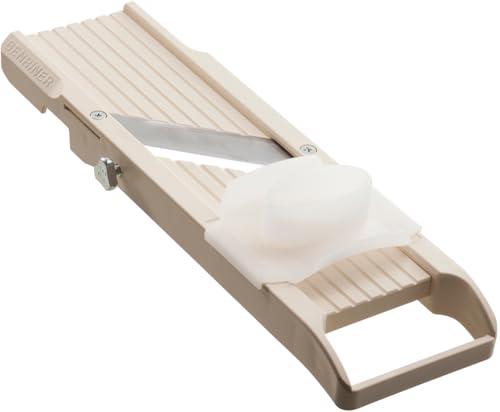
Benriner Mandoline Slicer with 4 Blades, Japanese Stainless Steel, BPA Free, 12.75 x 3.625-Inches, Beige
Included for 'V Blade vs Straight Blade Mandoline Slicer: Which Is Right for Your Home' as a representative home product in this roundup; selection reflects the product set returned for this topic.
View on Amazon- Brand: Benriner, Japanese stainless steel blades
- Includes 4 blades, per the listing title
- BPA-free body, about 12.75 x 3.625 inches
This is a step up from the single-blade Benriner above for cooks who want julienne cuts as well as flat slices while keeping the narrow, drawer-friendly shape of a straight-blade slicer. It suits confident cooks who already use a guard.
Skip it if… you want a stable, legged base for large batches; a V-blade model like the OXO Good Grips V-Blade Mandoline Slicer is more forgiving.
Cost Over 5 Years
The five-year cost difference is usually smaller than buyers expect. A basic straight-blade mandoline costs roughly $15 to $35, while a dependable V-blade model generally falls between $25 and $60. If you buy once and care for it properly, either can last five years or longer in a home kitchen.
A realistic five-year budget for a straight-blade slicer is about $20 to $45: the slicer itself plus a possible replacement hand guard or replacement unit if the blade dulls or the plastic frame cracks. Because many compact slicers are inexpensive, replacement is often more sensible than trying to source individual parts.
For a V-blade mandoline, plan on about $35 to $75 over five years. The higher total reflects the initial purchase price and the possibility of replacing a food holder, blade insert, or storage case. The upside is broader functionality, which may prevent you from buying a separate julienne cutter or crinkle cutter.
Neither tool uses electricity, so wattage and energy costs are not a factor. To extend service life, hand-wash blades promptly, dry them fully before storage, and do not let loose inserts rattle around in a drawer. Dishwasher compatibility varies by model, but hand-washing is generally gentler on sharp edges and safer for the person unloading the rack.
Which One for Your Home
Small apartment
Choose a straight-blade mandoline or compact handheld slicer if every drawer inch matters. Look for a model around 11 to 13 inches long with a hand guard and non-slip grip. It is the better choice when you mainly make salads, slaws, and simple vegetable sides. Select a V-blade only if you cook large batches often and have room for a 15-inch tool plus its blade inserts.
Family with kids or pets
A V-blade mandoline is usually the more practical choice because it is more likely to include enclosed blade storage, a substantial food holder, and a stable base. Store it in a latched cabinet or high drawer, never loose in a utensil bin. Kids should not operate either style without close adult supervision, and pets should be kept away from dropped food and exposed blades during prep and cleanup.
Rental
For a rental kitchen, prioritize a tool that stores easily and does not require dedicated counter space. A $20 to $35 straight-blade slicer is a sensible low-commitment option for one or two people. If you cook frequently and want to avoid accumulating specialty cutters, a mid-priced V-blade can still be the smarter single purchase.
Long-term home
Choose a quality V-blade mandoline if you expect to cook regularly for years, host dinners, or prepare vegetables in volume. Its larger size is easier to justify when you have a dedicated drawer or cabinet. Buy a straight-blade slicer instead if you already own a good knife, prefer minimalist tools, and know that thin cucumber, cabbage, and root-vegetable slices are your primary use.
FAQ
Is a V-blade mandoline safer than a straight-blade mandoline?
Neither is inherently safe enough to use carelessly. V-blade models often feel safer because they commonly have more stable bases and larger food holders. Use the guard, keep fingers away from the blade path, and stop slicing before food becomes too small to hold securely.
Does a V blade make better slices?
Not necessarily. A V blade often handles varied and softer produce more comfortably, while a straight blade can produce exceptionally thin, clean slices of firm vegetables. Slice quality depends on blade sharpness, thickness adjustment, produce firmness, and technique.
Can a mandoline slice tomatoes?
Yes, but results vary. A sharp V-blade mandoline is often easier to use on firm tomatoes because its cutting action reduces drag. Use firm, chilled tomatoes, set a moderate thickness, and make smooth passes. Very ripe tomatoes are usually better sliced with a sharp serrated or chef’s knife.
What thickness should I use for potatoes?
For scalloped potatoes or gratin, start around 1/8 inch. For potato chips, use a much thinner setting, often around 1/16 inch. For roasted potato rounds, 1/8 to 3/16 inch gives a sturdier slice. Keep thickness consistent so the potatoes cook evenly.
Is a Benriner a V-blade or straight-blade mandoline?
A Benriner is a straight-blade mandoline. Its single flat blade is the reason cooks reach for it when they want thin, even cucumber, cabbage and potato slices.
Can I sharpen a mandoline blade at home?
It depends on the model. Many V-blade inserts are not designed for home sharpening, while some straight blades can be removed and honed. Check the maker’s guidance, and replace the blade or slicer if it starts to snag.
Which is easier to clean, a V blade or a straight blade?
A straight blade is usually quicker because it has fewer parts and no crevices. V-blade models have more pieces to rinse and dry, but a brush clears the blade crevices easily.
Which mandoline is better for onions?
A V-blade mandoline tends to be easier with larger onions because the wider food holder keeps the onion steady. A straight blade works well for small onions and very thin slices.






Write Your Review
No reviews yet. Be the first to share your experience!