
Quick answer: Our top pick in 2026 is the Measuring spoons, including a 1/8-teaspoon spoon — our #1 rated choice. See the full ranked comparison, alternatives and buying advice below.
The Short Answer
Yes—if you regularly bake very small, high-impact ingredients and already own a reliable kitchen scale. For most home bakers, however, a precision milligram scale is a specialty tool rather than a baking essential. The one condition is that your recipes must actually call for quantities below about 0.1 gram; otherwise, a standard food scale will be easier, faster, and more useful.
The phrase “milligram scale” sounds like a major upgrade, but it describes a different job from the scale you use for flour, sugar, and butter. A typical kitchen scale measures in 1-gram or 0.1-gram increments and handles several pounds. A milligram scale may read to 0.001 gram, or 1 milligram, but usually has a tiny capacity—often around 50 grams. That makes it excellent for minute quantities and awkward for nearly everything else in a typical baking session.
As an Amazon Associate we earn from qualifying purchases at no extra cost to you. Product prices and availability are accurate as of the date shown and are subject to change.

What You Actually Get
A precision milligram scale is a compact electronic scale with a small weighing platform, a digital display, and a protective cover or weighing tray. A product such as the MAXUS Digital Milligram Scale listed at $19.99 measures up to 50 grams in 0.001-gram increments and includes two 20-gram calibration weights. Its small footprint is convenient for a drawer, but the 50-gram limit is not remotely large enough for a bowl of flour or a stick of butter.
That resolution can be useful for ingredients such as baking soda, baking powder, instant yeast, xanthan gum, citric acid, powdered colors, and strong flavor extracts. It can also help when scaling a formula down to a fraction of its original size. For example, if a recipe uses 0.35 gram of a potent ingredient, a scale that only displays whole grams cannot give you a practical measurement.
There is an important distinction between resolution and accuracy. A display that changes in 0.001-gram steps does not automatically mean the scale is accurate to 0.001 gram. Small scales are affected by drafts, vibration, uneven surfaces, temperature changes, static electricity, and the way an ingredient is placed on the platform. The included calibration weights are useful, but they do not turn an inexpensive scale into laboratory equipment.
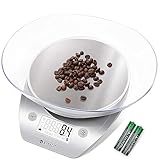
For everyday baking, a 0.1-gram food scale is usually the better general-purpose tool. The Etekcity 0.1g Food Kitchen Scale, for example, is listed at $18.99 and has an 11-pound/5-kilogram capacity. That combination lets you weigh a mixing bowl, several cups of flour, and the rest of a recipe without stopping to work in tiny batches. It also measures in grams and ounces, which is helpful if you use recipes from different sources.
Pros
- It handles genuinely tiny quantities. A milligram scale can measure ingredients in the 0.01- to 1-gram range more meaningfully than a standard kitchen scale. That matters when a small error could noticeably affect a formula.
- It helps with small-batch baking. Dividing a recipe by four, eight, or more can produce quantities too small for ordinary measuring spoons. A digital readout is more repeatable than estimating a pinch.
- It supports precise formula development. Bakers who test sourdough percentages, modernist recipes, food colors, or unusual leavening blends may appreciate the ability to record and repeat very small additions.
- It is inexpensive compared with professional equipment. Entry-level models commonly cost about $15 to $40, so experimenting with one does not require a major investment.
- It takes up little storage space. Most pocket-style models are small enough to keep with measuring spoons or other baking accessories rather than occupying counter space full-time.
Cons
- The capacity is extremely limited. A 50-gram maximum leaves no room for a mixing bowl and cannot accommodate most primary baking ingredients. You will still need a regular kitchen scale.
- It can be slower than measuring spoons. You may need to weigh a tiny cup or piece of paper, tare it, add the ingredient gradually, and wait for the display to settle. That process is not ideal when you are trying to get cookies into the oven quickly.
- Fine resolution does not eliminate measurement error. Air movement, static, vibration, and residue on the platform can affect readings. A number with three decimal places may create more confidence than the tool deserves.
- Small quantities are easy to overshoot. Adding 0.1 gram to a 0.5-gram target is a 20 percent increase. Some models respond slowly, so an impatient pour can pass the desired amount before the display catches up.
- Cleaning requires care. Powdered ingredients can collect around buttons and seams. Because the platform is small and sensitive, it is better to use a disposable weighing boat or a clean, dry container than to pour ingredients directly onto the scale.
- It adds another calibration routine. For dependable results, place the scale on a stable, level surface, allow it to settle, and calibrate as directed. Batteries may also need replacement more often than you expect with frequent use.
Who Should Buy It
Buy a precision milligram scale if you already use a standard kitchen scale and have a clear reason to measure below 0.1 gram. It makes the most sense for serious home bakers, sourdough experimenters, recipe developers, confectioners, and people who routinely make reduced-size formulas.
It can also be worthwhile if you make recipes that use potent ingredients in very small amounts. A tiny change in baking soda, certain gums, concentrated acids, or powdered color can alter taste, texture, spread, or appearance. In those situations, repeatability is more valuable than speed.
Before buying, check the maximum capacity, the stated readability, the calibration procedure, the platform size, the display, and the included power source. A scale with a 50-gram capacity is suitable for small additions, not for weighing a bowl. If you want one device for nearly all baking, prioritize a broad capacity and 0.1-gram readability instead.
Who Should Skip It
Skip it if your recipes measure small ingredients in teaspoons, fractions of teaspoons, or grams rounded to the nearest whole number. You are unlikely to notice a practical benefit from 0.001-gram readability when the recipe itself is not that precise.
It is also a poor first scale for a new baker. Start with a dependable food scale that can handle at least 5 kilograms/11 pounds and reads in grams. That tool will improve flour, sugar, butter, and portion accuracy in almost every recipe. Add a milligram scale later if a specific technique creates a real need.
Cheaper Alternatives
| Option | Cost | Trade-off |
|---|---|---|
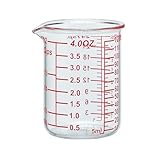
| Measuring spoons, including a 1/8-teaspoon spoon | $5–$15 | Fast and inexpensive, but volume varies with ingredient density and how the spoon is filled. |
| Standard 1-gram kitchen scale | $10–$25 | Good for basic baking, but too coarse for tiny amounts of leavener, gum, or color. |
| Etekcity 0.1g food kitchen scale | About $18.99 | Handles up to 11 pounds/5 kilograms and is more versatile, but it cannot reliably replace a milligram scale for sub-gram measurements. |
| MAXUS 0.001g milligram scale | About $19.99 | Provides very fine displayed increments and includes 20-gram calibration weights, but its 50-gram capacity makes it a specialty tool. |
For most kitchens, the best value is a 0.1-gram scale first and a milligram scale second. The price difference between the two examples is only about one dollar, but their purposes are very different. Choose based on capacity and use case, not on the number of decimal places alone.
FAQ
Can a milligram scale replace a kitchen scale?
No. Its maximum capacity is usually too low for bowls and major ingredients, and its small platform makes everyday weighing inconvenient. Use a high-capacity food scale for flour, sugar, butter, dough, and finished portions. Treat the milligram scale as a companion for tiny additions.
Is 0.001 gram necessary for baking?
Usually not. For standard cakes, cookies, breads, and pies, 0.1-gram readability is generally the more practical target. A 0.001-gram scale becomes useful when a formula calls for less than 0.1 gram, when you are scaling recipes dramatically, or when you are developing recipes and need highly repeatable small additions.
How should I use one accurately?
Put it on a firm, level surface away from fans and open windows. Let the display settle, place a lightweight container on the platform, press tare, and add the ingredient slowly. Keep the load below the stated maximum, avoid touching the container while weighing, and calibrate with the supplied weights according to the instructions.
Is a milligram scale worth it in 2026?
It is worth it for a narrow group of bakers, especially those working with tiny quantities or developing precise formulas. For ordinary home baking, the better purchase remains a reliable 0.1-gram food scale. Buy the milligram model only when you can name the ingredient and recipe situation it will improve.
Ready to decide? Our #1 pick for 2026 is the Measuring spoons, including a 1/8-teaspoon spoon.
Live price & availability on Amazon.





Write Your Review
No reviews yet. Be the first to share your experience!