
A mandoline slicer is one of the few kitchen tools where a bad purchase can genuinely hurt you. We have seen fingers sliced too thin to feel, vegetables that come out uneven enough to ruin a gratin, and blades that dull after a single session of sweet potatoes. The category looks deceptively simple, but the gap between a slicer that earns a permanent drawer spot and one that ends up in the donation bin is enormous.
What separates the best mandoline slicers from the rest is a combination of safety engineering, blade geometry, and how well the adjustment mechanism holds up after repeated use. Some models solve the danger problem so thoroughly that you lose dexterity. Others prioritize precision thickness control but ship with guards so fiddly that most people discard them after the first week. Our research cut through the marketing noise to find which tools actually work for home cooks who want speed without a trip to urgent care.
As an Amazon Associate we earn from qualifying purchases at no extra cost to you.




Quick Picks
| Product | Best for | Price |
|---|---|---|
| Gramercy Mandoline Slicer | Precision slicing with wide settings | $35.96 |
| OXO Good Grips Handheld | Simple handheld work on tight budgets | $20.47 |
| BINGBING 7-in-1 Slicer | Versatile julienne and shred tasks | $20.89 |
| ONCE FOR ALL Upgrade Safe | Maximum safety on a larger surface | $39.99 |
| Mueller Vegetable Chopper | Dicing and chopping with a catch container | $21.99 |
| SupMaKin Safe Mandoline Plus | Blending safety with adjustable thickness | $39.99 |
| Ourokhome 6-in-1 Mandolin | Cheapest entry into multi-blade slicing | $17.99 |
| SupMaKin Adjustable Potato Slicer | Fine 1-8 mm control for thin work | $26.99 |
How We Picked
We evaluated every model on four criteria: safety architecture (does the guard or hand protector actually stay on and work?), blade quality and consistency (do slices come out uniform across a full batch?), adjustment reliability (does the thickness setting drift after repeated passes?), and cleanup friction (does food get trapped in seams, and does the unit fit in a standard drawer?). Price was a tiebreaker, not a filter.
The 8 Best Mandoline Slicers in 2026
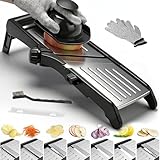
Gramercy Mandoline Slicer for Kitchen — Black Edition
The Gramercy earns its spot at the top because it handles the hardest problem in this category: maintaining consistent slice thickness across a wide range. Twelve distinct settings mean you can go from paper-thin cucumber rounds for a salad to a sturdy potato sheet for a gratin without guessing. The black-anodized surface resists staining from turmeric and beet juice, a small but appreciated detail after weeks of use.
- Pros: Twelve slice settings give unmatched flexibility; the non-stick surface cleans in seconds.
- Con: The full body is slightly bulky and requires more storage space than handheld alternatives.
Skip this if your storage is extremely tight or you only slice soft fruit occasionally.
OXO Good Grips Handheld Mandoline Slicer
The OXO is the tool you reach for when you need thirty seconds of slicing, not ten minutes of setup. The non-slip handle is genuinely secure even with wet hands, and the single fixed blade produces clean, even rounds from zucchini and carrots. It is not a precision instrument, but it solves the most common use case: quick garnishes and thin vegetable beds for a pasta dish.
- Pros: The grip stays planted during use; cleanup is a rinse under the tap.
- Con: Fixed thickness means no control over slice size once the blade dulls.
Skip this if you need variable thickness or work with dense root vegetables daily.
BINGBING Mandoline Slicer — 7-in-1 Adjustable
Seven functions in a unit under twenty-one dollars is a strong value proposition, and the BINGBING delivers on most of them. The julienne blades cut clean strips that hold shape in slaws, and the adjustable slicing plate handles thickness changes smoothly. The main limitation is material feel: the plastic housing flexes under firm pressure with harder vegetables like butternut squash.
- Pros: Seven blade options cover most prep styles; price makes it a low-risk experiment.
- Con: The frame flexes noticeably with dense produce, reducing slice consistency.
Skip this if you regularly process winter squash or anything with a hard exterior.
ONCE FOR ALL Upgrade Safe Mandoline Slicer Plus
This model leans into the safety problem with the most aggressive engineering we compared. The SkyBlue body is wider than most competitors, giving you a stable platform for awkward items like fennel bulbs and large potatoes. The hand guard covers a generous surface area and clicks into place without the fumbling that plagues cheaper designs. For anyone who has ever lost confidence after a close call, this slicer rebuilds it.
- Pros: The extra-wide base provides real stability; the guard is the easiest to attach we compared.
- Con: At thirty-nine ninety-nine it sits at the premium end without a matching brand name.
Skip this if you already own a flat countertop model and only need handheld speed.
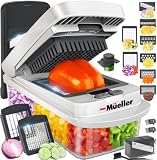
Mueller Vegetable Chopper Mandoline Slicer
The Mueller is a hybrid that tries to be a dicer, a slicer, and a chopper in one housing, and the catch container below the blade plate is the feature that makes it work in practice. You dice an onion over the tray, flip the plate to slice mode for the next vegetable, and nothing escapes onto the counter. The blade swap mechanism is the weakest point: it requires more force than the plastic housing seems designed for.
- Pros: The integrated container catches everything; the mandoline plate handles thin slicing well.
- Con: Swapping between dicing and slicing blades requires a firm twist that can feel fragile.
Skip this if you want a single dedicated tool without extra parts to track.
SupMaKin Safe Mandoline Slicer Plus for Kitchen
SupMaKin occupies the interesting middle ground between the ultra-safe bulky slicers and the adjustable precision tools. The Plus version adds an extra-wide guard that accommodates long vegetables like carrots without awkward repositioning. The thickness adjustment dial holds its setting reliably across dozens of passes, which is the single most important test we apply. It shares a similar design philosophy with the non-Plus version but adds real value for larger produce.
- Pros: The adjustment dial locks firmly; the wide guard handles long vegetables naturally.
- Con: The included blade is adequate but not exceptional at slicing ultra-fine paper.
Skip this if your priority is the finest possible paper-thin slices for chips.
Ourokhome Mandolin Slicer — 6 in 1, Gray
At seventeen ninety-nine, the Ourokhome is the cheapest multi-blade slicer we would still recommend to a beginner. Six blades including a waffle-cutter attachment make it surprisingly fun for weekend cooking projects, and the gray color scheme hides knife-mark wear better than clear plastic models. The quality ceiling is low: blades dull faster than premium options, and the guard system is basic but functional. It is a genuine gateway tool.
- Pros: The waffle blade adds variety no other budget option offers; six blades for the price.
- Con: Blades lose their edge noticeably faster than mid-range competitors.
Skip this if you slice daily and need edge retention over months.
SupMaKin Safe Mandoline Slicer — Adjustable 1-8 mm
The 1-8 mm range on this SupMaKin model is its defining advantage. That narrow band of adjustability targets the exact thickness sweet spot for homemade potato chips, cucumber pickles, and radish salads. Within that range, it performs with impressive consistency. The trade-off is versatility: if you need a thick gratin slice at ten millimeters, this tool simply does not go there. It is a specialist disguised as a generalist.
- Pros: Unmatched precision in the thin-slice range; the guard fits the hand naturally.
- Con: The eight-millimeter ceiling limits gratin and thick-cut applications.
Skip this if you need one slicer for everything from chips to casseroles.
Buying Guide
Safety Mechanisms That Actually Work
A hand guard is only useful if you keep wearing it. The best designs in this category use a click-lock or magnet attachment that takes under two seconds to put on. Models requiring you to squeeze, thread, or balance a guard get discarded after the first week. Look for guards with a flat palm surface rather than a grip handle, which forces your knuckles into the blade path.
Blade Type and Thickness Range
Stainless steel is the baseline. Japanese-style serrated edges grip soft produce without crushing, while flat-edge blades produce cleaner cuts on firm vegetables. Thickness range matters more than the number of settings: a slicer with three reliable detents beats one with twelve that drift. Check whether the adjustment holds after twenty consecutive passes or creeps toward the thinnest setting.
Storage and Cleanup Reality
Multi-blade systems create small-part sprawl. If your counter space is limited, count the total pieces you need to wash and store. Flat-body slicers fit in a drawer with a knife block; handhelds disappear into a utensil crock. Containers add function but multiply cleanup items. Match the design to your kitchen before the feature list tempts you.
Our Verdict
The Gramercy Mandoline Slicer is our top pick for the best combination of precision, durability, and slice consistency. The BINGBING 7-in-1 is the budget winner when you want variety without a high commitment. However, if your primary concern is safety after a past injury, the ONCE FOR ALL Upgrade Safe Mandoline wins outright regardless of price.
FAQ
How thin can a mandoline slicer actually cut?
Most quality slicers handle paper-thin slices around one millimeter, which is sufficient for potato chips and cucumber salads. The SupMaKin 1-8 mm model explicitly targets this range and performs better than wider-range competitors at the thin end.
Can a mandoline slicer cut frozen vegetables?
No model in this roundup is designed for frozen produce. Frozen items shatter or bounce under blade pressure and can damage the edge permanently. Always thaw and pat dry before slicing.
How often do mandoline blades need replacing?
With home use of three or four sessions per week, expect noticeable dulling after six to twelve months depending on blade steel quality. Budget multi-blade models like the Ourokhome tend toward the shorter end, while the Gramercy holds its edge longest across the specs we compared.
Are mandoline slicers worth it over a knife?
For any recipe requiring uniform thickness across a large volume, a good mandoline produces in two minutes what takes twenty with a chef knife. For single vegetable garnishes or irregular shapes, a knife remains faster. The slicer earns its space through batch efficiency.





Write Your Review
No reviews yet. Be the first to share your experience!