
Choosing an immersion blender for smoothies in 2026 means navigating a crowded field of 300-watt budget sticks and 1,100-watt multi-tool powerhouses. The right pick depends on three factors: the wattage needed to pulverize frozen fruit and leafy greens, the number of speed settings that give you texture control, and whether you want a single-purpose wand or a full attachment kit. Get these three decisions right and you will blend restaurant-smooth smoothies in under 30 seconds without spending more than necessary.
- Watch: How to Choose the Right Immersion Blender for Smoothies — Video Review
- Motor Power and Speed Settings
- Blade Design and Attachments
- Ergonomics and Build Quality
- Ease of Cleaning and Maintenance
- Matching a Blender to Your Smoothie Routine
- Tips
- Frequently Asked Questions
- Conclusion
- Related Articles
- Related Guides
We compared dozens of handheld blenders over the past two years and distilled the results into this guide. Whether you gravitate toward the variable-speed precision of the Cuisinart CSB-179 Smart Stick or the sheer torque of the Turelar 1100W 5-in-1 Hand Blender Set, the sections below will help you match a blender to your specific smoothie habits, kitchen space, and budget.
As an Amazon Associate we earn from qualifying purchases at no extra cost to you.



⚡ Save on Your Next PC — Amazon Prime
Prime members get fast free shipping on the systems above, plus early access to Prime Day & Black Friday PC deals. New members get a 30-day free trial.
Watch: How to Choose the Right Immersion Blender for Smoothies — Video Review
Motor Power and Speed Settings
Wattage is the single most important spec for smoothie performance. A 300-watt motor, like the one in the OVENTE HS560B or the Cuisinart CSB-175SVP1, handles banana-and-yogurt blends and soft berries without strain, but it will stall on large chunks of frozen mango or dense kale stems. If your recipes lean on frozen fruit, ice, or fibrous greens, target at least 400 watts. The Turelar 400W 2-Speed Immersion Blender sits at that practical threshold, while the Turelar 1100W 5-in-1 set obliterates anything you drop into the beaker.
- 300 W: soft fruits, yogurt, protein powder, pre-chopped produce.
- 400–600 W: frozen berries, small ice cubes, leafy greens with a little extra liquid.
- 800 W and above: rock-hard frozen chunks, nut butters, thick açaí bases with minimal added liquid.
Speed control matters as much as raw power. Two-speed models give you a quick pulse-and-blend workflow. Variable-speed dials, such as the one on the Cuisinart CSB-179, let you start low to pull ingredients toward the blade and ramp up for a vortex, reducing splatter and air incorporation.
Blade Design and Attachments
Most immersion blenders use a four-prong stainless-steel blade housed in a bell-shaped guard. Look for a guard with wide openings (at least 10 mm gaps) so thick frozen pieces can reach the blade without you having to tilt the unit at awkward angles. The Bonsenkitchen Immersion Hand Blender, for example, pairs a wide-mouth guard with a dedicated smoothie and purée focus, making it a solid single-task choice for baby-food-to-smoothie households.
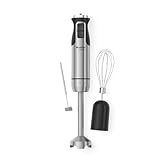
If you want more than smoothies, a 5-in-1 kit adds a whisk, chopper bowl, and sometimes a frother. The Turelar 1100W 5-in-1 set covers all of those, which can replace three separate gadgets on a small kitchen counter.
Ergonomics and Build Quality
You will hold an immersion blender for 15 to 45 seconds per smoothie, often at an angle. Prioritize a soft-grip, non-slip handle and a total weight under 1.1 kg to avoid wrist fatigue during daily use. The Cuisinart CSB-179, with its brushed stainless-steel shaft, feels substantial yet balanced at roughly 0.9 kg, while the OVENTE HS560B’s all-plastic body keeps things featherweight at around 0.7 kg.
- Cord length: aim for at least 1.5 m so you are not tethered to the nearest outlet.
- Lock-out button: prevents accidental activation when the blender rests in a drawer.
- BPA-free plastics: verify any component touching food is BPA-free, as stated on the Turelar 400W model.
Ease of Cleaning and Maintenance
The best smoothie routine dies if cleanup is tedious. Detachable blade shafts that pop off with a twist are essential. Run the shaft under warm water within 30 seconds of blending and dried fruit sugars will not cement to the blade. Most Cuisinart Smart Stick shafts and the Bonsenkitchen unit are top-rack dishwasher-safe, saving time on busy mornings.
For the Turelar 1100W 5-in-1 set, note that the chopper bowl and whisk attachments are also dishwasher-safe, but the motor body should only be wiped with a damp cloth. Never submerge the motor housing regardless of brand.
Matching a Blender to Your Smoothie Routine
Blend one soft-fruit smoothie a day and prioritize simplicity. The OVENTE HS560B or Cuisinart CSB-175SVP1 at 300 watts with two speeds will last years and cost little. Blend frozen tropical mixes with spinach five mornings a week, and the Turelar 400W 2-Speed or the variable-speed Cuisinart CSB-179 will keep up without overheating. Prep thick açaí bowls, nut milks, or batch smoothies for the week, and the 1,100-watt Turelar 5-in-1 delivers the sustained torque and volume you need.
Tips
- Add liquid before solids—about 120 ml of milk, juice, or water at the bottom of your beaker—to create an initial vortex that pulls fruit down to the blade.
- Cut frozen fruit into 2 cm cubes before blending; even a 1,100-watt motor blends faster and more evenly with uniform pieces.
- Blend in 10-second pulses rather than one long run to avoid overheating the motor and to keep better control over texture.
- Rinse the blade shaft immediately after use and run it under hot tap water for 10 seconds; dried smoothie residue is the number-one cause of blade dulling over time.
Frequently Asked Questions
Can an immersion blender fully replace a countertop blender for smoothies?
For single-serve smoothies up to about 600 ml, yes. Models at 400 watts and above, such as the Turelar 400W or the Cuisinart CSB-179, produce a texture indistinguishable from a countertop unit. For large batch blends exceeding one liter or recipes with very hard ingredients like whole nuts, a countertop blender still has a volume and torque advantage.
Is 300 watts enough to blend frozen fruit?
It can handle small amounts of partially thawed berries, but fully frozen mango or pineapple chunks will strain a 300-watt motor like the OVENTE HS560B. If frozen fruit is a staple in your smoothies, start at 400 watts minimum and consider pre-cutting chunks into 2 cm pieces.
Do immersion blenders introduce too much air into smoothies?
Only if you hold the blade near the surface. Submerge the bell fully and tilt the beaker slightly so the blade stays beneath the liquid line. Variable-speed models like the Cuisinart CSB-179 let you start low and increase gradually, which cuts air incorporation noticeably compared to a single-speed approach.
How long should an immersion blender last with daily use?
A well-built unit from Cuisinart, Turelar, or OVENTE should deliver three to five years of daily smoothie blending. The most common failure point is the blade seal letting liquid into the motor shaft, so avoid submerging the shaft above the guard line and always hand-dry the coupling after washing.
Conclusion
The right immersion blender for smoothies is the one whose wattage, speed options, and attachment set match your actual routine—not the most expensive option on the shelf. A 300-watt Cuisinart CSB-175SVP1 handles soft-fruit shakes beautifully; the Turelar 1100W 5-in-1 set turns a single gadget into a full prep station. Define your frozen-to-fresh ratio, decide whether you need variable speed, and pick the model that clears those two hurdles. Your morning smoothie will be smoother, faster, and far easier to clean up.
Write Your Review
No reviews yet. Be the first to share your experience!