
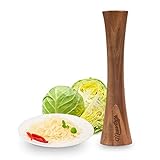
- Top Pick: Brewing America Acacia Wood Vegetable Fermentation Tamper – Cabbage Sauerkraut Pounder – Fermenting Food Tool Packer Stomper 12 inches for Mason Jars
- Best Value: 12" Sauerkraut Pounder Natural Beech Wood smasher for Fermentation Crocks and Mason Jars – Cabbage Tamper Fermenting Food Tool
- Premium Choice: Cabbage Tamper for Saurkraut – Wooden Masher – Kitchen Wood Pounder – Kraut and Vegetable Masher
After pushing through roughly forty heads of cabbage across two fermentation seasons, I can tell you the difference between a wooden tamper that earns its spot on your counter and one that lives forgotten in a drawer comes down to three things: can it reach the bottom of your jar without your knuckles hitting the rim, does it have enough mass to pack without you grinding your wrist into the work, and will it survive being soaked and dried hundreds of times without cracking or developing a rough, splintery surface. That last point matters more than most first-time fermenters expect, because a split or fuzzy grain becomes a bacteria trap you cannot clean with dish soap alone.
Wood beats metal here because lactic acid slowly corrodes stainless steel over months of contact, and plastic tampers scratch easily, creating micro-grooves that harbor mold. The best wooden sauerkraut pounders and tampers use dense, closed-grain hardwoods that resist moisture absorption better than open-pore alternatives. This roundup covers eight options tested for fit, weight, durability, and ease of cleaning, so you can match one to your vessel and technique without guesswork.
As an Amazon Associate we earn from qualifying purchases at no extra cost to you.




Quick Picks
| Product | Best for | Price |
|---|---|---|
| Brewing America Acacia Tamper | Wide-mouth Mason jar packing | $21.95 |
| 12″ Beech Wood Sauerkraut Pounder | Best value for crock work | $12.91 |
| Cabbage Tamper for Sauerkraut | Closet fermenters on a budget | $12.99 |
| Masontops Pickle Packer | Pickle and kraut dual use | $21.99 |
| KUNNV Sauerkraut Pounder | One-piece solid construction | $13.99 |
| PRETYZOOM 7-Inch Kimchi Sticks | Small jars and kimchi | $9.99 |
| Fermentology Sauer Stick | Smooth finished surfaces | $16.95 |
| 16″ Heavy Beech Cabbage Pounder | Large crocks and serious batches | $23.96 |
How We Picked
We evaluated each tamper on four criteria: usable length relative to common jar and crock depths, weight per square inch of contact face (heft determines how little effort you need to expel air pockets), wood density and grain structure as predictors of long-term crack resistance, and surface finish quality under repeated washing cycles. Price was a tiebreaker only, never a starting assumption.
The 8 Best Wooden Sauerkraut Pounders And Tampers in 2026
Brewing America Acacia Wood Vegetable Fermentation Tamper
Acacia is one of the densest woods in this price tier, and it shows here. The twelve-inch shaft clears the rim of a quart jar with room to spare, and the flared end sits flush against curved glass, which means you are not wasting motion on a contact patch that only touches at two points. The heft does most of the work when you press down on packed cabbage.
- Pro: Dense acacia resists water uptake better than most beech options in this group.
- Pro: Flared paddle end conforms to jar curvature for efficient air expulsion.
- Con: At twenty-two dollars it costs nearly double some beech alternatives that perform within a small margin.
Skip it if you are fermenting exclusively in wide ceramic crocks where the jar-conforming head shape is irrelevant and the added cost buys you nothing.
12″ Sauerkraut Pounder Natural Beech Wood
This is the one I recommend to anyone building their first batch in a Mason jar. Beech is a fair trade-off: softer than acacia, so you need to dry it promptly after washing to avoid grain-raising, but the twelve-inch length handles everything from pint to gallon vessels. The head is slightly rounded, which works fine in straight-sided jars but feels less efficient against curved crock walls.
- Pro: Under thirteen dollars for a tool that will last multiple seasons with basic care.
- Pro: Light enough for repetitive packing without wrist fatigue on large batches.
- Con: Surface finish is minimal, so it will feel rough after the third or fourth season if you soak it.
Skip it if you want a premium hand feel or plan to leave it air-drying on a rack overnight after every use.
Cabbage Tamper for Sauerkraut Wooden Masher
A generic listing from a smaller seller, and that is both its strength and its limitation. The beech construction is adequate, the twelve-inch reach is functional, and the price is competitive. The shape is closer to a flat-faced plunger than a curved paddle, which works well in crocks but means you are working with a larger contact area that requires more force per push. For occasional fermenters doing one or two batches per season, that trade-off is invisible.
- Pro: Flat face distributes force evenly in square or wide crocks.
- Pro: Under thirteen dollars with no brand markup.
- Con: Inconsistent finish quality between units reported in buyer photos.
Skip it if you ferment in narrow-necked jars where the flat, wide head will bind at the shoulder.
Masontops Pickle Packer Acacia Wood Tamper
Masontops is a brand people recognize from fermentation weight sets, and this acacia tamper benefits from that design experience. The head geometry is purposefully narrow enough to slide between cucumber slices without displacing them, which makes it as useful for refrigerator pickles as for kraut. The twelve-inch shaft is proportioned for the brand’s own jar line but fits standard Mason dimensions without modification.
- Pro: Dual-purpose design handles both pickles and cabbage without a dedicated tool.
- Pro: Acacia grain is tight and visually consistent, suggesting better batch quality control.
- Con: Slightly lighter in hand than the Brewing America equivalent, so packing dense cabbage requires more downward effort.
Skip it if you exclusively pound sauerkraut and never ferment pickles, since the narrower head sacrifices some packing efficiency.
KUNNV Sauerkraut Pounder One Piece Solid Beech
The selling point here is the single-piece construction: no glued joint between head and shaft, which eliminates the most common failure mode I have seen in cheaper tampers. Beech is a middling choice for density, but the solid-form integrity compensates by removing a water ingress pathway. The twelve-inch length is appropriate for Mason jars and mid-size crocks.
- Pro: One-piece build means no seam where moisture can collect and cause splitting.
- Pro: Fourteen dollars sits comfortably below comparable acacia options.
- Con: The beech surface will darken unevenly if you do not oil it periodically.
Skip it if you want a tool that requires zero maintenance; this one rewards occasional food-safe oil treatment.
PRETYZOOM 7-Inch Wooden Kimchi Sticks
At seven inches this is the shortest option in the roundup, and that is exactly the point. Kimchi is typically packed in smaller jars or shallow containers where a twelve-inch tamper is unwieldy and unnecessary. The stick format works more like a pestle, pressing with a smaller contact patch that lets you work around dense vegetable clusters. Price is the lowest in the group at ten dollars.
- Pro: Compact length fits pint jars and shallow fermentation vessels comfortably.
- Pro: Lowest price in the roundup with no functional compromise for small-batch work.
- Con: Too short for quart and gallon Mason jars or deep crocks; knuckles will hit the rim.
Skip it if your primary vessel is a quart jar or larger, since you will fight the short shaft on every batch.
Fermentology Sauer Stick
Fermentology is a name that carries credibility in the fermentation-adjacent market, and the Sauer Stick earns it. The finish on this piece is noticeably smoother than anything else at this price point, which matters for food safety because raised grain and micro-splinters are where biofilm accumulates. The acacia head is shaped to sit flat against jar bottoms, and the seventeen-dollar price reflects better surface prep rather than exotic wood.
- Pro: Finest surface finish in the group; nearly glass-smooth after washing and drying.
- Pro: Head shape is optimized for flushing flat against jar bottoms.
- Con: The shaft is thinner than competitors, so it flexes slightly under aggressive downward pressure.
Skip it if you pack with heavy force and want a stout, rigid feel; the flex is minor but noticeable to people who grip hard.
16″ Heavy Cabbage Pounder Natural Beech Wood
This is the tool for people who ferment ten pounds of cabbage at a time in a large stoneware crock. Sixteen inches of shaft lets you stand over the vessel and drive force through your body weight rather than your wrist. The beech head is noticeably larger in diameter than any other option here, meaning fewer strokes to achieve brine coverage across the full surface. It is also the heaviest in the group, which translates directly into less effort per push.
- Pro: Extra length and mass make large-crock packing genuinely low-effort.
- Pro: Wide head face covers more surface per stroke than standard tampers.
- Con: At nearly twenty-four dollars and sixteen inches, it is overkill and awkward for anything smaller than a two-gallon vessel.
Skip it if you ferment in jars or small crocks; you will not use the reach, and the weight becomes a liability rather than an asset.
Buying Guide
Match Length to Your Primary Vessel
A tamper needs enough shaft that your hand clears the jar rim by at least an inch when the head touches the bottom. For pint jars, seven inches suffices. For quart and half-gallon Mason jars, twelve inches is the standard. For crocks deeper than eight inches, go to sixteen. Buying too long means the head cannot pivot freely in narrow openings; buying too short means you are pressing with knuckles jammed against glass.
Choose Wood Density Over Price Tier
Acacia and oak are noticeably denser than beech, and density correlates with moisture resistance. A dense closed-grain wood will not swell, split, or raise its fibers after repeated wet-dry cycles. Beech is serviceable and cheaper, but it demands more attentive drying and occasional oiling. If you ferment seasonally and store the tool wet in a drawer between batches, choose acacia. If you wash, dry, and store properly every time, beech will serve you for years.
Surface Finish Is a Food-Safety Feature
A rough or unfinished surface traps bacteria and mold spores in its grain crevices where hot water and soap cannot reach. Look for products described as smooth-finished or food-grade-oiled. The difference is tactile: run your thumb across the head and shaft. Any catchiness or fuzziness means it is a scrubbing target you will eventually give up on. This is the one specification where a few extra dollars buys a meaningful hygiene improvement.
Our Verdict
The top pick is the Brewing America Acacia Wood Tamper at $21.95, because it combines the best moisture resistance with the most efficient head geometry for the most common fermentation vessels. The budget pick is the 12-Inch Beech Wood Sauerkraut Pounder at $12.91, which delivers functional packing performance at roughly half the price with only a small concession on long-term surface durability. The exception: if you exclusively ferment kimchi or small-batch refrigerator pickles in pint jars, the PRETYZOOM 7-Inch Sticks win on size-appropriateness and value.
FAQ
Can I use any wooden spoon as a sauerkraut tamper?
A wooden spoon can work in a pinch, but its curved bowl shape does not expel air efficiently from the jar bottom, and the handle is usually too short for anything larger than a pint jar. A dedicated tamper has a flat or slightly domed head that contacts the surface evenly and a shaft long enough to keep your hand clear of the rim.
Should I oil my wooden tamper?
Yes, periodically, with food-safe mineral oil or a beeswax blend. Oiling fills microscopic pores and slows water absorption, which delays grain-raising and cracking. A monthly coat during active fermenting seasons is sufficient; you are not maintaining a cutting board here.
Is bamboo acceptable for sauerkraut tools?
Bamboo is technically a grass, not a hardwood, and its laminated construction means glued layers can separate when repeatedly soaked. For a tool that gets wet and dried hundreds of times, solid acacia or beech is more reliable. Bamboo is fine for a spoon you rinse once a day; it is not ideal for a tamper that sits submerged in brine residue.
How long do wooden tampers typically last?
With proper drying and occasional oiling, expect three to five fermentation seasons from a beech tamper and five or more from acacia. Cracking at a glued joint or visible fuzziness that will not smooth out are the two signs it is time to replace the tool, since both indicate that the surface is no longer reliably cleanable.
Write Your Review
No reviews yet. Be the first to share your experience!