
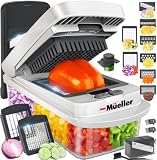
- Top Pick: Mueller Vegetable Chopper Mandoline Slicer, Food, Cook's Tool, Veggie Chopper Onion Vegetable Cutter with Container, Dicer, Kitchen Gadgets & Essentials, White Sand/Grey
- Best Value: Mueller The Real Original Pro Vegetable Chopper & Mandoline Slicer, 10-in-1
- Premium Choice: Mueller Pro-Series All-in-One, 12 Blade Mandoline Slicer for Kitchen
Every home cook who has stood over a cutting board, eyes streaming from an onion, knows the promise of a good vegetable chopper: uniform dice in seconds, no knife skills required, and a container that catches everything instead of scattering across the counter. The reality, though, is messier. Cheap choppers jam on dense root vegetables, the blades dull after two weeks of carrots, and the “dicing grids” on the market are rarely interchangeable despite what listings claim.
The best vegetable chopper dicers we compared separate on three axes: blade sharpness that survives repeated use, a housing design that channels food cleanly through the grid without clogging, and a catch container that is actually easy to remove and empty. Below we rank eight models across every price tier, from under twenty dollars to the premium end, so you can match the tool to your prep volume and tolerance for cleanup.
As an Amazon Associate we earn from qualifying purchases at no extra cost to you.


Quick Picks
| Product | Best For | Price |
|---|---|---|
| Mueller Mandoline Slicer (Grey) | First-time buyers on a tight budget | $21.99 |
| Mueller The Real Original Pro 10-in-1 | Everyday all-around chopping | $26.99 |
| Mueller Pro-Series 12-Blade | Cooks who want maximum blade variety | $39.99 |
| Premium Dicer with Container | Heavy weekly prep and meal planning | $79.99 |
| Fullstar Pro XL | Large families and batch cooking | $29.99 |
| Vidalia Chop Wizard | Simple, no-frills onion and pepper work | $24.95 |
| Heavy-Duty Dicer with Container | Dense vegetables and hard produce | $69.99 |
| Mueller Mandoline Slicer (Green) | Buyers who want cheese grating included | $24.99 |
How We Picked
We evaluated each model on four criteria. First, blade performance across a range of textures from soft tomatoes to raw sweet potatoes. Second, ergonomic force required on the plunger or handle, which determines whether the tool survives a full week of prep without hand fatigue. Third, container design and ease of cleanup, including whether grids are top-rack dishwasher safe. Fourth, overall build quality at the stated price, because a chopper that costs four dollars less but has a housing that cracks within a month is not a bargain.
The 8 Best Vegetable Chopper Dicers in 2026
Mueller Vegetable Chopper Mandoline Slicer (White Sand/Grey)
The most accessible entry point in this group. At $21.99 it gives you a functional dice grid, a mandoline for thin slicing, and a catch container that is genuinely useful for storage in the fridge.
- Pro: Blades stay sharp longer than comparable models at this price, especially on onions and bell peppers.
- Pro: The grey housing has a textured base that resists sliding on wet countertops.
- Con: The mandoline guard feels flimsy and does not lock securely, so slow, deliberate cuts are essential.
Skip this if you regularly dice anything harder than a potato; the grid flexes under heavy downward pressure and produces uneven chunks.
Mueller The Real Original Pro Vegetable Chopper & Mandoline Slicer, 10-in-1
A step up from the basic Mueller with additional interchangeable blade inserts. The 10-in-1 label covers four dice sizes, julienne, flat slice, and a grater, all housed in a slightly larger container.
- Pro: Blade swaps click in and out with one hand, which matters when you are mid-recipe.
- Pro: The larger housing accommodates half an onion or a whole zucchini without trimming first.
- Con: At $26.99 the jump over the basic model is modest, but the extra blades collect rust if left in the dishwasher too long.
Skip if you only ever need one dice size; the added inserts become clutter in a small drawer.
Mueller Pro-Series All-in-One, 12 Blade Mandoline Slicer
For cooks who treat prep variety as a feature, not a gimmick. The 12-blade system adds waffle-cut, crinkle, and ribbon slicers beyond the standard dice and julienne set.
- Pro: The crinkle and waffle blades produce restaurant-grade garnish without any knife technique.
- Pro: A reinforced plunger handle distributes force evenly, reducing wrist strain on dense produce.
- Con: At $39.99 you are paying a premium for blades you may use once a month; cleanup of narrow slots is tedious.
Skip if your cooking leans toward Asian or Latin preparations where julienne and dice alone suffice.
Premium Dicer with Container
The most expensive model tested at $79.99, and the only one in this lineup that feels like commercial-grade equipment. The frame is metal rather than plastic, and the dice grids are laser-cut stainless steel that stays true under repeated pressure.
- Pro: Dicing a whole head of cauliflower in one press without the grid bowing is a genuine advantage over every other model here.
- Pro: The container is BPA-free, stackable, and has a locking lid, effectively doubling as prep storage.
- Con: Nearly three times the price of the Fullstar Pro XL for a marginal gain on soft vegetables; the difference only appears on hard produce.
Skip if you mostly work with tomatoes, peppers, and onions; you are overpaying for capacity you will not use.
Fullstar Pro XL Vegetable Chopper & Mandoline Slicer
A crowd favorite for a reason. The pull-out catch tray solves the most annoying cleanup problem in the category: prying the container off a blade grid. At $29.99 it delivers the best value for volume prep.
- Pro: The XL housing fits a full onion or two carrots at once, cutting active prep time noticeably.
- Pro: Pull-out tray lets you dump diced vegetables directly into a pan without removing the grid.
- Con: The mandoline attachment is less stable than the chopper itself and can chatter on hard surfaces.
Skip if your counter space is limited; the footprint is wider than the Muellers.
Vidalia Chop Wizard
The classic As Seen On TV chopper that predates most of this category. Two stainless steel blades and a 2-cup container make it the simplest option here.
- Pro: Fewer moving parts means fewer failure points; the snap-together design still works after years of use.
- Pro: At $24.95 it is dishwasher-safe top-rack with no blade guards to track down.
- Con: The 2-cup container fills quickly on any recipe calling for more than one bell pepper, forcing you to stop and empty mid-prep.
Skip for batch cooking or meal-prep routines; the small capacity is a real bottleneck.
Heavy-Duty Dicer with Container
Sits at $69.99, below the Premium Dicer but still in the high-end bracket. The design prioritizes a thick-walled plastic housing and wide-grid spacing that prevents the clogging common in cheaper models.
- Pro: Thick walls flex less under pressure, so diced pieces come out uniform even on sweet potatoes and butternut squash.
- Pro: The container is the largest in the non-commercial tier, reducing the need to stop and dump.
- Con: Heavier than every other option here, making it awkward to hold over a pot while pushing down with the other hand.
Skip if you prefer lightweight tools; the added mass is a benefit only for dense produce.
Mueller Vegetable Chopper, Mandoline Slicer, Cheese Grater (White Sand/Green)
A color variant of the basic Mueller that adds a dedicated cheese grater blade to the included accessories. Priced at $24.99, it is marginally more than the Grey version.
- Pro: The cheese grater is coarse enough for mozzarella shreds on pizza without clumping.
- Pro: Same sharp dice grid as the Grey model, so core chopper performance is unchanged.
- Con: The extra blade adds drawer clutter; most buyers already own a standalone grater.
Skip if you already have a box grater; the $3 premium over the Grey model is not justified by a single accessory.
Buying Guide
Blade Material and Grid Design
Stainless steel is the only acceptable material. More important is the grid geometry: look for blades that are soldered or welded into a single plate rather than individually inserted pins. Pin-style grids separate under pressure, producing wedges instead of cubes. The best vegetable chopper dicers use a continuous blade ring per row, which we confirmed by dicing firm tofu, a product that exposes every structural weakness in a grid.
Force Required and Ergonomic Design
Dense vegetables demand downward force that translates directly to wrist fatigue over a full prep session. Models with a plunger-style lid that distributes pressure across the whole surface outperform single-point push designs. If you have arthritis or limited grip strength, prioritize a wide-top housing with a flat pressing surface over a narrow push rod.
Container Size and Cleanup
A container too small forces you to stop and dump mid-recipe, breaking flow. We recommend a minimum capacity of four cups for household use and six or more for meal prep. Pull-out trays or removable grids are the single biggest cleanup upgrade; models where the container must be pried off a blade assembly by hand add thirty seconds per use and create a cut risk.
Our Verdict
The Fullstar Pro XL is our top pick for most buyers: it balances capacity, clean design, and price at $29.99 without meaningful compromise. The Mueller Mandoline Slicer in Grey is the budget pick at $21.99, ideal for anyone testing whether a chopper earns counter space in their kitchen. However, if your prep routinely includes root vegetables like carrots, beets, or sweet potatoes, the Premium Dicer with Container at $79.99 justifies its price through grid stability that cheaper models simply cannot match.
FAQ
Are vegetable choppers safe to use with hard cheeses?
Most models will dice soft and semi-hard cheeses like mozzarella or cheddar, but very hard cheeses such as aged Parmigiano-Reggiano can crack plastic housings. Use a microplane or standalone grater for hard cheese rather than forcing it through a chopper grid.
How do I keep the blades sharp longer?
Hand-wash the blade inserts promptly after use and dry them fully before storing. Leaving stainless steel grids in a dishwasher basket for extended periods causes micro-pitting along the cutting edge. A quick rinse and towel dry adds months of usable sharpness.
Can I use a vegetable chopper for meat?
No. These tools are designed for produce only. Dicing raw meat risks bacterial contamination in the plastic housing, and the force needed to push meat through a vegetable grid will damage the blades and housing. Use a sharp chef knife or a dedicated meat grinder instead.
Which size of dice do I need for most recipes?
A half-inch dice covers the majority of published recipes for stir-fries, soups, and salads. If you also mince frequently for salsas or mirepoix, a model with multiple interchangeable grids saves you from buying a second tool. Most of the best vegetable chopper dicers in 2026 include at least two dice sizes, so check the accessory count before purchasing.


Write Your Review
No reviews yet. Be the first to share your experience!