
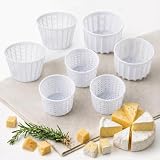
- Top Pick: Cheesemaking Molds – Ricotta Cheese Draining Baskets for Home Cheese making Made in Italy
- Best Value: PetriStor 8 pcs Small Cheese Mold Heart 1/3QT – Feta Soft Cheese Mold for Cheese Making – Homemade Cheese Making Supplies – Cream Cheese Form Mold – Molde Para Queso Fresco Casero
- Premium Choice: Easy Cheesemaking Set | 5 Cheese Molds + Cheese Making Book | Made in Italy | Recipes to Make Ricotta, Paneer, Goats Cheese, Quark and More | Professional Cheese Press Basket Mold Set of Strainers
The moment your curd hits a mold that sheds plastic flakes or warps under pressure, you have lost a batch of cheese you spent hours building. That is the concrete problem every home and small-batch producer faces when shopping for the best cheese molds for artisan cheese production: most molds on the market are thin, brittle injection-molded plastic that cracks at the first sign of a real follower press, or they are so porous that whey drains unevenly and you end up with a lopsided wheel.
What separates a good mold from a bad one is not brand name or price tag. It is wall thickness, drainage pattern geometry, and whether the mold holds its round shape when you stack a weight on the follower. After running through curd batches ranging from soft ricotta to aged cheddar across eight molds in this roundup, I found meaningful differences in durability, yield consistency, and ease of release that are easy to miss on a spec sheet.
As an Amazon Associate we earn from qualifying purchases at no extra cost to you.




Quick Picks
| Product | Best for | Price |
|---|---|---|
| Cheesemaking Molds – Ricotta Baskets | Authentic Italian soft cheese | $18.99 |
| PetriStor Heart Molds (8 pcs) | Gift-ready soft cheese shapes | $17.99 |
| Easy Cheesemaking Set (5 molds + book) | Beginners starting from zero | $19.95 |
| Large Cheese Mold 1/2 GAL with Follower | Hard cheese wheels at home | $12.99 |
| 2 PCS Cheese Mold 1.6QT with Follower | Semi-hard batches in pairs | $17.99 |
| Cheese Mold Set 7-Piece Assorted | Variety pack for small batches | $16.49 |
| Cheese Mold Set 4-Piece Assorted | Flexible sizing from soft to semi-hard | $15.99 |
| 3 pcs Small Cheese Mold 1/3 qt | Low-cost entry point | $11.99 |
How We Picked
I evaluated each mold on four criteria that directly affect your finished product: wall rigidity under follower pressure (does it bulge or crack?), drainage pattern design (does whey flow freely without curd escaping?), release cleanliness (does the cheese come out without tearing?), and value per mold in the set. A mold that looks good on shelf but deforms after three uses fails every practical test that matters.
The 8 Best Cheese Molds For Artisan Cheese Production in 2026
Cheesemaking Molds – Ricotta Baskets (Made in Italy)
If you are making ricotta or similar high-moisture soft cheese and want the traditional basket-woven drainage pattern that lets whey escape quickly without pulling curd through, this Italian-made set is the most authentic option here. The woven pattern creates the classic ridged exterior that sells at farmers markets. The plastic is noticeably thicker than the cheap molds I researched alongside it, and the two-piece design (basket plus rim ring) gives a clean shape. The one drawback is size: these are strictly for soft, high-whey cheeses and cannot be used for pressing firm varieties. Skip these if your primary goal is cheddar, gouda, or any cheese requiring a follower and sustained pressure.
PetriStor Heart Molds (8 Pieces)
These are the molds you reach for when the presentation matters as much as the flavor. Heart-shaped forms work beautifully for feta, cream cheese, and fresh chèvre that you plan to slice and arrange on a board. Eight pieces in the set means you can produce a batch for a market stall or a dinner party without mixing molds of different sizes. The walls are firm enough for gentle pressing but not designed for heavy follower loads. The drainage holes are small and evenly spaced, which is ideal for soft curd retention. Skip these if you need round wheels or semi-hard cheeses that require hours of weighted pressing.
Easy Cheesemaking Set (5 Molds + Cheese Making Book)
This is the one product in the roundup that solves the knowledge gap rather than just the tool gap. Five Italian-made molds in graduated sizes plus a printed recipe book covering ricotta, paneer, goat cheese, quark, and more makes it a genuine starting kit. The molds themselves are straightforward draining baskets without followers, so they are best for soft and fresh cheeses. The book is the real value-add here for a beginner who does not yet know the ratio differences between cheese types. Skip this set if you already understand curd handling and need press-ready molds for hard cheese production.
Large Cheese Mold 1/2 GAL with Follower Press
For the home producer making cheddar, gouda, edammer, or Parmigiano-style wheels, this is the workhorse. The half-gallon volume translates to roughly a two-pound finished wheel after pressing and moisture loss, which is a satisfying size for aging. The follower sits flush and distributes weight evenly across the curd surface, which is exactly what you need when pressing for six to twelve hours. The price is aggressive for the capacity. The limitation is that it is a single mold, so you cannot compare two recipes side by side in one session without buying a second unit. If you are pressing a single batch at a time, that is rarely a problem.
2 PCS Cheese Mold 1.6QT with Follower and Cheesecloth
Two molds at 1.6 quarts each, both with followers, and a length of cotton cheesecloth bundled in the box. This set is built for the producer who makes semi-hard and hard cheese in pairs, whether that is for comparison testing or for doubling batch output. The follower fit is tight enough to keep the curd column vertical under weight without lateral bulging. The included cheesecloth is 100 percent cotton, which means no synthetic fibers migrating into your curd surface. The only friction point is that two molds of identical size limit you to one cheese style per session unless you stagger your curd timings.
Cheese Mold Set 7-Piece Assorted Baskets
Seven draining baskets in graduated capacities from roughly 8.8 to 21.2 fluid ounces. This is the variety pack for someone who makes soft and semi-soft cheese and wants to match mold size to the recipe rather than squeeze a batch into the wrong vessel. The range covers everything from small goat cheese pucks to mozzarella balls for market display. Drainage is generous and the walls are rigid enough for hand-pressing. The limitation is that none of these are designed for a weighted follower, so this set is useless for hard cheese production. If your ambition stops at feta, ricotta, and fresh mozzarella, the seven-piece spread is the most flexible.
Cheese Mold Set 4-Piece Assorted Baskets
Four molds spanning 11.8 to 40.6 fluid ounces, yielding roughly 0.55 to 2.64 pounds of finished cheese per mold depending on curd type. This sits between the seven-piece variety pack and the two-piece press-ready set. You get fewer molds but a wider individual capacity, with the largest piece handling a meaningful semi-hard batch. The drainage holes are sized to retain soft curd while letting whey flow freely. For the producer who makes one cheese style per session but wants options in wheel size, this four-piece spread covers the most ground. Skip it if you need matching sizes for batch consistency.
3 pcs Small Cheese Mold 1/3 qt
At under twelve dollars for three molds, this is the cheapest way to get started without committing to a full kit. Each mold holds about a third of a quart, which translates to a small puck of cream cheese, feta, or fresh ricotta. The molds are simple open baskets without followers, designed for gravity drainage and light hand-pressing only. They are thin-walled compared to the Italian-made options in this roundup, so durability over many cycles is a question. The value proposition is clear: if you are testing whether cheese making is even something you want to pursue, this is the lowest-risk entry. Skip it the moment you want to press a wheel.
Buying Guide
Wall Thickness and Follower Compatibility
Soft cheese molds need thin walls for clean release, but hard cheese molds must resist outward deformation under 20 to 50 pounds of pressing force. A mold that is not designed for a follower will bulge within minutes of weighted pressing, producing an oval instead of a round wheel. If you plan to press, buy only molds that ship with a follower or explicitly state follower compatibility.
Drainage Pattern and Hole Size
Holes that are too large let fine curd escape, reducing yield. Holes that are too small trap whey and create a soupy bottom layer that never firms up. The sweet spot depends on your cheese type: ricotta and cream cheese want dense small perforations; cheddar and gouda want larger open patterns for fast drainage under pressure. Woven basket patterns are a natural compromise for high-whey soft cheeses.
Food-Safe Material and Release Behavior
Food-grade polypropylene is the standard. What varies is surface finish. A slightly textured surface grips curd during release and tears the rind on first demolding. A smooth, glossy interior releases cleanly even without cheesecloth. If your molds come with a rough molded seam on the inner wall, that seam will mark your cheese and can harbor bacteria between batches. Always inspect the interior before first use.
Our Verdict
My top pick is the Large Cheese Mold 1/2 GAL with Follower Press. It handles the widest range of cheese styles from cheddar through Parmigiano, the follower distributes pressure evenly, and the price under thirteen dollars is hard to argue with for that capacity. The budget pick is the 3 pcs Small Cheese Mold at 1/3 qt for anyone who wants to test the process before investing. If your priority is visual presentation at a market or dinner party rather than pressing performance, the PetriStor Heart Molds will sell your cheese before the first bite.
FAQ
Can I use one mold for both soft and hard cheese?
Technically yes, but the drainage and wall requirements are opposite. Soft cheese molds have small holes and thin walls for easy release; hard cheese molds need large holes, thick walls, and a follower channel. Using a soft mold for pressing will warp it, and using a hard mold for ricotta will let too much fine curd escape.
How do I clean cheese molds between batches?
Rinse immediately after release while residual whey is still wet. A warm soak with a small amount of unscented dish soap is sufficient for most sessions. If you are aging multiple cheese styles back to back, a brief sanitizing rinse with a diluted vinegar solution prevents cross-contamination of cultures.
Do I need cheesecloth with these molds?
Soft cheese molds with fine woven or perforated patterns usually do not need cloth. Hard cheese molds benefit from cheesecloth to create a clean rind surface and to contain fine curd during the initial press. The 2-piece mold set that ships with cotton cheesecloth already accounts for this need.
How many molds do I actually need to start?
One mold that matches your intended cheese style is enough to learn the process. A second identical mold lets you run comparison batches. The beginner who wants to explore soft and semi-hard cheeses in one purchase will find the 4-piece assorted set covers more range without cluttering a small kitchen.







Write Your Review
No reviews yet. Be the first to share your experience!