
The best coffee grinder for a coarse grind is the OXO Brew Conical Burr Grinder if you want an easy electric option with a labeled coarse band (settings 11 to 15), and the Baratza Encore if you want the widest, most repeatable range, reaching roughly 1200 microns at its coarsest. For a no-power kitchen gadget with a big capacity, the Hario Skerton Pro is the classic coarse hand mill, and the KINGrinder K6 is the premium hand grinder for people who want speed and fine control. All four are covered below with the specs that matter for French press, cold brew, percolator and cowboy-style coffee.
- Top Picks at a Glance
- Comparison Table
- What Counts as Coarse, and Which Brewer Needs What
- 1. OXO Brew Conical Burr Grinder: Best Overall for Coarse Brewing
- 2. Baratza Encore: Best Range and Repeatability
- 3. Capresso Infinity Plus: Best for Slow, Quiet Coarse Grinding
- 4. Hario Skerton Pro: Best Large-Capacity Hand Mill
- 5. KINGrinder K6: Best Premium Hand Grinder
- 6. Bodum Bistro Burr Grinder: Best Compact Electric
- A Worked Example: Capacity and Time for Cold Brew
- Reducing Fines in Coarse Grinds
- Reading a Particle-Size Chart Without Fooling Yourself
- Also Consider
- How We Chose
- Buying Guide
- Common Mistakes
- Frequently Asked Questions
- Which One Should You Buy?
- Sources
Coarse grinding looks easy and is not. A French press or cold brew steeps the grounds for minutes or hours, so the particles need to be large and even, with few fines. Fines are the tiny dust-like pieces that slip through a metal mesh, over-extract and turn the cup muddy or bitter. A blade grinder makes a lot of fines, which is why a burr grinder is the usual advice for coarse brewing. The other hidden problem is quantity: coarse recipes use a lot of coffee, around 55 grams for a 34 oz press and 100 grams or more for a batch of cold brew concentrate. That makes grinder capacity and speed more important than they are for a single cup of pour over. This guide compares six grinders sold in the shop catalog, explains what the specs mean for coarse grinding, and ends with a buying guide. It is research-based: we did not personally use these grinders, and sources are listed at the end.

Hamilton Beach Custom Grind Electric Coffee Grinder For Up To 14 Cups | Grinds Beans, Spices & More | Hands-Free Operation, Auto Shutoff | Easy-Clean Removable Chamber | Stainless Steel
Included for 'Coffee Grinder for Coarse Grind: A Particle-Size Guide by Brewer' because the listing specifies Grinds Beans and Spices & More, details this guide uses to compare options.
View on Amazon
SHARDOR Electric Super Silent Blade Coffee Grinder, Timed Grind Control Rotary Knob, Adjustable Coarse to Fine for Coffee Beans, Spices & Herbs, with 1 Removable Stainless Steel Bowl, Black
Included for 'Coffee Grinder for Coarse Grind: A Particle-Size Guide by Brewer' because the listing specifies Timed Grind Control Rotary Knob and Adjustable Coarse to Fine for Coffee Beans, details this guide uses to compare options.
View on Amazon
Hamilton Beach Custom Grind Electric Coffee Grinder For Up To 14 Cups | Grinds Coffee Beans, Spices & More | Customizable Grind Settings | Easy-Clean Removable 10 oz. Chamber | Grey | 80396V
Included for 'Coffee Grinder for Coarse Grind: A Particle-Size Guide by Brewer' because the listing specifies Grinds Coffee Beans and Spices & More, details this guide uses to compare options.
View on Amazon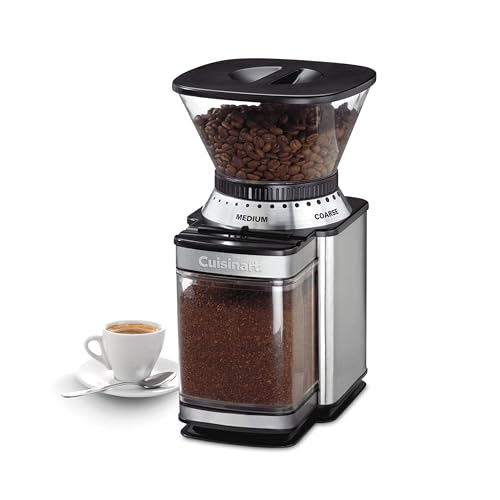
Cuisinart Supreme Grind Electric Burr Coffee Grinder, 18 Settings, DBM-8P1 | Grind settings for drip, espresso and French press, 4–18-cup selector, 8 oz. bean hopper and automatic shutoff
Included for 'Coffee Grinder for Coarse Grind: A Particle-Size Guide by Brewer' because the listing specifies 18 Settings and DBM-8P1, details this guide uses to compare options.
View on AmazonTop Picks at a Glance
- Best Overall Electric: OXO Brew Conical Burr Grinder, with a labeled coarse band, a 12 oz hopper and a timer.
- Best Range and Repeatability: Baratza Encore, with 40 settings and 40mm conical steel burrs.
- Best for Slow, Quiet Grinding: Capresso Infinity Plus, with 16 settings and a low-speed gear motor.
- Best Large-Capacity Hand Mill: Hario Skerton Pro, with 100g capacity and ceramic burrs.
- Best Premium Hand Grinder: KINGrinder K6, with a 48mm burr and 16 micron steps.
- Best Compact Electric for a Small Counter: Bodum Bistro burr grinder, with 12 settings and a 220g bean container.
Comparison Table
| Product | Best for | Key specs | Watch for | Price tier |
|---|---|---|---|---|
| OXO Brew Conical Burr | French press and cold brew on a timer | 43 positions; coarse band 11 to 15; 12 oz hopper | Fine end is limited | Mid-range |
| Baratza Encore | Any coarse recipe, repeatable | 40 settings; 40mm conical burrs; up to about 1200 microns | Static in dry air | Mid-range |
| Capresso Infinity Plus | Quiet coarse grinding | 16 settings in four bands; timer 5 to 60 seconds | Hopper size differs by listing | Mid-range |
| Hario Skerton Pro | Hand grinding big coarse doses | Ceramic burrs; about 10 steps; 100g capacity | Slow; coarse steps | Budget |
| KINGrinder K6 | Fast hand grinding with precision | 48mm burr; 60 clicks per turn; 30 to 35g capacity | Weight about 630 to 650g | Premium hand |
| Bodum Bistro burr | Small counters | 12 settings; 220g bean container; timer | Small catcher | Budget to mid-range |
What Counts as Coarse, and Which Brewer Needs What
Coarse is not a single size. Brewers sit on a spectrum from slightly coarse to very coarse, and the right size changes with steep time. A rough guide, measured in microns, is helpful even though exact numbers vary by grinder.
| Brewer | Typical grind | Approx. size | Steep time | Dose for a typical batch |
|---|---|---|---|---|
| French press (34 oz) | Coarse | About 900 to 1100 microns, like coarse sea salt | 4 minutes | About 55 to 60g |
| Cold brew concentrate | Coarse | About 1000 to 1200 microns | 12 to 18 hours | About 100g per 800 ml |
| Percolator | Coarse | About 1000 microns | 6 to 10 minutes | About 1 tablespoon per cup |
| Cowboy or pot coffee | Coarse | About 1000 microns | 3 to 4 minutes | About 2 tablespoons per cup |
| Chemex | Medium-coarse | About 800 to 900 microns | 3.5 to 4.5 minutes | About 36g per 600 ml |
These sizes are starting guides, not laws. The key takeaway is that the Baratza Encore reaches around 1200 microns at its coarsest setting, so it covers every row in the table. A grinder that tops out below 1000 microns will struggle with cold brew.
1. OXO Brew Conical Burr Grinder: Best Overall for Coarse Brewing
- 43 grind positions: 15 main settings with in-between steps
- Settings 1 to 5 fine, 6 to 10 medium, 11 to 15 coarse (OXO’s guide)
- Stainless steel conical burrs
- 12 oz UV-blocking hopper with a trap door; stainless steel static-fighting catcher
- One-touch timer (0 to 30 seconds) that remembers the last setting
Best for: households that brew French press or cold brew several times a week and want a timer-based routine. Skip if: you need espresso or very fine grinds.
For coarse grinding, the OXO’s clearest advantage is how it presents the range. A five-step coarse band, with in-between positions, lets you find the right size for a press and then move a half-step toward coarser for cold brew. The 12 oz hopper holds enough for a cold brew batch without refilling, and the timer means you can set a duration that matches your dose. The steel catcher reduces static, which is useful with coarse grounds that otherwise cling to plastic.
To plan the timer, use a kitchen scale: weigh the output after 20 seconds and scale up. We cannot give a universal grams-per-second figure because motor speed varies by source. Wattage is reported differently by retailers and reviewers, so it is not listed here.
Pros: clear coarse band; large hopper; timer memory; steel catcher. Cons: limited fine range; larger than the Bodum; not for espresso.
2. Baratza Encore: Best Range and Repeatability
- 40 stepped settings, from about 250 to 1200 microns
- 40mm conical steel burrs
- Grounds bin about 5 oz (142g); hopper listed as 8 oz by most retailers
- Low-speed DC motor with a thermal cutout; about 70W
Best for: anyone who wants to move between French press, cold brew and filter without losing track of settings. Skip if: you want a timer or a very large hopper.
The Encore’s coarsest settings reach around 1200 microns, which is the top of the useful range for cold brew. Because the steps are numbered, you can note a number for each brewer: for example 28 for press and 32 for cold brew, as a starting idea. The 40mm burrs are not the largest in this guide, but the slow motor gives a relatively quiet, cool grind.
The 5 oz grounds bin holds roughly 140 grams, which is enough for a cold brew batch of 100 grams. That is a practical benefit: you can grind a full batch of cold brew in a single run. Coarse grounds are lighter and less prone to static than fine grounds, but dry air can still make them cling.
Pros: widest range here; numbered settings; replaceable burrs; well supported. Cons: no timer; hopper has no airtight lid; spec reports for hopper vary.
3. Capresso Infinity Plus: Best for Slow, Quiet Coarse Grinding
- 16 settings in four labeled bands: extra fine, fine, regular and coarse
- Commercial-grade conical steel burrs; low-speed gear motor
- Timer from 5 to 60 seconds, a pulse option and a 12-cup selector
- Hopper 8.8 oz on the standard Infinity; some Plus listings state 11 oz
- Ground coffee container about 4 oz per America’s Test Kitchen
Best for: users who want a calm motor and clearly labeled bands. Skip if: you need many steps between press and cold brew.
The Infinity Plus offers a simple route to coarse grounds: turn the dial to the coarse band and grind. The slower burr speed produces less heat, which is an advantage when grinding a large dose in one go. A 4 oz grounds container means a 100 gram cold brew dose slightly exceeds the container, so plan to grind in two rounds. The cup selector is useful for press: set 12 cups, then adjust time if the dose is wrong.
Because Capresso sells several versions of the Infinity, confirm the model number if hopper size matters to you.
Pros: slow motor; labeled bands; timer and pulse; durable reputation. Cons: fewer steps; small grounds container; hopper figures vary.
4. Hario Skerton Pro: Best Large-Capacity Hand Mill
- Conical ceramic burrs; about 10 usable steps, roughly 100 microns apart
- 100g capacity of grounds; the hopper holds roughly 60g of beans
- Stabilizer bar on the upper burr carrier
- Glass catcher; aluminum handle; weight about 480 to 650g depending on source
Best for: French press, cold brew and percolator in a quiet kitchen. Skip if: you need fine steps for pour over.
A hand mill gives you coarse grounds without a motor, and the Skerton’s design focuses on this. The ceramic burrs produce a coarse, fairly consistent grind with fewer fines than a blade. At roughly 100 microns between steps, the adjustment is coarse, but for press and cold brew, that is fine. The 100g grounds capacity matches a cold brew batch, though the bean hopper holds about 60 grams, so you will refill once. A full 100 gram dose takes several minutes of turning, so this is a weekend-batch tool rather than a daily one.
A tip: the stabilizer bar reduces wobble but does not eliminate it. Tighten the adjustment and check that the handle turns smoothly before each session.
Pros: large capacity; quiet; no power; easy to clean. Cons: slow; coarse steps; glass jar can break.
5. KINGrinder K6: Best Premium Hand Grinder
- 48mm heptagonal stainless steel burrs (SUS420)
- 60 clicks per rotation, 16 micron gaps, about 240 total settings over four rotations
- Capacity listed between 30 and 35g in most sources
- Anodized aluminum body, dual bearings, 6.35mm hex drive
Best for: people who want a fast, precise hand grinder and brew a press for one or two. Skip if: you brew cold brew in batches over 100g.
The K6’s large burr cuts beans quickly, and the 16 micron steps give you the precision to move a press recipe by a hair. The limitation for coarse brewing is capacity: 30 to 35 grams means a 58 gram press dose needs two rounds, and a 100 gram cold brew dose takes three. The hex drive allows you to power it with a drill, which is helpful for big batches, but check that your drill spins at a modest speed.
Reports of capacity and total settings differ by retailer, so treat them as approximate.
Pros: fast; fine steps; external adjustment; solid build. Cons: small capacity for coarse batches; heavy; premium cost.
6. Bodum Bistro Burr Grinder: Best Compact Electric
- 12 grind settings set by twisting the upper bean container
- Stainless steel conical burrs; about 160W
- Up to 220g (about 7 oz) bean container with a measuring guide in the lid
- Preset timer; the borosilicate glass catcher version resists static
- Two-year warranty; catcher and lid are dishwasher safe
Best for: small households that press coffee a few times a week. Skip if: you make cold brew in large batches; the catcher is small.
The Bodum covers coarse press settings in a compact body. Its 220g bean container can hold a full cold brew dose, but the catcher is smaller, so you will empty it between rounds. The glass catcher model is better against static. With 12 settings, you have less room to refine, which is acceptable for press and cold brew, where recipes are forgiving.
Pros: compact; glass catcher option; warranty; easy cleanup. Cons: few settings; small catcher; versions easy to confuse.
A Worked Example: Capacity and Time for Cold Brew
Suppose you make cold brew concentrate with a 1:8 ratio. For 800 ml of water you need 100 grams of coarse grounds. Using the Encore at roughly one gram per second, that is about 100 seconds of grinding, and the 142g grounds bin holds it in one run. The OXO has no stated grams-per-second figure in the sources we checked, so weigh the grounds after 20 seconds and scale up. A hand grinder is a different story: the Skerton Pro holds 100g of grounds but takes several minutes to fill, while the K6 holds 30 to 35g, so you would fill it three times, with a few minutes of cranking each. For one batch a week that may be acceptable. For two or three batches, an electric grinder is worth the money.
A second example is a daily French press. At 58 grams per day, a 12 oz hopper holds about 6 doses, so a OXO hopper lasts about six days. A 220g Bodum container holds about 3.8 doses. This is why we suggest filling hoppers only for what you will use in a few days, even when the hopper can hold more.
Reducing Fines in Coarse Grinds
- Choose burrs. Blades produce the most fines; burrs produce fewer.
- Grind at the setting, not finer. Going finer to compensate for a weak cup adds dust. Increase dose or steep time instead.
- Sift. A fine mesh strainer over a bowl removes dust in seconds. Discard what falls through.
- Let the press settle. After four minutes, wait a minute before pressing and pour slowly, leaving the last sip behind.
- Filter cold brew twice. Strain through a mesh and then a paper filter to remove silt.
Reading a Particle-Size Chart Without Fooling Yourself
Micron figures are useful for comparing grinders, but they hide two things. First, a number describes the average or the target, not the spread. Two grinders can both aim for 1000 microns while one delivers a tight cluster and the other a wide spread that includes dust and boulders. That spread is what you taste in the cup, and it is why burr quality matters more for coarse brewing than the headline number. Second, the setting a grinder calls “coarse” is relative to its own scale. Setting 11 on the OXO is not the same size as setting 11 on the Baratza, and neither matches a click count on a hand grinder.
The practical way to use a chart is to anchor on a brew you like. Make a press with a recipe you know, note the setting, and then use the chart’s ratios to move to another brewer. If your press at setting 28 on the Encore tastes good, a percolator might want one or two steps finer to avoid the brew running too light, while cold brew might want two steps coarser to reduce silt and bitterness over a long steep. Treat each move as a hypothesis, taste the result, and write the new number on a note beside the grinder.
Finally, remember that bean and roast change the answer. Dense, light-roasted beans resist extraction and often need a slightly finer coarse grind than a darker, more brittle roast. If your coarse brews taste weak with a new bag, adjust by one step before you change anything else.
Also Consider
- 1Zpresso Q: a compact hand grinder with 38mm burrs, 30 clicks per turn and about 25 micron steps; capacity is only 15 to 20g, which limits coarse batches.
- Cuisinart DBM-8: an 18-position budget burr with an extra-coarse end and an 8 oz hopper; reviewers report weaker evenness at coarse settings.
- Hamilton Beach Electric Burr Grinder: listed with a 16 oz hopper and 18 settings; a budget option for big batches, though specs beyond the title are not listed.
- Baratza Virtuoso+: a step-up Baratza with 40 settings, for those who want a timer and better build.
How We Chose
We started with grinders in the shop catalog and selected those that reach a true coarse setting with a burr set. We checked each against manufacturer pages, retailer spec tables and independent reviews from sites such as Coffee Gear Zone, Roast Aroma and Balance Journal. We favored a labeled or numbered coarse range, a hopper or capacity large enough for a press dose, and designs that limit static. Where sources disagreed (Baratza hopper size, Capresso hopper size, K6 capacity), we say so. This guide is research-based and we did not personally use these grinders. We use price tiers because prices change.
Buying Guide
Reach: Does It Go Coarse Enough?
Look for a stated coarse range of at least 1000 microns. The Encore lists about 1200, and the OXO groups settings 11 to 15 as coarse. Hand mills such as the Skerton reach coarse by loosening the burr, and the number of turns varies.
Capacity and Dose
Match capacity to your largest batch: 60 grams for a press, 100 grams for cold brew. A grinder with a 30g capacity needs multiple rounds, which is fine occasionally but tedious weekly.
Burr Type
Conical burrs are common and work well for coarse brewing. Ceramic burrs are fine for coarse, and steel burrs offer longer life.
Static and Mess
Steel and glass catchers reduce static. A small brush next to the grinder helps. Spritzing the beans with a few drops of water before grinding can reduce static for some users.
Noise and Speed
Slow conical grinders are quiet but take longer to grind a large dose. Hand grinders are silent and slowest. If you grind large batches, factor in the time.
Common Mistakes
- Using a blade grinder for a French press, which leaves a muddy cup.
- Grinding too fine for cold brew, which makes it bitter and hard to filter.
- Skipping the scale; coarse coffee takes more volume, so scoops mislead.
- Forgetting that hand grinders have small capacities for large doses.
Frequently Asked Questions
What is the best coffee grinder for a coarse grind?
The OXO Brew and the Baratza Encore are the most practical electric choices, and the Hario Skerton Pro is the classic hand mill for large coarse doses.
How coarse should French press coffee be?
About the size of coarse sea salt, roughly 900 to 1100 microns, with a four-minute steep. Go slightly coarser if the cup tastes bitter.
Can I use a blade grinder for a coarse grind?
You can, using short pulses, but you will get dust along with chunks. A sieve helps remove the fines.
Why does my French press coffee have sludge?
Fines pass through the mesh. Use a burr grinder, sift the grounds, and let the press settle before pouring.
How much coffee do I grind for cold brew?
A common concentrate ratio is about 100 grams of coarse coffee for 800 ml of water, diluted with water or milk when serving. Adjust to taste.
Is a hand grinder good for coarse grinding?
Yes for small doses. For larger doses like cold brew, capacity and time become limits, so choose a hand mill with a large capacity or an electric grinder.
Do I need a stepless grinder for a coarse grind?
No. Coarse recipes are forgiving, and stepped grinders with 15 or more positions are enough.
Which One Should You Buy?
Choose the OXO Brew for an easy timer-based coarse routine, the Baratza Encore for the widest range, and the Capresso Infinity Plus for a slow, quiet motor. Pick the Hario Skerton Pro if you want a big-capacity hand mill, the KINGrinder K6 if you want a premium hand grinder for small doses, and the Bodum Bistro for a small counter. Whatever you choose, use a scale, sift out the fines, and grind per batch.
Sources
- OXO Brew Conical Burr Grinder product page and usage guide
- Baratza Encore product sheet (2023) and retailer listings
- Capresso Infinity retailer listings and America’s Test Kitchen entry
- Hario Skerton Pro retailer listings and Balance Journal review
- KINGrinder K6 listings and Coffee Gear review
- Bodum Bistro product page and Coffeeness review
Last updated: October 2026
Write Your Review
No reviews yet. Be the first to share your experience!