
- Top Pick: Hudson Essentials Stainless Steel Measuring Spoons Set for Dry or Liquid – Fits in Spice Jars – Set of 7
- Best Value: Cornucopia Brands Bulk Pack of Teaspoon Measuring Spoons (24-Pack); 5 ml / 5 cc Scoops Which Fit Inside a Spice Bottle
- Premium Choice: FANGSUN Stainless Steel Measuring Spoons Set of 6, Narrow Design
The Short Answer
The measuring spoons most likely to fit inside a standard spice jar are narrow spoons with a bowl width of about 1 inch (2.5 cm) or less. A 1-teaspoon spoon is usually the most useful size because it holds 5 milliliters and fits many jars with openings between 1.25 and 1.75 inches wide.
For the best chance of a comfortable fit, look for a set labeled slim, narrow, rectangular, or spice-jar friendly. The key measurements are the spoon’s outside width and bowl depth, not just its capacity. A round 1-teaspoon spoon may hold the correct amount but still be too wide for a small bottle opening.
As an Amazon Associate we earn from qualifying purchases at no extra cost to you. Product prices and availability are accurate as of the date shown and are subject to change.


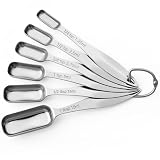

Most spice containers have an opening from approximately 1.25 to 2 inches (3.2 to 5.1 cm), although shaker-top bottles may have a much smaller dispensing opening. Measuring spoons are intended to go into the jar after the shaker insert or sifter is removed. For everyday seasoning, a narrow 1/4-teaspoon, 1/2-teaspoon, and 1-teaspoon set offers the most practical combination.
Standard Sizes
Measuring spoon capacities are standardized, but the physical dimensions are not. The measurements below are useful buying targets for spoons intended to fit inside spice jars. Width refers to the widest part of the spoon bowl; overall length includes the handle.
| Spoon size | Capacity | Typical bowl width | Typical overall length | Best use |
|---|---|---|---|---|
| 1/4 teaspoon | 1.25 ml | 0.55–0.75 in (1.4–1.9 cm) | 3.5–5 in (8.9–12.7 cm) | Salt, pepper, chili powder, baking spices |
| 1/2 teaspoon | 2.5 ml | 0.65–0.85 in (1.7–2.2 cm) | 3.5–5 in (8.9–12.7 cm) | Small spice additions and seasoning blends |
| 1 teaspoon | 5 ml | 0.75–1.05 in (1.9–2.7 cm) | 4–6 in (10.2–15.2 cm) | Most spice jars, extracts, and dry ingredients |
| 1 tablespoon | 15 ml | 1.1–1.5 in (2.8–3.8 cm) | 4.5–7 in (11.4–17.8 cm) | Wide-mouth jars and pantry containers |
These are typical product dimensions rather than guarantees. A spoon may be longer and narrower, or short and wide, while holding the same volume. For a jar with a 1.25-inch opening, choose a spoon no wider than about 1 inch. Leaving at least 1/8 inch (3 mm) of clearance on each side makes it easier to insert and remove the spoon without scraping the rim.
Narrow stainless-steel sets often have a 1-teaspoon spoon measuring roughly 0.7 to 0.9 inch (1.8 to 2.3 cm) across. Some rectangular designs are only about 0.5 to 0.7 inch (1.3 to 1.8 cm) wide, making them better for small-necked bottles. A typical four- to seven-piece stainless set weighs approximately 3 to 8 ounces (85 to 227 grams), depending on handle thickness and whether a storage ring is included.
Prices for spice-jar-friendly measuring spoons commonly range from about $7 to $20. Basic narrow sets are often near the lower end, while heavier stainless sets with seven pieces, engraved markings, or a storage ring may cost $15 to $20. Bulk packs of individual 1-teaspoon spoons can cost about $15 for 24 pieces, which is useful for baking stations, cooking classes, or a busy commercial kitchen.
How to Measure Your Space
- Remove the shaker insert. If the jar has a plastic sifter or sprinkle top, take it off before measuring. The insert opening is not the usable opening for a measuring spoon.
- Measure the inside diameter. Use a ruler or tape measure across the inside of the jar mouth, from one inner edge to the opposite inner edge. Measuring the outside diameter can overstate the available space.
- Check the narrowest point. Some jars have a lip, threaded neck, or shoulder that reduces clearance below the visible rim. Measure the narrowest section the spoon must pass through.
- Subtract clearance. For easy handling, subtract about 1/4 inch (6 mm) from the opening diameter. For example, a 1.5-inch opening should pair with a spoon no wider than roughly 1.25 inches.
- Measure the jar depth. A long-handled spoon may fit through the mouth but be awkward if the jar is shallow. For a compact jar, a 3.5- to 5-inch handle is usually easier to store.
- Compare the bowl shape. Look at the spoon’s widest point, including rolled edges and side walls. A narrow rectangular spoon may fit better than a round spoon with the same capacity.
- Account for the ingredient. Fine powders can be scooped from a deep bowl, while whole peppercorns, dried herbs, and coarse salt may be easier to collect with a slightly shallower bowl.
By Room or Use Case
Kitchen Spice Cabinet
For everyday spice jars, prioritize a 1-teaspoon spoon that is no more than 1 inch (2.5 cm) wide. Add 1/4- and 1/2-teaspoon sizes for recipes that call for small quantities. A connected ring is convenient for storage, but check that the ring can open or detach; otherwise, the largest spoon may block a narrow jar.
Baking Pantry
Baking often requires 1/4 teaspoon through 1 tablespoon. A narrow set works well for vanilla, cinnamon, baking soda, and cream of tartar, but the tablespoon may not fit in small spice bottles. Store the tablespoon with flour, sugar, or cocoa containers instead. Engraved or stamped markings are preferable because printed markings can wear with repeated washing.
Drawer or Countertop Spice Rack
Short, nesting spoons are best when storage space is limited. Choose handles around 3.5 to 5 inches long and a nested stack under about 1.5 inches high. If the spoons will remain on a counter, stainless steel is easier to wipe clean and less likely to retain strong aromas than some porous materials.
Meal Prep and Portioning
A bulk pack of 1-teaspoon spoons is useful when preparing spice blends, filling jars, or portioning ingredients for several meals. The 5 ml capacity is easy to recognize, and multiple identical spoons prevent repeated washing during a long prep session. Keep one clean spoon for each open container when cross-contamination is a concern.
Travel and Camping
For a camp kitchen or small travel kit, select a lightweight set with rounded edges and a secure ring. Plastic spoons may weigh less, but stainless steel usually resists staining and odor better. A 1/4-teaspoon and 1-teaspoon pair covers most seasoning needs without carrying a full set.
Common Sizing Mistakes
- Buying by capacity alone: A standard teaspoon can be too wide for a spice jar if its bowl is round and deep.
- Measuring the label opening: The outside rim is larger than the usable inside diameter. Measure the interior.
- Ignoring the sifter: A spoon will not fit through a shaker insert. Remove it or choose a jar with a wide-mouth design.
- Choosing an oversized tablespoon set: A tablespoon is useful for pantry containers but is rarely the best first spoon for spice bottles.
- Forgetting handle clearance: A long handle can catch on a cabinet shelf or prevent the jar from standing in a narrow rack.
- Assuming all “narrow” sets match: Check the listed width. Some sets call the handles narrow while the bowls remain more than 1 inch wide.
- Overlooking cleaning: One-piece stainless spoons are generally simpler to wash than designs with seams, hinges, or permanently attached rings.
FAQ
What size measuring spoon fits most spice jars?
A narrow 1-teaspoon spoon is the best general choice. Look for a bowl width of about 0.75 to 1 inch (1.9 to 2.5 cm), and confirm that the jar’s inside opening is at least 1.25 inches (3.2 cm) wide. A 1/4-teaspoon spoon is more likely to fit very small jars.
Will a tablespoon measuring spoon fit inside a spice jar?
Sometimes, but not usually. A tablespoon bowl is commonly about 1.1 to 1.5 inches (2.8 to 3.8 cm) wide, so it needs a wide-mouth container. It is better suited to flour, sugar, oil, and large pantry jars than to conventional spice bottles.
Are rectangular measuring spoons better for spice jars?
They can be. Rectangular or elongated bowls often provide more capacity without being as wide as a round spoon. However, compare the manufacturer’s actual bowl width and depth rather than relying on the shape alone. A narrow 5 ml spoon is generally the most useful design.
What should I look for when buying measuring spoons for spice jars in 2026?
Check the spoon’s maximum width, overall length, capacity markings, material, and cleaning instructions. For most kitchens, choose stainless steel, a width of 1 inch or less for the teaspoon, and a handle between 4 and 6 inches. If you use unusually narrow bottles, measure first and select a rectangular set or individual 5 ml spoons.
Ready to decide? Our #1 pick for 2026 is the 1/4 teaspoon.
Live price & availability on Amazon.





Write Your Review
No reviews yet. Be the first to share your experience!