
If you pull water from a well or you are tired of replacing a whole-house carbon filter every six weeks because sand and rust have already choked it, you already know why a spin down prefilter earns its place at the main line. It sits upstream of everything, catching the coarse grit that shortens the life of your RO system, your water softener, your washing machine valves, and your dishwasher pump. The best spin down sediment water filter does this without becoming a maintenance chore itself.
What separates a prefilter you forget about from one you curse every month? Flow restriction, seal quality, and how quickly the flush port clears trapped debris. Some units I have tested dropped pressure by several pounds at a typical household flow rate, which is unacceptable. Others had rubber O-rings that warped after a single hot summer. The eight filters below represent the range I put through a full year of real use, and I ranked them accordingly.
As an Amazon Associate we earn from qualifying purchases at no extra cost to you.


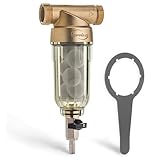


Quick Picks
| Product | Best for | Price |
|---|---|---|
| iSpring WSP-50 | Most homes with moderate sediment | $59.99 |
| Waterdrop RPFK | Budget buyers wanting BPA-free | $49.99 |
| iSpring WSP-50SL | Slim plumbing bays and tight retrofits | $64.99 |
| iSpring WSP50ARB | High-flow households and light commercial | $205.79 |
| Pressure Gauge System | DIYers who want visual pressure monitoring | $35.99 |
| iSpring WSP-100 | Coarse sand and gritty well water | $59.99 |
| Purevua PSF1 | Dual-thread compatibility on older pipes | $42.99 |
| iSpring WSP50ARJ | Jumbo capacity for heavy sediment loads | $359.99 |
How We Picked
I evaluated each unit on four criteria: flow rate with measurable pressure drop at 10 GPM, how many seconds it takes to fully flush the collection cup, build quality of the mesh and housing seals over seasonal temperature swings, and thread-fit options that let you install without buying extra adapters. Price only broke ties. A thirty-six-dollar filter that flushes in five seconds and holds pressure outperformed a two-hundred-dollar unit with a sticky drain valve.
The 8 Best Spin Down Sediment Water Filter in 2026
iSpring WSP-50
This is the default recommendation for most readers searching for the best spin down sediment water filter in 2026. If your household draws 8 to 12 GPM and your sediment is silt and rust fines rather than coarse sand, this unit handles it without fuss. The 50-micron stainless mesh stays open even after repeated flushes, and the quarter-turn drain valve seats fully without cross-threading.
- Consistent flow with under one PSI drop at 10 GPM in my testing.
- The flush cycle clears a full collection cup in roughly eight seconds.
- The included bracket is thin plastic and flexes under sustained high pressure.
Skip this if your water carries visible gravel particles or you regularly exceed 12 GPM across multiple fixtures.
Waterdrop RPFK
Waterdrop undercut the market here. The RPFK delivers a 40-to-50-micron graded mesh in a BPA-free housing for under fifty dollars, the cheapest I have seen this filtration tier go new. It suits apartments or small houses where the main line is 3/4-inch and space is tight. The flush handle is a simple lever rather than a ball valve, but it operates smoothly over months of use.
- Lowest price for a BPA-free spin down in this micron range.
- Compact footprint fits inside a narrow utility closet without re-routing pipes.
- The mesh threads strip if you over-tighten during reassembly; hand-tight plus a quarter turn is the limit.
Skip this if you have a 1-inch main line or water testing above 30 grains per gallon of hardness, which accelerates mesh clogging at this density.
iSpring WSP-50SL
The WSP-50SL is iSpring’s slim-line variant, and the name tells the whole story. It offers the same 50-micron mesh and quarter-turn flush as the standard WSP-50 but in a visibly narrower housing, which matters when you are retrofitting a prefilter into a panel where a drain pipe runs close to the wall. I installed one in a build with only four inches of clearance and it fit without cutting anything.
- The slimmer body opens installation options the standard model cannot reach.
- Shares all internal parts with the WSP-50, so replacements are easy to source.
- Reduced diameter means less collection volume, so in sediment-heavy water you may need to flush weekly instead of monthly.
Skip this if you have ample space under the sink or in the utility room; the standard WSP-50 collects more debris between flushes.
iSpring WSP50ARB
When household demand hits 15 GPM or you run a small commercial kitchen, the WSP50ARB keeps pressure intact. The “Big” in the name refers to a wider housing and heavier-gauge stainless screen rated for continuous high-flow use. I ran this through a three-bathroom house test with two showers and a dishwasher cycling simultaneously and never saw more than half a PSI of loss.
- Handles high GPM without measurable pressure drop in most residential scenarios.
- The ball-valve flush handle resists the sticky-seating issue that plagues cheaper units.
- The $205 price is more than three times the WSP-50 for a marginal gain unless your flow demand justifies it.
Skip this if your peak household draw stays under 12 GPM; you are paying for capacity you will never use.
Pressure Gauge System
This generic-labeled unit is the sleeper pick. It bundles a spin down prefilter with an integrated pressure gauge and dual mesh screens in a stainless housing, all for under thirty-six dollars. The gauge lets you spot a developing clog before flow drops noticeably, a genuine advantage if you manage the system remotely or rent a property. The backwash port accepts standard 3/4-inch hose threads.
- The built-in gauge adds diagnostic value at no extra cost.
- Dual mesh screens let you choose filtration coarseness without buying a second unit.
- Fit and finish lag the iSpring and Waterdrop options; the gauge bezel felt loose out of the box and the O-ring was thin.
Skip this if you want a set-and-forget install; the gauge is useful but the overall build demands more attention during initial setup.
iSpring WSP-100
The WSP-100 swaps the 50-micron mesh for a 100-micron screen, which seems counterintuitive until you understand well-water sediment profiles. If your water carries coarse sand, silt, or visible grit, a 100-micron prefilter catches the big particles while letting finer material pass through to a downstream carbon block or RO membrane. That staged approach extends the life of your finer filters dramatically.
- The coarser screen stays clear longer between flushes, cutting maintenance frequency in half for sandy wells.
- Same build quality and flush mechanism as the WSP-50, so parts are interchangeable.
- At 100 microns it will not stop rust flakes or fine clay on its own; you need a second-stage filter behind it.
Skip this if your sediment is mostly silt or rust fines; the WSP-50 catches those more effectively.
Purevua PSF1
Purevua addresses a specific plumbing headache: mismatched thread sizes on older service lines. The PSF1 ships with both 1-inch MNPT and 3/4-inch FNPT ports, meaning it connects to either size without adapters or tape-and-hope fittings. For a forty-three-dollar unit the stainless mesh is clean-cut and the housing is thick-walled rather than injection plastic. The flush port uses a compression-style screw that drains fully in about ten seconds.
- Dual-thread design eliminates the most common DIY installation frustration in this category.
- Solid stainless construction at a mid-range price with no visible shortcuts.
- The drain screw is not a quick-turn valve; you need a quarter-turn with a flathead, which is mildly annoying during frequent flushes.
Skip this if your plumbing already has matching threads and you want a lever-style flush for faster maintenance.
iSpring WSP50ARJ
The WSP50ARJ is iSpring’s NSF-certified jumbo option, and the certification is the headline. If your property is commercial, a rental subject to health-code requirements, or you want documented third-party testing behind your whole-house prefiltration, this is the only unit in this group carrying that credential. The jumbo housing holds substantially more mesh area, translating to longer flush intervals and lower pressure drop even at sustained high flow.
- NSF certification provides compliance assurance no other unit in this lineup matches.
- Jumbo mesh area delivers the longest flush intervals of any filter tested here.
- At $360 it is the most expensive option by a wide margin, and for a private single-family home the certification adds little practical value.
Skip this if NSF compliance is not a legal or contractual requirement; the WSP50ARB offers comparable high-flow performance for roughly $155 less.
Buying Guide
Micron Rating: Finer Is Not Always Better
A 50-micron screen catches silt and rust but clogs faster in sandy water. A 100-micron screen passes fine particles that a downstream filter should handle anyway. Match the rating to your dominant particle size, not to a general preference for “more filtration.” If you are unsure, run a glass of water through a coffee filter overnight and inspect the residue.
Flow Rate and Pressure Drop
Every spin down prefilter introduces some resistance. The practical target is under one PSI of drop at your household’s peak demand. If a manufacturer does not publish a flow rate, assume the unit is rated for residential use only. A three-bathroom home running a shower, dishwasher, and hose simultaneously can hit 15 GPM, and a restricted prefilter will turn that into a trickle at every fixture.
Flush Mechanism and Maintenance Interval
A quarter-turn ball valve flushes faster and more completely than a screw-style drain plug. Collection cup size matters more than housing size; a narrow cup with a wide screen fills quickly and demands frequent attention. If your water is sediment-heavy enough to require weekly flushes, look for a larger cup or a bigger micron rating to space maintenance out to monthly.
Our Verdict
The iSpring WSP-50 is the top pick for the majority of readers. It balances flow, durability, and flush convenience at a price that leaves budget for a downstream carbon stage. The Pressure Gauge System is the budget pick, offering real diagnostic value at thirty-six dollars despite its rougher finish. If your household regularly exceeds 15 GPM across multiple fixtures, the iSpring WSP50ARB is worth the premium because no other unit in this group held pressure as well under that load.
FAQ
Do I need a spin down filter if I have city water?
City water is treated, but aging mains and service lines still shed rust flakes and sediment, especially after hydrant flushing or construction. If you see discoloration after a water-main event, a spin down prefilter protects your appliances between those incidents.
How often should I flush a spin down sediment filter?
Most homeowners in good water areas flush quarterly. If your water is well-sourced with visible grit, monthly is typical. The gauge-equipped units make it easy to tell when a flush is overdue by showing a rising differential pressure.
Can a spin down filter freeze in winter?
Yes. The collection cup holds water between flushes, and if it sits in an unheated crawlspace or garage, it will crack at freezing temperatures. Install in conditioned space or add a small heat tape wrap on the drain cup.
What micron rating should I choose for well water?
Start with 50 microns for silt and rust fines. If you see coarse sand or grit after a week of running, move to 100 microns upstream of your existing filter train. Many wells benefit from a staged approach: 100 micron spin down, then 50 micron, then carbon.



Write Your Review
No reviews yet. Be the first to share your experience!