
Choosing a precision digital baking scale is less about finding the highest capacity or the longest feature list. It is about matching the scale’s resolution, platform size, controls, and durability to the way you bake. A scale that reads to 0.1 gram may be excellent for yeast and sourdough ingredients but unnecessarily slow for weighing 20 pounds of flour. Likewise, a low-cost model can be perfectly accurate for everyday cookies while frustrating you with a small platform, short auto-off timer, or difficult-to-read display.
The most common mistake is confusing capacity with precision. A 22-pound scale is not automatically more accurate than an 11-pound model, and “high precision” does not guarantee reliable readings at every weight. Before buying in 2026, consider your recipes, bowls, storage space, and tolerance for cleaning and recharging. The following guide focuses on the specifications that make a difference in a real kitchen.
As an Amazon Associate we earn from qualifying purchases at no extra cost to you. Product prices and availability are accurate as of the date shown and are subject to change.


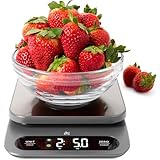

Decide These 3 Things First
- What will you weigh? For standard baking, choose at least 11 pounds of capacity and 1-gram readability. For very small quantities such as instant yeast, baking powder, salt, or spices, look for a dedicated 0.1-gram mode or a separate jeweler-style scale.
- What size bowls do you use? A platform around 7 by 7 inches handles most mixing bowls. If you weigh dough directly on the scale or use a 5-quart bowl, a platform closer to 9 by 7 inches is more comfortable.
- How often will it be used? Occasional bakers can prioritize price and compact storage. Daily bakers should spend more on a sturdy platform, fast response, rechargeable power, and a display that remains visible behind a large bowl.
Size and Capacity
Most household baking scales fall into two useful capacity categories: 11 pounds and 22 pounds. An 11-pound limit is sufficient for nearly all cake, cookie, bread, and pastry recipes, including a large batch of dough. A 22-pound model gives you more headroom for stockpots, bulk ingredients, or weighing produce, but it may take up more counter space and need a larger platform.
Check the scale’s physical dimensions, not only its maximum weight. Compact models may measure approximately 7 by 5 inches and weigh less than 1 pound, making them easy to store in a drawer. Larger models can measure 9 by 7 inches or more and weigh 1.5 to 3 pounds. The larger footprint is useful when a bowl blocks the display or overhangs the weighing surface.
Readability matters as much as capacity. A scale marked in 1-gram increments is suitable for flour, sugar, butter, and water. A 0.1-gram scale is better for small additions, but it does not make a 22-pound load more precise. If you regularly weigh more than 11 pounds, confirm that the scale maintains its stated increment across the full range.
Materials and Cleanability
Stainless steel is usually the most practical top-surface material. It resists stains, does not absorb flour or oil, and can be wiped clean quickly. Tempered glass is also smooth and easy to sanitize, but it can show fingerprints and may be less forgiving if a heavy bowl is dropped onto it. Plastic platforms are lighter and often less expensive, though textured plastic can trap flour around seams.
Look for a sealed control panel and a platform with minimal gaps. A spill-resistant design is more valuable than a claim that the entire scale is waterproof. Some rechargeable models advertise ratings such as IPX6, which indicate strong water-jet resistance under specified test conditions; they still should not be submerged or placed in a dishwasher. Keep water away from the charging port unless the manufacturer specifically says the port is protected.
A removable silicone mat can help prevent bowls from sliding, but it adds one more part to wash and dry. For any material, clean with a damp cloth and mild soap rather than immersing the scale.
Construction and Stability
A good baking scale should sit flat without rocking when you press the tare button. Look for four rubber feet, a rigid platform, and a body that does not flex under a full bowl. A scale weighing roughly 1 to 2.5 pounds is often stable enough for home use without being cumbersome to store.
Check the stated weight limit against your actual setup. A 22-pound capacity includes the bowl, not just the ingredients. A 6-quart stainless mixing bowl may weigh 2 to 4 pounds before you add anything, reducing the usable capacity. Oversized bowls can also cover the screen, so a display positioned at the front edge or raised above the platform is preferable.
Construction quality also shows up in the buttons. Physical keys with clear labels are easier to use with flour-covered hands than a completely flat touch panel. However, touch controls are simple to wipe clean. Either design can work if the tare and unit buttons are distinct and responsive.
Comfort and Performance
The most useful feature for baking is tare, which resets the display to zero after you place a bowl on the platform. A responsive scale should settle within roughly 1 to 2 seconds after an ingredient is added. A slow or unstable display makes it harder to pour directly into the bowl without overshooting.
Choose a model that displays grams prominently. Ounces and pounds are helpful for general cooking, but volume measurements are not a substitute for weight. Useful extras include milliliters for water and milk, a hold function that keeps a reading visible, and a backlit display that can be read in a dim kitchen.
Auto-off settings deserve attention. A timer of 60 to 180 seconds can be annoying when you are weighing several ingredients in sequence. Some scales let you extend the timer or disable it while powered by USB. Battery models typically use two or three AAA batteries, while rechargeable models may use a lithium battery with a USB-C or micro-USB connection. Expect several weeks to several months of ordinary use between charges, depending on the battery size and display behavior; manufacturers’ runtimes vary.
Price Tiers
Budget: $15 to $30. This range includes many 11- and 22-pound scales with 1-gram readability, tare, multiple units, and stainless-steel or glass tops. Examples such as the Nicewell 22-pound model at about $25.99, the Greater Goods 22-pound model around $24.99, and the Etekcity 22-pound rechargeable model near $29.99 illustrate the typical feature set. At this price, inspect display size, button quality, and return terms rather than assuming one brand is automatically more accurate.
Midrange: $30 to $60. Scales in this tier may offer a larger platform, improved sealing, rechargeable power, better visibility, and 0.1-gram measurement for lighter loads. They are worthwhile for frequent bread bakers, meal preppers, and cooks who weigh large bowls several times a week.
Premium or specialty: $60 and up. Premium pricing should bring a meaningful benefit such as laboratory-style calibration controls, a particularly robust platform, dual displays, a commercial warranty, or a dependable 0.1-gram range. A specialty bakery scale such as the BOMATA 11-pound model, listed around $33.88, shows that a large platform and 0.1-gram readability can sometimes appear below premium pricing. Verify the operating range: the fine increment may apply only to lighter weights.
Warranty and Support
A one-year limited warranty is common and adequate for an inexpensive household scale, provided the seller offers straightforward returns. Two years is more reassuring for a rechargeable model because battery and charging problems are harder to diagnose than a simple display issue. Commercial users should look for longer coverage and accessible replacement parts.
Before buying, confirm what the warranty excludes. Accidental water damage, overloaded platforms, and battery wear are often excluded. Keep the receipt and packaging until you have tested the scale with a known weight. A support page with a clear manual, calibration instructions, and a published customer-service contact is a positive sign.
Delivery and Assembly
Kitchen scales normally require no assembly. At most, you may need to insert batteries, remove a protective film, or charge the unit before use. Be cautious if a listing suggests a separate platform, remote display, or accessory that must be attached; extra pieces create more cleaning and storage concerns.
For delivery, check whether the scale ships with batteries or a charging cable, and confirm the return window before opening the package. A compact scale should arrive in a box that protects the glass or platform from impact. After delivery, place it on a level counter, test the tare function, and compare it with a known packaged weight. That is a basic check, not a substitute for certified calibration.
Spec Checklist
| Spec | Budget | Mid | Premium |
|---|---|---|---|
| Typical price | $15–$30 | $30–$60 | $60–$150+ |
| Capacity | 11–22 lb | 11–22 lb | 11–33 lb or specialty range |
| Readability | 1 g | 1 g; sometimes 0.1 g | 0.1 g with a defined operating range |
| Platform size | About 7 × 5 to 8 × 6 in. | About 8 × 6 to 9 × 7 in. | About 9 × 7 in. or larger |
| Power | 2–3 AAA batteries | Rechargeable or AAA batteries | Rechargeable, replaceable, or commercial power options |
| Best for | Everyday cookies and cakes | Frequent baking and large bowls | Specialty precision or heavy use |
Red Flags
- Precision with no range: “0.1 g” is incomplete unless the listing explains how much weight can be measured at that increment.
- Capacity that ignores the bowl: A 22-pound limit is the total load, including the container.
- Unclear units: Avoid a scale that lists unusual units but does not prominently support grams, ounces, and pounds.
- Hard-to-read displays: A screen hidden behind a bowl defeats the purpose of direct weighing.
- Vague waterproof claims: Water resistance does not mean dishwasher-safe or submersible.
- No return or warranty information: Precision electronics should have a clear path for replacement if readings drift or the display fails.
- Overloaded feature lists: Recipe apps and Bluetooth connectivity add little value if the basic tare, stability, and display functions are weak.
FAQ
Is 0.1-gram precision necessary for baking?
Usually not. A 1-gram scale is accurate enough for flour, sugar, butter, and most liquids. A 0.1-gram scale is useful for very small amounts of yeast, salt, or chemical leaveners, but use it only within the manufacturer’s stated fine-measurement range.
Is an 11-pound or 22-pound scale better?
Choose 11 pounds for ordinary home baking and easier storage. Choose 22 pounds if you weigh large dough batches, stockpots, produce, or bulk ingredients. Remember to subtract the bowl’s weight from the maximum capacity.
Can I wash a digital baking scale?
Do not immerse it unless the manufacturer explicitly permits that treatment. Wipe the platform and controls with a damp, soapy cloth, then dry thoroughly. Even an IPX6-rated model should be kept away from standing water and dishwasher cycles.
How can I tell whether a scale is accurate?
Place it on a level, stable counter and test it with a sealed item whose labeled weight is known. Repeat the test in different spots on the platform. Small differences can occur, but large or inconsistent changes suggest a problem with the surface, batteries, overload, or scale itself.
Ready to decide? Our #1 pick for 2026 is the Typical price.
Live price & availability on Amazon.






Write Your Review
No reviews yet. Be the first to share your experience!