
Our Short List of 3
All 4 Picks at a Glance
| Product | Specs | Action |
|---|---|---|
| 1. Mercer Culinary Millennia 8-Inch Chef’s Knife — the line-cook staple | Check price on Amazon | |
 2. Victorinox Fibrox Pro 8-Inch Chef’s Knife — the safe middle | Check price on Amazon | |
| 3. Wüsthof Gourmet 8-Inch Chef’s Knife — Solingen steel with real heft | Check price on Amazon | |
 4. Tojiro DP Gyuto 210mm F-808 — the step into Japanese steel | Check price on Amazon |
As an Amazon Associate we earn from qualifying purchases.
- Quick comparison
- 1. Mercer Culinary Millennia 8-Inch Chef’s Knife — the line-cook staple
- 2. Victorinox Fibrox Pro 8-Inch Chef’s Knife — the safe middle
- 3. Wüsthof Gourmet 8-Inch Chef’s Knife — Solingen steel with real heft
- 4. Tojiro DP Gyuto 210mm F-808 — the step into Japanese steel
- How to choose among these four
- Care rules that apply to every pick
- Frequently asked questions
- Verdict
Affiliate disclosure: Kitchen Widgetry is a participant in the Amazon Services LLC Associates Program, an affiliate advertising program designed to provide a means for sites to earn advertising fees by advertising and linking to Amazon.com. If you buy through a link on this page, we may earn a commission at no extra cost to you.
If you cook most nights, one good knife does more for your kitchen than a drawer full of mediocre ones. It dices the onion, breaks down the chicken, slices the melon, and then does it all again tomorrow. The budget tier covered in this guide is the most generous one most home cooks will ever need: it stretches from honest workhorse blades that cost very little to a genuine Japanese gyuto with a hardened specialty steel core, and every step in between buys you something real — better steel, better balance, a better handle, or an edge that holds longer between sharpenings. What it should never buy you is more knives than you need, which is why this guide is deliberately narrow.
Every pick below is a single, full-size kitchen knife: an 8-inch chef’s knife or its Japanese counterpart, the 210mm gyuto. There are no sets, no blocks, and no steak knives here. That distinction matters on this site, because we cover those categories separately. If you want a matched collection that arrives with its own storage, our guide to kitchen knife sets is the right page, and the knife block roundups cover blocks sold with steak knives included. Likewise, the specialist blades reviewed elsewhere on Kitchen Widgetry — boning knives, nakiri, slicing knives, skinning knives, and the rest — each solve one narrow job. This page answers a different question: if you are spending on one primary knife to handle the large majority of everyday prep, which single blades in this budget tier deserve the money?
The honest answer is that the tier breaks into a ladder. At the bottom sit stamped workhorses built for professional kitchens and culinary schools, where grip and easy maintenance matter more than finish. In the middle sits the Swiss all-rounder that has been the default recommendation at its level for years. Above that, a heavier German knife rewards cooks who like weight to do the pushing. At the top, the gyuto trades some toughness for a thinner, harder, sharper edge. Most home kitchens will land happily on the second or third rung, and that is a perfectly good place to stop.
Quick comparison
| Pick | Blade | Steel | Weight | Handle | Best for |
|---|---|---|---|---|---|
| Mercer Culinary Millennia 8-inch | 8 in chef’s knife | High-carbon Japanese steel, stamped | 6.7 oz | Santoprene with textured finger points | Hard daily use on a tight budget |
| Victorinox Fibrox Pro 8-inch | 8 in chef’s knife | High-carbon stainless steel, stamped | 6.4 oz | Fibrox Pro thermoplastic elastomer | One knife for everything |
| Wüsthof Gourmet 8-inch | 8 in chef’s knife | High-carbon stainless steel, stamped and laser cut | 8.5 oz | Synthetic, triple riveted | Dense prep that likes heft |
| Tojiro DP Gyuto F-808 | 8.2 in (210mm) gyuto | VG-10 core clad in 13-chrome stainless steel | 7.4 oz | Laminated composite wood with bolster | Fine slicing and long edge life |
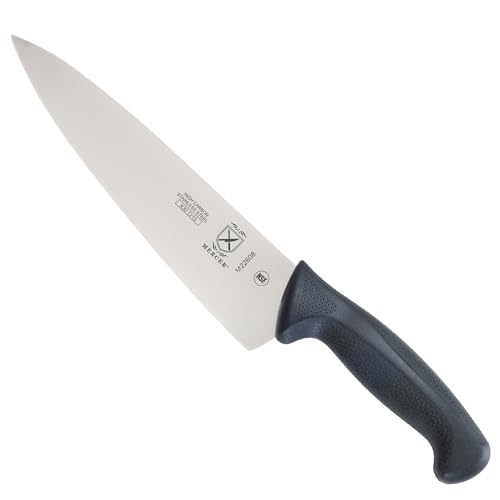
1. Mercer Culinary Millennia 8-Inch Chef’s Knife — the line-cook staple
View the Mercer Culinary Millennia 8-Inch Chef’s Knife on Amazon
Mercer Culinary built the Millennia line for professional kitchens and culinary schools, and the 8-inch chef’s knife is the one students get handed first. That origin explains everything about its design. The blade is stamped rather than forged, in high-carbon Japanese steel chosen to take a working edge and to come back quickly on a honing rod or stone. Nothing about the finish is polished for a gift box, and that is deliberate: this is a tool priced and built to be used hard, rinsed off, and used again the same evening.
The handle is the real reason the Millennia survives in working kitchens. It is molded from Santoprene and carries textured finger points that lock into a wet or greasy grip, which is exactly when a smooth handle becomes a liability. At 6.7 ounces it sits in the middle of this group for weight — light enough for long sessions of chopping without wearing out your wrist, heavy enough that the blade tracks straight through an onion instead of wandering. The overall length of about 13 inches is standard for the class, so it will feel familiar if you have used any conventional chef’s knife.
The compromises are the ones you would expect at the bottom rung of the ladder. A stamped blade has a touch of flex on hard squash and dense root vegetables, where a heavier knife would simply muscle through. The edge steel is chosen for toughness and easy sharpening rather than maximum retention, so plan on regular honing to keep it slicing tomatoes cleanly. And the plain, utilitarian look will not impress anyone across the counter. None of that changes the value calculation: for a first serious knife, a rental kitchen, a second knife for messy jobs, or a tight budget that still needs money left over for a decent cutting board, the Millennia is the sensible starting point on this page.
2. Victorinox Fibrox Pro 8-Inch Chef’s Knife — the safe middle
View the Victorinox Fibrox Pro 8-Inch Chef’s Knife on Amazon
Victorinox makes the Fibrox Pro in Switzerland, and it has been the default recommendation at its level for years — the knife reviewers, cooking schools, and working cooks reach for when someone asks for one knife with no research and no special care rules. The formula is simple and proven: an 8-inch blade in high-carbon stainless steel, and a Fibrox Pro handle in thermoplastic elastomer that stays grippy even with wet hands. Maker figures put the knife at 13.4 inches overall and 6.4 ounces, making it the lightest Western knife in this guide, and its Amazon listing carries a 4.8-star average across more than 15,000 ratings, a volume of owner feedback none of the other picks here can match.
That light, stamped feel is both the appeal and the compromise. The Fibrox Pro is nimble, forgiving, and easy to control for cooks who guide the knife rather than letting its weight work. Cooks who prefer to push through dense prep with heft behind the edge will find it a little insubstantial, and should look one rung up this ladder instead. Edge retention is good rather than exceptional, in line with the other stamped Western blades here, and the knife rewards a few passes on a honing rod before a big session.
Care is as easy as this group gets. Victorinox rates the Fibrox Pro as dishwasher safe, which sets it apart from the Japanese pick below, although hand washing remains the kinder option for any edge you care about. A lifetime warranty covers defects in materials and workmanship. If your household includes several cooks of different skill levels, shared drawers, and a realistic chance the knife will be left in the sink, this is the pick that tolerates all of it while still cutting far better than the anonymous knives most kitchens start with. For the majority of readers, this is where the ladder can stop.
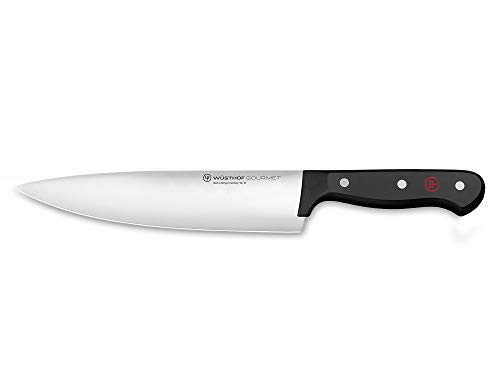
3. Wüsthof Gourmet 8-Inch Chef’s Knife — Solingen steel with real heft
View the Wüsthof Gourmet 8-Inch Chef’s Knife on Amazon
Wüsthof has made knives in Solingen, Germany since 1814, and the Gourmet line is its stamped, laser-cut entry point into that tradition — a way to buy a genuine Solingen chef’s knife without paying forged-knife money. The blade is high-carbon stainless steel at 8 inches, paired with a triple-riveted synthetic handle that the maker says resists fading, heat, and impact. Where this knife separates itself from the two workhorses above is mass: at 240 grams, about 8.5 ounces, it is the heaviest Western knife in this guide by a clear margin, and it is also the longest-feeling in the hand, at about 13.2 inches overall.
That weight is a feature, not a flaw, for the right cook. Through squash, sweet potato, dense cabbage, and a whole chicken, the Gourmet’s heft does a share of the pushing for you, and the blade sits flatter and steadier on the board than the lighter stamped picks. If your prep leans toward root vegetables, large melons, and batch cooking, the difference is noticeable across a long session. If your prep is mostly herbs, garlic, and delicate slicing, the same weight can feel like work, and one of the lighter knives above — or the gyuto below — will suit you better.
You are paying for balance and finish as much as for steel. The Gourmet’s fit, riveted handle, and overall polish are a step above the molded-grip workhorses, and Wüsthof backs the knife with a limited lifetime warranty. It is still a stamped blade, so do not expect the edge retention of the hardened Japanese steel at the top of this guide, and the forged Classic line above it in Wüsthof’s own range costs more again while giving up little in everyday cutting. Judged on its own terms — a weighty, well-finished German all-rounder in the middle of this budget tier — the Gourmet earns its rung.
4. Tojiro DP Gyuto 210mm F-808 — the step into Japanese steel
View the Tojiro DP Gyuto 210mm F-808 on Amazon
The Tojiro DP Gyuto is the different animal in this guide, and for cooks ready to look after an edge properly, it is the most rewarding knife here. Tojiro builds the DP in Japan around a VG-10 steel core, clad in softer 13-chrome stainless steel that protects the hard center from staining and damage. The blade runs 8.2 inches — the 210mm size that is the standard gyuto length — the knife measures about 14 inches overall, and it weighs 0.21 kilograms, roughly 7.4 ounces. A Western-style handle in laminated composite wood, fitted with a stainless bolster, keeps the grip familiar even though the edge geometry is pure gyuto: thinner behind the edge and ground finer than any Western knife on this page.
Hard, thin steel cuts differently, and the difference shows up in the food. Slices fall cleaner, herbs keep their color instead of bruising, onions come apart in even sheets, and the edge holds longer between sessions on a whetstone than the softer steels above. Published figures for the DP line put the core at around 60 on the Rockwell hardness scale, noticeably harder than the Western picks, which is precisely why it sharpens to a keener edge and keeps it.
In return, the Tojiro asks for care the other three do not. Hand wash it and dry it. Keep it off bones, frozen food, and hard pits, and never twist it sideways to free it from a squash — a hard, thin edge chips where a softer blade would merely dull. Store it on a magnetic strip, in a sheath, or in a block slot rather than loose in a drawer. Cooks who accept that bargain get the sharpest knife in this group by a clear margin, and the natural top rung of this budget tier: the point at which spending more buys decoration and exotic steels rather than better everyday cutting.
How to choose among these four
Start with how you actually cook, not how you imagine cooking. If the knife will be shared, dropped in the sink, and used for everything from opening packaging-adjacent tasks to Sunday roasts, the Mercer and the Victorinox are built to survive that life, and the Victorinox is the better finished of the two. If your sessions are long and your ingredients dense, the Wüsthof’s weight earns its keep. If you already own a honing rod, are willing to learn a whetstone, and care about clean slices more than brute durability, the Tojiro is the one you will still be pleased with years from now.
Consider grip next. The molded Santoprene and Fibrox Pro handles are designed for wet, greasy hands and for cooks who use a pinch grip loosely or a full handle grip. The Wüsthof’s riveted handle suits a fuller grip and larger hands. The Tojiro’s laminated composite handle is a conventional Western shape, so the transition from a chef’s knife to a gyuto is about the blade, not about relearning how to hold the knife.
Then be honest about sharpening. Every knife on this page will dull; they differ in how fast, and in how they come back. The three Western blades respond well to a honing rod for routine maintenance and are forgiving of inexpensive sharpening. The VG-10 core in the Tojiro holds its edge longer but deserves a whetstone rather than a pull-through sharpener, and repays the effort with a finer edge than the others can take. If nobody in your household will ever sharpen anything, buy the Victorinox and a honing rod, and your results will still beat a neglected premium knife.
Finally, think about size. All four picks cluster around the 8-inch standard because it is the most versatile length for home boards and home hands: long enough for melons and cabbage, short enough to control at the tip. If you regularly break down very large produce, a longer blade helps; if your board is small and your prep is mostly vegetables for two, the standard size here will feel right rather than oversized.
Care rules that apply to every pick
Wash and dry your main knife by hand after use, even the one rated for the dishwasher; detergents and rattling racks are hard on edges and handles alike. Hone little and often rather than sharpening rarely and aggressively, and keep the honing rod for the Western blades, the whetstone for the gyuto. Store the knife where the edge cannot strike other metal — a block slot, a magnetic strip, or a simple sheath — and never loose in a cutlery drawer. Use wood or soft plastic boards rather than glass or stone, which will dull any of these edges quickly. Follow those four habits and even the least expensive knife in this guide will out-cut a neglected blade from a tier above.
Frequently asked questions
Is one good knife really better than a set? For most home cooks, yes. A single quality chef’s knife or gyuto handles the overwhelming majority of prep, and the money a set spreads across many rarely used blades can instead buy one better blade, a good board, and a honing rod. Sets make sense when you want matched storage and specialty shapes from day one, which is why they are covered in their own guide on this site.
What does the budget tier in this guide actually buy as you climb it? At the bottom, durability and grip. In the middle, finish, balance, and weight. At the top, harder steel, a thinner edge, and longer edge retention — paid for with stricter care requirements. Cutting ability improves at every rung, but the nature of the improvement changes.
Chef’s knife or gyuto — which shape should a first-time buyer choose? A chef’s knife if you want toughness, a curved belly for rock-chopping, and minimal care rules. A gyuto if you mostly slice and push-cut, want cleaner cuts, and will hand wash and stone-sharpen. Neither is objectively better; they are different answers to different habits.
How long should an 8-inch knife last? With normal home use, honing, and occasional sharpening, any pick in this guide should serve for many years. Knives in this tier are replaced because they are lost, damaged by misuse, or outgrown — rarely because they wear out.
Verdict
Buy the Victorinox Fibrox Pro if you want one knife, no research, and no special care rules — it is the recommendation most kitchens should start from. Choose the Mercer Culinary Millennia to spend as little as possible while still getting a genuine working knife, or as a hard-use second blade. Pick the Wüsthof Gourmet when your prep is dense and you like a knife with weight behind it, finished a step above the workhorses. And step up to the Tojiro DP Gyuto when you are ready to trade a little toughness for the cleanest cuts and the longest-lasting edge in this budget tier. Any of the four is a real upgrade over a drawer of dull knives — the best choice is simply the one that matches how you cook and how you will care for it.




Write Your Review
No reviews yet. Be the first to share your experience!