
Our Short List of 3

- Best for: A household or group where several people practice together.
- Set of nine throwing knives
- Each knife 6.25 inches overall
- Black stainless steel blades with red cord-wrapped handles
- Nylon sheath included

- Best for: A first-time thrower who wants a small, carry-friendly set.
- Set of three throwing knives
- Each knife 8 inches overall
- 3Cr13 stainless steel, one-piece full tang construction
- Skeleton handle design
- Best for: A beginner who wants longer knives with a slower, steadier spin.
- Set of three throwing knives
- Each knife 10 inches overall
- 2Cr13 stainless steel construction
- Nylon belt sheath included
All 3 Picks at a Glance
| Product | Specs | Action |
|---|---|---|
| Perfect Point PP-060-9 |
| Check price on Amazon |
| Perfect Point RC-179-3 |
| Check price on Amazon |
| Smith and Wesson Bullseye SWTK10CP |
| Check price on Amazon |
The decision is which throwing knife forgives a beginner while still sticking in the target, because the first knives decide whether the sport feels rewarding or frustrating. A good starter knife has enough weight to fly straight, a grip that stays put in the hand, and steel that survives hitting the ground when a throw goes wrong. The four options below include one single thrower and three sets, and each one suits a different way to start: one knife to master, or several to share and practice with.
This guide is for adults starting knife throwing as a backyard hobby, campers who want a new skill at the fire pit, and anyone buying a first set for target practice. Every knife here was chosen from the names and specifications shown on its Amazon page, so the details reflect what the listing itself states about length, weight, steel, and what comes in the box.
Quick Picks
As an Amazon Associate we earn from qualifying purchases.
| Product | Best for | Key spec from title |
|---|---|---|
| Cold Steel True Flight Thrower | One knife to master first | 12-inch overall, 1055 carbon steel |
| Perfect Point PP-060-9 | A full nine-knife practice set | Nine 6.25-inch knives, cord-wrapped handles |
| Perfect Point RC-179-3 | A compact three-knife starter set | Three 8-inch knives, 3Cr13 stainless steel |
| Smith and Wesson Bullseye SWTK10CP | Longer knives for a steady spin | Three 10-inch knives, 2Cr13 stainless steel |
How to Choose
Start With Weight and Length That Forgive Mistakes
A beginner throwing knife should be heavy enough to fly straight and long enough to rotate predictably, because a light knife is harder to control and a short knife spins too fast to read. The knives in this guide run from 6.25 inches to 12 inches and from under 5 ounces to nearly 10 ounces, and the heavier, longer knives are the more forgiving ones for a first thrower. A single 12-inch thrower teaches the spin with one consistent weight, while a set of lighter knives lets you throw several times before walking to the target. Pick the weight you can throw repeatedly without tiring your arm.
Check the Steel and the Construction
Throwing knives hit wood, bounce off the ground, and sometimes strike each other, so the steel must bend rather than snap. The knives in this guide use 1055 carbon steel, 3Cr13 stainless steel, or 2Cr13 stainless steel, and all three are chosen for toughness over hardness. Full tang construction matters too: a knife cut from one piece of steel with no separate handle scales has no weak joint to break. A cord-wrapped handle adds grip without adding a failure point, which is why several starter sets use it. A skeleton handle or cord wrap adds grip without a separate scale that can loosen over time.
Think About Sets Versus a Single Knife
A set of three, six, or nine knives means more throws between trips to the target, which speeds up learning, and it means a broken or lost knife does not end the session. A single knife forces focus on one throw and one rotation, which some beginners prefer, and it is easier to carry on a camping trip. The sets in this guide include a nylon sheath for transport, while the single thrower includes a Cor-Ex sheath. Choose a set if you practice at home with a fixed target, and a single knife if you want to master one tool first.
Throw Safely and Check Local Rules
Knife throwing needs a clear range, a proper target, and respect for the tool. Throw only at a softwood target board or log round, with no people, pets, or hard surfaces behind it, and keep a clear space around the throwing line. Wear closed shoes and keep your non-throwing hand away from the target while a knife is in flight. Check the knife laws where you live before ordering, because carrying and throwing rules differ by state and country, and some places restrict blade length or public carry. A safe setup is part of the purchase, not an afterthought. Keep spare knives in their sheath when not throwing.
The 4 Best Options
Cold Steel True Flight Thrower
The Cold Steel True Flight Thrower is the pick for learning with one well-made knife instead of a set. It is 12 inches long in 1055 carbon steel with a 5-millimetre blade thickness, a paracord-wrapped handle, and a Cor-Ex sheath included. The listing states a 9.7-ounce weight, which gives the knife enough heft to fly straight and stick reliably. It suits a beginner who wants to master one rotation and one grip before adding more knives to the collection.
Specs
- 12-inch overall length
- 1055 carbon steel with baked-on black protective coating
- 5-millimetre blade thickness
- Paracord-wrapped handle for grip
- Cor-Ex sheath included
- Listed weight 9.7 ounces
Best for: A beginner who wants to master one knife before buying a set.
Watch out for: It is a single knife, so every throw means a walk to the target.
ASIN: B000BSY9AI
Perfect Point PP-060-9
- Best for: A household or group where several people practice together.
- Set of nine throwing knives
- Each knife 6.25 inches overall
- Black stainless steel blades with red cord-wrapped handles
- Nylon sheath included
A household or group where several people practice together.
The short length spins fast, so start close to the target.
The Perfect Point PP-060-9 is the pick for a full practice set, because nine knives mean nine throws before walking to the target. Each knife is 6.25 inches overall in black stainless steel with a red cord-wrapped handle, and the set comes with a nylon sheath for transport. The short length makes the knives quick to spin, which suits a beginner learning at a short distance, and the low weight of each knife keeps the arm fresh through a long session. It suits a household where several people want to practice together.
Perfect Point RC-179-3
- Best for: A first-time thrower who wants a small, carry-friendly set.
- Set of three throwing knives
- Each knife 8 inches overall
- 3Cr13 stainless steel, one-piece full tang construction
- Skeleton handle design
A first-time thrower who wants a small, carry-friendly set.
The skeleton handle offers less grip than a cord-wrapped handle in wet hands.
The Perfect Point RC-179-3 is the pick for a compact three-knife starter set with a classic design. Each knife is 8 inches overall, cut from one piece of 3Cr13 stainless steel with a skeleton handle, and the set comes with a belt sheath. The full-tang construction has no separate handle to break, and the 8-inch length gives a steady, readable spin at a beginner distance. It suits a first-time thrower who wants a small set that is easy to carry and simple to maintain.
Smith and Wesson Bullseye SWTK10CP
- Best for: A beginner who wants longer knives with a slower, steadier spin.
- Set of three throwing knives
- Each knife 10 inches overall
- 2Cr13 stainless steel construction
- Nylon belt sheath included
A beginner who wants longer knives with a slower, steadier spin.
The longer blade needs more space behind the target, so check your range.
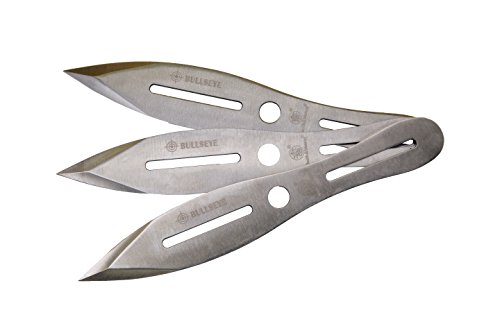
The Smith and Wesson Bullseye SWTK10CP is the pick for longer knives with a slower, steadier spin. The set includes three 10-inch knives in 2Cr13 stainless steel with a nylon belt sheath, and the listing states a limited lifetime warranty. The extra length makes the rotation easier to judge, which helps a beginner learn the timing of the release. It suits a thrower who has tried shorter knives and wants a longer blade that sticks with a more relaxed throw.
Which One Fits Your Situation
You Want to Master One Knife First
Choose the Cold Steel True Flight Thrower if you want to learn with a single, well-balanced knife. The 12-inch length and 9.7-ounce weight give a predictable spin, and the paracord grip stays secure while you build the habit of a clean release. The 5-millimetre blade thickness keeps the knife rigid in flight, and the included Cor-Ex sheath protects the point when the knife is carried or stored.
You Practice With Family or Friends
Choose the Perfect Point PP-060-9 if several people will throw together. Nine knives mean everyone gets turns without waiting at the target, and the short 6.25-inch length suits a close-range backyard setup. The red cord-wrapped handles make each knife easy to see on the ground, and the nylon sheath keeps all nine together between sessions.
You Want a Small Set to Carry Anywhere
Choose the Perfect Point RC-179-3 if the set must fit in a bag for camping or a trip. Three 8-inch knives with a belt sheath are easy to carry, and the one-piece steel construction survives being knocked around in transit. The skeleton handle keeps the set light, and the 3Cr13 stainless steel resists rust when the knives are used outdoors in damp weather.
You Want a Slower, Steadier Spin
Choose the Smith and Wesson Bullseye SWTK10CP if shorter knives spin too fast for you to read. The 10-inch length slows the rotation and makes the release timing easier to judge, which helps the knife stick more often. The 2Cr13 stainless steel construction stands up to repeated impacts, and the limited lifetime warranty backs the set for years of practice.
Common Mistakes
- Starting with a knife that is too light, then wondering why it will not fly straight or stick in the target, and blaming the throw instead of the tool.
- Throwing at a hardwood board or a tree, which dulls the point and bounces the knife back toward the thrower.
- Practising with people standing behind the target or to the sides, where a missed throw can land.
- Gripping the knife too tightly, which kills the release and sends the knife spinning off line.
- Buying a set with no sheath, then carrying loose knives in a bag where they can cut through fabric.
Frequently Asked Questions
How far should a beginner stand from the target?
Start close, at about one full rotation distance for your knife, which is usually a few paces for a beginner. Step back gradually as your throws start sticking, and mark the distance that works for each knife, because different lengths rotate at different rates. A tape mark on the ground keeps the distance consistent between sessions.
What kind of target should I use for throwing knives?
A softwood log round or a thick softwood board is the standard target, because the wood accepts the point without dulling it quickly. Avoid hardwood, metal, and trees, which can bounce a knife back or chip the point. Mount the target on a solid stand and replace the board when it is too chewed to hold a knife.
Do throwing knives need sharpening?
A throwing knife needs a point, not a razor edge, because the point is what sticks in the target. Keep the tip clean with a file, and do not grind a sharp edge along the blade. Carbon steel knives benefit from a light coat of oil to stop rust in damp weather.
Are throwing knives legal to own?
Laws differ by state and country, and some places restrict blade length, public carry, or throwing in public spaces. Check the rules where you live before ordering, and transport the knives in their sheath in a bag rather than loose in a pocket. Private land with a safe backstop is the usual place to practice.

Write Your Review
No reviews yet. Be the first to share your experience!