
The best kitchen knives for most home cooks are an 8-inch chef’s knife, a small paring knife and, if you prefer a shorter, flatter blade, a santoku. Our top picks are the Victorinox Fibrox Pro 8″ Chef’s Knife for value, the Wüsthof Classic 8″ Chef’s Knife for a forged German knife that lasts decades, and the Shun Premier 7″ Santoku for a premium Japanese-style blade. Buy those individually rather than in a big block set and you get better knives for the same money.
- Best Kitchen Knives: Quick Comparison
- 1. Victorinox Fibrox Pro 8″ Chef’s Knife: Best Chef Knife for Value
- 2. Wüsthof Classic 8″ Chef’s Knife: Best Forged German Chef’s Knife
- 3. ZWILLING Professional S 8″ Chef’s Knife: Best Balanced Heavyweight
- 4. Shun Premier 7″ Santoku: Best Premium Santoku
- 5. Mercer Culinary Genesis 7″ Santoku: Best Value Santoku
- 6. Victorinox Swiss Classic 3.25″ Paring Knife: Best Paring Knife for Value
- 7. Wüsthof Classic 3.5″ Paring Knife: Best Forged Paring Knife
- Also Consider
- Best Chef Knife vs Santoku vs Paring: Which Do You Need?
- Best Kitchen Knife Brands at a Glance
- Ownership Realities: What Wears and What It Costs Over Time
- Knife Safety Basics That Also Protect Your Edge
- How We Chose
- Buying Guide: How to Choose Kitchen Knives
- Which One Should You Buy?
- Frequently Asked Questions
- Sources
This guide is about choosing individual knives by type. It covers seven main picks across chef’s, santoku and paring knives, four more worth considering, a comparison of steel hardness and edge angles, and a buying guide with concrete sizes. If you are weighing a full block set instead, that is a different decision; the picks here focus on the individual blades that do most of the work.

Astercook Knife Set, 13 Pieces Kitchen Knives Set with Healthy Anti-Rust Coating, Dishwasher Safe, Stainless Steel Chef Knife Sets with 6 Blade Guards, Perfect Holiday Gifts for Kitchen
Included for 'Best Kitchen Knives: Chef, Santoku and Paring Picks' because the listing specifies 13 Pieces Kitchen Knives Set with Healthy Anti-Rust Coating and Dishwasher Safe, details this guide uses to compare options.
View on Amazon
Astercook Knife Set, 6-Piece Kitchen Knife Set with Block, High Carbon Stainless Steel Ultra Sharp Kitchen Knives, Wood Grain Handle, Dishwasher Safe Knife Block Set, Black, Kitchen Utility Knives
Included for 'Best Kitchen Knives: Chef, Santoku and Paring Picks' because the listing specifies 6-Piece Kitchen Knife Set with Block and High Carbon Stainless Steel Ultra Sharp Kitchen Knives, details this guide uses to compare options.
View on Amazon
Brewin Professional Kitchen Knives, 3PC Chef Knife Set Sharp Knives for Kitchen High Carbon Stainless Steel, Japanese Cooking Knife with Gift Box
Included for 'Best Kitchen Knives: Chef, Santoku and Paring Picks' because the listing specifies Japanese Cooking Knife with Gift Box, details this guide uses to compare options.
View on Amazon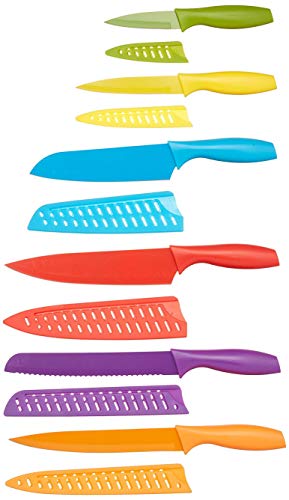
Amazon Basics Color-Coded Dishwasher Safe Kitchen Knife Set, 12-Piece with Ergonomic Handles, Non-stick Sharp Blades, 6 Knives with 6 Blade Guards, Multicolor, 13.88 x 4.13 x 1.38 inch
Included for 'Best Kitchen Knives: Chef, Santoku and Paring Picks' because the listing specifies 12-Piece with Ergonomic Handles and Non-stick Sharp Blades, details this guide uses to compare options.
View on AmazonKey takeaways
- Best chef’s knife for value: Victorinox Fibrox Pro 8″.
- Best forged German chef’s knife: Wüsthof Classic 8″.
- Best santoku: Shun Premier 7″ (premium) or Mercer Culinary Genesis 7″ (value).
- Best paring knife: Victorinox Swiss Classic 3.25″ for value, Wüsthof Classic 3.5″ for a forged option.
- German knives (about 56-58 HRC) are tougher and easier to maintain; Japanese knives (about 60-61 HRC) hold a finer edge longer but chip more easily.
Quick answer: For most people in 2026, the best kitchen knives is the Victorinox Fibrox Pro 8" Chef's — our #1 rated choice. See the full ranked comparison, alternatives and buying advice below.
Best Kitchen Knives: Quick Comparison
| Knife | Best for | Type | Blade | Build | Price tier |
|---|---|---|---|---|---|
| Victorinox Fibrox Pro 8″ Chef’s | Best value chef’s knife | Chef’s | 8 in stainless, about 56 HRC | Stamped, TPE handle | Budget |
| Wüsthof Classic 8″ Chef’s | Best forged German | Chef’s | 8 in X50CrMoV15, 58 HRC | Forged, full tang | Premium |
| ZWILLING Professional S 8″ | Best balanced heavyweight | Chef’s | 8 in ice-hardened stainless, about 57 HRC | Forged, full tang | Mid-premium |
| Shun Premier 7″ Santoku | Best premium santoku | Santoku | 7 in VG-MAX Damascus, about 61 HRC | Hammered finish, Pakkawood | Premium |
| Mercer Culinary Genesis 7″ Santoku | Best value santoku | Santoku | 7 in German steel, about 56 HRC | Forged, Santoprene handle | Budget-mid |
| Victorinox Swiss Classic 3.25″ Paring | Best value paring | Paring | 3.25 in stainless | Stamped, PP handle | Budget |
| Wüsthof Classic 3.5″ Paring | Best forged paring | Paring | 3.5 in X50CrMoV15, 58 HRC | Forged, full tang | Mid |
1. Victorinox Fibrox Pro 8″ Chef’s Knife: Best Chef Knife for Value
Spec line: 8-inch stamped stainless blade · textured TPE handle · NSF-certified
- Stamped high-carbon stainless steel, around 56 HRC
- Lightweight with a thin, sharp factory edge
- Non-slip Fibrox (TPE) handle that grips well when wet
- Made in Switzerland; widely used in culinary schools and commercial kitchens
- Dishwasher-safe per Victorinox, though hand-washing protects the edge
The Fibrox Pro has been a long-standing recommendation from cooking schools and food publications because it delivers most of what an expensive chef’s knife does at a fraction of the price tier. The blade is thinner than a forged German knife, so it glides through onions and carrots, and the light weight reduces fatigue in long prep sessions. It looks utilitarian, and it is.
Best for: new cooks, students, anyone replacing a dull hand-me-down knife.
Skip if: you want a heavy, forged knife with a bolster or a heirloom look.
Pros
- Outstanding value
- Light and agile
- Secure grip when wet
Cons
- Softer steel needs more frequent honing
- Plain plastic-feel handle
2. Wüsthof Classic 8″ Chef’s Knife: Best Forged German Chef’s Knife
Spec line: 8-inch forged X50CrMoV15 · 58 HRC · 14° per side PEtec edge
- Precision-forged from one piece of steel, full tang, triple-riveted handle
- 58 Rockwell hardness per Wüsthof
- Laser-controlled PEtec edge at 14° per side
- Bolster protects fingers and adds balance
- Made in Solingen, Germany
The Wüsthof Classic is the reference German chef’s knife. It has more heft than the Victorinox, which helps it power through squash and chicken joints, and its tough steel shrugs off the occasional bump against a pot. The full bolster makes it slower to sharpen near the heel, but it also gives a secure pinch grip. Many owners use the same Classic for decades.
Best for: home cooks who want one durable, heavier chef’s knife for everything.
Skip if: you prefer very light, thin Japanese-style blades.
Pros
- Very durable, forgiving steel
- Excellent balance and fit
- Long track record
Cons
- Premium price tier
- Full bolster complicates sharpening the heel
3. ZWILLING Professional S 8″ Chef’s Knife: Best Balanced Heavyweight
Spec line: 8-inch forged special-formula steel · FRIODUR ice-hardened · full tang
- Forged in ZWILLING’s company-owned German factory
- Ice-hardened blade for corrosion resistance and edge retention
- Traditional triple-rivet handle and full bolster
- About 57 HRC with an edge of roughly 15° per side, per ZWILLING
ZWILLING’s Professional S is the main rival to the Wüsthof Classic, and choosing between them mostly comes down to hand feel. The Pro S handle is slightly rounder and the balance point sits near the bolster, which many cooks find steady for rock-chopping. Steel performance is very similar.
Best for: cooks who like a substantial, balanced German knife.
Skip if: you want a lightweight knife.
Pros
- Excellent balance
- Durable ice-hardened steel
- Classic, comfortable handle
Cons
- Heavier than stamped knives
- Mid-premium price tier
4. Shun Premier 7″ Santoku: Best Premium Santoku
Spec line: 7-inch VG-MAX core · 68-layer Damascus cladding · hammered tsuchime finish
- VG-MAX steel core hardened to about 60-61 HRC, per Shun
- Hand-sharpened 16° edge per side
- Hammered finish helps food release from the blade
- Walnut-colored Pakkawood handle
- Made in Seki, Japan
A santoku has a shorter, flatter blade than a Western chef’s knife and a rounded “sheep’s foot” tip. It favors push-cuts and precise slicing over rocking. The Shun Premier is one of the best-known premium examples: very sharp out of the box, light in the hand and beautiful to look at. Harder steel holds its edge longer, but it is less forgiving; avoid twisting it through bones, frozen food or hard squash rinds.
Best for: precise vegetable work and cooks who enjoy fine Japanese knives.
Skip if: you are hard on knives or use a glass board.
Pros
- Exceptional sharpness and edge retention
- Light, agile and attractive
- Food release from hammered finish
Cons
- Harder edge can chip if misused
- Premium price tier; hand-wash only
5. Mercer Culinary Genesis 7″ Santoku: Best Value Santoku
Spec line: 7-inch forged German steel · Santoprene handle · NSF-certified
- High-carbon German steel, about 56 HRC, 15° edge, per Mercer’s Genesis specs
- Forged with a full tang
- Non-slip Santoprene handle tolerates oils and heat
- Granton or plain edge versions sold
Mercer is a staple in culinary schools, and the Genesis line offers forged construction at a lower price tier than the big German brands. The 7-inch santoku is a good fit for smaller hands or anyone who finds an 8-inch chef’s knife unwieldy. Its softer steel needs regular honing but resharpens easily.
Best for: value-minded cooks who want a forged santoku.
Skip if: you want the thin, very hard edge of a Japanese santoku.
Pros
- Forged and full tang at a lower tier
- Comfortable non-slip handle
- Easy to sharpen
Cons
- Edge needs frequent honing
- Handle style is utilitarian
6. Victorinox Swiss Classic 3.25″ Paring Knife: Best Paring Knife for Value
Spec line: 3.25-inch straight edge · spear point · polypropylene handle
- Thin stamped stainless blade for peeling and trimming
- Spear point for coring strawberries and tomatoes
- Lightweight ergonomic handle
- Low price tier makes it easy to own two
A paring knife handles the jobs a chef’s knife is too big for: peeling apples, hulling strawberries, deveining shrimp, trimming fat. This Victorinox is thin, sharp and cheap enough that you will not mind if it gets lost in a picnic basket. Many cooks keep one in the kitchen and one for travel.
Best for: every kitchen; a second paring knife for picnics.
Skip if: you want a forged paring knife with heft.
Pros
- Very sharp, thin blade
- Great value
- Light and nimble
Cons
- Short blade limits some tasks
- Lightweight handle feels basic
7. Wüsthof Classic 3.5″ Paring Knife: Best Forged Paring Knife
Spec line: 3.5-inch forged X50CrMoV15 · 58 HRC · full tang
- Same steel and edge as the Classic chef’s knife
- Triple-riveted, full-tang handle
- Stiffer blade suits trimming and in-hand cuts
- Matches other Classic knives if you build a collection
The forged Wüsthof paring knife feels more substantial than stamped models and holds its edge well. It suits cooks who do a lot of in-hand work like segmenting citrus or trimming Brussels sprouts and want a knife that matches their chef’s knife.
Best for: cooks building a matching set of quality knives.
Skip if: you want the cheapest effective paring knife.
Pros
- Durable forged construction
- Excellent edge retention for German steel
- Comfortable handle
Cons
- Higher price tier for a small knife
- Heavier than stamped paring knives
Also Consider
- HENCKELS Classic 8-Inch Chef Knife: fully forged · German-engineered · budget-mid tier. A forged chef’s knife for less than the premium German brands.
- Mercer Culinary Millennia 10-Inch Wide Wavy Edge Bread Knife: 10-inch serrated · non-slip handle · budget tier. The third knife most kitchens need, for crusty bread and tomatoes.
- imarku Santoku Knife 7 Inch: Japanese-style high-carbon stainless · hollow edge · budget-mid tier. A low-cost entry to santoku shapes.
- KAWAHIRO 8.27 Inch Japanese Chef Knife: hand-forged VG10 · gyuto profile · mid tier. A Japanese chef’s knife for cooks who want a harder, thinner 210 mm blade.
Best Chef Knife vs Santoku vs Paring: Which Do You Need?
| Knife | Typical length | Best tasks | Cutting style |
|---|---|---|---|
| Chef’s knife (Western) | 8 in (6-10 in range) | Chopping, mincing, slicing meat, breaking down chicken | Rocking and push-cuts |
| Santoku | 5-7 in | Vegetables, boneless proteins, thin slicing | Push-cuts, up-and-down chopping |
| Gyuto (Japanese chef’s) | 210-240 mm (8.25-9.5 in) | Same as chef’s knife, with a thinner blade | Push-cuts and light rocking |
| Paring knife | 3-4 in | Peeling, trimming, coring, in-hand cuts | Detail work |
| Bread knife | 8-10 in | Crusty bread, tomatoes, cake layers | Sawing |
| Utility knife | 5-6 in | Sandwiches, small fruit, cheese | Slicing |
Most home cooks need only three: a chef’s knife or santoku, a paring knife and a bread knife. Choose a chef’s knife if you like rocking through herbs and want one blade for everything including poultry. Choose a santoku if you mainly cut vegetables with a straight up-and-down motion or have smaller hands.
A few specialist shapes are worth knowing about once the basics are covered. A nakiri has a flat, rectangular blade built purely for vegetables and makes very even slices with a straight up-and-down motion. A boning knife has a narrow, sometimes flexible blade for working around joints and removing silver skin. A slicing or carving knife has a long, narrow blade for roasts and brisket. None is essential for a typical home kitchen, but each makes one job noticeably easier if you do it every week.
Best Kitchen Knife Brands at a Glance
| Brand | Origin | Typical hardness | Known for |
|---|---|---|---|
| Wüsthof | Solingen, Germany | About 58 HRC | Forged Classic line, durability |
| ZWILLING / HENCKELS | Germany (ZWILLING); global (HENCKELS) | About 57 HRC | Ice-hardened forged knives; value lines under HENCKELS |
| Victorinox | Switzerland | About 56 HRC | Light, stamped professional knives at low cost |
| Mercer Culinary | US brand | About 56 HRC | Culinary-school knives, strong value |
| Shun | Seki, Japan | About 60-61 HRC | Damascus-clad premium Japanese knives |
| Global, MAC, Tojiro | Japan | About 58-61 HRC | Thin, light Japanese blades |
Ownership Realities: What Wears and What It Costs Over Time
Knives are one of the few kitchen tools that can last a lifetime, but only if you understand what wears.
- The edge is a consumable. Every sharpening removes a little steel. A home cook who sharpens twice a year will not wear out a chef’s knife for decades, but aggressive pull-through sharpeners remove far more metal than stones or a professional service.
- Tips break first. The thin tip is the most fragile part, especially on harder Japanese steel. Most tip damage comes from prying, dropping or using the knife as a can opener. Small chips can be ground out during sharpening.
- Handles fail from water. Wood and Pakkawood handles can crack or loosen after repeated soaking or dishwasher cycles. Synthetic handles like Fibrox and Santoprene tolerate abuse better.
- Rust spots appear on neglected edges. Even stainless steel can spot if left wet with acidic food on it. Wipe the blade after cutting tomatoes, citrus or onions.
A quick cost-per-year example
Suppose a budget stamped chef’s knife costs one unit of money and a premium forged knife costs about four units. If the budget knife is replaced after five years because the handle cracks or the blade is ground down, it costs 0.2 units per year. If the forged knife lasts 25 years with sensible care, it costs about 0.16 units per year. The premium knife is not automatically cheaper over time, but it can be when it is well maintained. The real savings come from not buying a large set of knives you never use.
Knife Safety Basics That Also Protect Your Edge
- Use a pinch grip and curl the fingertips of your guiding hand into a “claw” so knuckles, not fingertips, face the blade.
- Stabilize round foods by cutting a flat side first.
- Put a damp towel under the board so it cannot slide.
- Scrape food off the board with the spine of the knife, not the edge.
- Never try to catch a falling knife; step back and let it drop.
A sharp knife is safer than a dull one because it needs less force and is less likely to skid off the skin of a tomato or onion.
How We Chose
We did not personally use these knives. We researched widely sold kitchen knives from established makers, compared published specifications (steel type, Rockwell hardness, edge angle, forged versus stamped construction, handle material), and considered long-standing recommendations from culinary schools and food publications. We favored knives with consistent manufacturing, replacement and sharpening support, and a clear use case, and we limited the list to two knives per brand while covering chef’s, santoku and paring types at different price tiers.
Buying Guide: How to Choose Kitchen Knives
Start with length
An 8-inch chef’s knife suits most cooks. Go down to 6-7 inches (or a 7-inch santoku) if you have smaller hands, a small cutting board or a cramped counter. Consider 9.5-10 inches only if you regularly cut large melons or big roasts and have a board at least 18 inches long.
Understand steel hardness
Rockwell hardness (HRC) tells you how a blade balances edge retention and toughness. Knives around 56-58 HRC (most German and Swiss knives) are tough, easy to hone and forgiving of bumps. Knives around 60-63 HRC (most Japanese knives) hold a sharper edge longer but are more brittle and prone to chipping. If you are rough on knives or use the dishwasher, stay in the 56-58 range.
Edge angle
Western knives are commonly sharpened at about 14-20° per side; Japanese knives at about 10-16°. A smaller angle cuts more easily but needs more care. If you will use a pull-through sharpener, make sure it matches your knife’s angle.
Forged or stamped
Forged knives are shaped from a heated steel blank and usually have a bolster and more weight. Stamped knives are cut from sheet steel, lighter and less costly. Performance depends more on steel, heat treatment and edge geometry than on forging; the Victorinox Fibrox Pro is stamped and widely praised.
Handle and balance
Hold the knife in a pinch grip (thumb and index finger on the blade just ahead of the handle). The handle should fill your hand without pressure points, and the knife should feel balanced near the bolster or heel. Textured synthetic handles grip better when wet; wood and Pakkawood look nicer but need hand-washing.
Weight
Light knives (stamped or Japanese) reduce fatigue and feel precise. Heavier forged knives power through dense food. Neither is better; choose based on what you cut most.
Budget sensibly
One excellent chef’s knife plus an inexpensive paring and bread knife beats a large set of mediocre blades. Spend most of your budget on the chef’s knife or santoku you will use every day.
Left-handed cooks
Most Western knives, including every chef’s knife and santoku on this list, have symmetric double-bevel edges that work equally well for left- and right-handed cooks. Some Japanese knives use asymmetric or single-bevel edges that favor one hand; if you are left-handed, confirm the edge is symmetric or that a left-handed version is offered. Handles matter too: D-shaped handles like Shun’s are often made in left-hand versions.
Check the return policy and warranty
Hand feel is personal, and a knife that looks perfect online can feel too heavy or too light in practice. Buy from a retailer with a straightforward return window and check the maker’s warranty. Wüsthof, ZWILLING, Victorinox, Mercer and Shun all offer warranties against manufacturing defects, and Shun also offers a sharpening service for its knives. Keep the box and avoid using the knife on hard foods until you are sure you will keep it.
Plan for maintenance
Hone with a steel or ceramic rod weekly, sharpen once or twice a year (or when a tomato skin resists), hand-wash and dry immediately, and store knives in a block, on a magnetic strip or in edge guards rather than loose in a drawer. Cut on wood or rubber boards; glass, stone and metal boards dull edges fast.
Which One Should You Buy?
- Best chef knife on a budget: Victorinox Fibrox Pro 8″.
- Best chef knife to keep for decades: Wüsthof Classic 8″.
- Prefer a heavier balanced knife: ZWILLING Professional S 8″.
- Vegetable-focused or smaller hands: Mercer Culinary Genesis 7″ Santoku.
- Premium Japanese experience: Shun Premier 7″ Santoku.
- Every kitchen’s second knife: Victorinox Swiss Classic 3.25″ Paring.
Frequently Asked Questions
What is the best chef knife for home cooks?
For most home cooks, the Victorinox Fibrox Pro 8″ offers the best mix of sharpness, comfort and value. If you want a forged knife that lasts decades, the Wüsthof Classic 8″ is the standard choice.
Is a santoku better than a chef’s knife?
Neither is better overall. A santoku is shorter and flatter, suited to push-cutting vegetables; a chef’s knife has a curved belly for rocking and handles a wider range of tasks including poultry.
Are Japanese knives better than German knives?
Japanese knives are usually harder and thinner, so they take and hold a finer edge. German knives are tougher, heavier and easier to maintain. Your cutting style and care habits should decide.
How many kitchen knives do I really need?
Three cover nearly everything: a chef’s knife or santoku, a paring knife and a serrated bread knife. Add a boning or utility knife only if you regularly need one.
Can I put good kitchen knives in the dishwasher?
It is best not to. Dishwasher heat, detergent and rattling dull edges and can damage handles. Hand-wash and dry knives right after use.
How often should I sharpen my kitchen knives?
Hone weekly with a rod to realign the edge, and sharpen with stones or a quality sharpener every 6-12 months for typical home use, or whenever honing no longer restores the edge.
What are the best kitchen knife brands?
Wüsthof, ZWILLING, Victorinox and Mercer Culinary are standouts for Western-style knives, while Shun, Global, MAC and Tojiro are well-regarded Japanese makers. Each brand offers lines at several price tiers.
Sources
Manufacturer specifications from Victorinox, Wüsthof, ZWILLING, Shun and Mercer Culinary; culinary school equipment recommendations; published knife steel hardness and edge angle references.
Last updated: October 2026
Ready to decide? Our #1 pick for 2026 is the Victorinox Fibrox Pro 8" Chef's.
Live price & availability on Amazon.

Write Your Review
No reviews yet. Be the first to share your experience!