
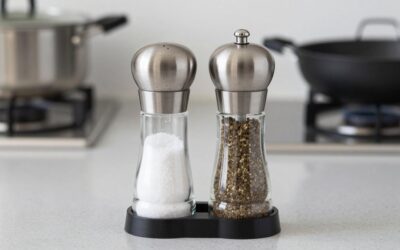
The best electric pepper mill for most kitchens is a rechargeable model with a ceramic mechanism, 40–60 g hopper, adjustable grind dial, and a one-handed trigger or tilt sensor; choose a battery-powered steel model instead if you value lower upfront cost and easy replacement batteries.
Quick picks by kitchen situation
| Situation | Best choice | Why it fits |
|---|---|---|
| Frequent cooking and table use | Rechargeable ceramic mill | Low ongoing battery cost, corrosion resistance, and easy one-hand operation |
| Lowest purchase cost | AA- or AAA-powered steel mill | Usually cheaper and immediately usable with standard batteries |
| Coarse-crust steak or finishing salt | High-torque mill with a wide ceramic burr | Less stalling and more consistent large particles |
| Small kitchen or shallow cabinets | Compact mill under 18 cm tall | Less countertop and storage space; typically holds 20–30 g |
| Limited grip strength or busy cooking | Tilt-activated rechargeable mill | Dispenses while tilted, leaving the other hand free |
What separates the best electric pepper mills
An electric motor makes grinding easier, but it does not automatically make a mill better. The useful differences are the burr material, adjustment system, power design, hopper size, and dispensing control. A good mill should produce a recognizable change from fine pepper for sauces to coarse pepper for a crust, without requiring two hands or constant disassembly.
Grind-size adjustment: dial control beats vague presets
Look for a numbered or clearly detented dial with at least five useful settings. “Fine” and “coarse” alone are difficult to reproduce. A dial with roughly 10–15 positions is more useful when a recipe calls for a particular texture, although the number of positions matters less than whether the mechanism changes consistently.
Adjust the grind while the mill is running or nearly empty if the instructions recommend it. Turning a tightly loaded burr can force peppercorns into the grinding teeth and make the adjustment feel stuck. For everyday cooking, a range from about 0.3 mm fine particles to 1.5 mm coarse particles covers most uses. Exact particle size varies by peppercorn shape and mechanism.
Ceramic versus steel mechanisms
| Mechanism | Strengths | Trade-offs | Best for |
|---|---|---|---|
| Ceramic | Resists rust, handles salt better, generally neutral in flavor | Can chip if dropped; inexpensive designs may grind slowly | Pepper and salt in the same household, humid kitchens |
| Stainless steel | Strong, often fast, and widely available | Can corrode if exposed to moisture or stored with damp salt | Dry peppercorns and users who prioritize speed |
| Carbon steel | Can provide a sharp, durable grinding edge | More vulnerable to moisture and requires careful storage | Dry-use pepper mills with good maintenance habits |
For pepper alone, a quality steel mechanism can be excellent. Ceramic is the safer all-purpose recommendation because pepper mills are often used near steam, wet hands, and salt. Do not assume a ceramic burr makes a mill suitable for wet salt: check whether the manufacturer specifically permits salt, and keep the hopper dry.
Battery or rechargeable power?
Battery-powered mills are convenient when you want to replace a depleted cell in seconds. They are also easier to keep in a drawer for occasional use. The disadvantages are recurring battery purchases, extra weight at the top, and declining performance as disposable batteries lose voltage.
Rechargeable models reduce waste and usually maintain more consistent motor speed until the charge is low. Their weak points are charging time, a proprietary battery or cable, and eventual battery aging. A USB-C port is preferable to a specialized charging cradle because replacement cables are easier to find.
For a rough ownership calculation, suppose a rechargeable mill costs $45–$80 more than a basic battery model and is used twice daily. Over five years, that is approximately 3,650 grinding sessions. Even a $60 price difference works out to about 1.6 cents per session before electricity. If you use the mill only a few times per month, the simpler battery model may be the more rational purchase.
Runtime and motor behavior
Published runtime is often measured in short bursts rather than continuous grinding. A practical target is at least 30 minutes of cumulative motor operation per charge for a rechargeable model, or several months of normal household use from a set of batteries. More important than headline runtime is whether the motor stalls on coarse settings. A high-torque motor, a properly aligned burr, and a hopper that is not overfilled matter more than speed alone.
Hopper capacity, size, and balance
A larger hopper is not always an advantage. Peppercorns gradually lose aroma after grinding, and a full hopper makes a tall mill heavier. For one or two people, 20–30 g is usually enough for several weeks. A family cooking frequently may prefer 40–60 g. Capacities above roughly 70 g are useful for entertaining but add weight and encourage long-term storage.
| Mill size | Typical capacity | Typical loaded weight | Best use |
|---|---|---|---|
| 15–18 cm | 20–30 g | 250–400 g | Small counters, occasional use |
| 18–23 cm | 35–60 g | 400–650 g | Most home kitchens |
| 24 cm or taller | 60–90 g | 600–900 g | Frequent cooking or serving at a large table |
Check the diameter as well as height. A narrow, tall mill can fit beside a cooker but may tip more easily. A wide base and a low center of gravity are valuable if the mill will be used by children, older cooks, or anyone with a less secure grip.
One-hand usability: the detail that matters most
There are three common controls: a push button, a squeeze trigger, and a tilt sensor. A push button offers the most deliberate control but may require two hands if the button is on top. A side trigger is usually the best compromise: hold the mill over the food and press with one finger. Tilt activation is the fastest for repeated seasoning, but it can dispense accidentally when the mill is moved or stored.
Before buying, check whether the control can be operated with the hand holding the mill, whether the opening points downward without twisting the wrist, and whether a light illuminates the food rather than the countertop. A removable base or cap is also useful because it catches residual pepper dust between uses.
Durability and maintenance realities
- What usually wears first is the burr adjustment, motor gear, or rechargeable battery—not the clear hopper. Avoid forcing the dial past its stops.
- Keep peppercorns dry and remove empty husks or foreign objects before refilling. Small stones can damage ceramic and steel mechanisms.
- Do not wash the motor body or immerse the hopper unless it is explicitly dishwasher-safe. Wipe the exterior with a damp cloth and dry it immediately.
- To clear stale particles, run the empty mill for a few seconds, then brush the opening with a dry, soft brush. Water inside the burr assembly can cause clumping.
- Fill only to the marked line. An overfilled hopper increases resistance and can make a modest motor sound as if it is failing.
- Store the mill upright and away from steam. If using salt, choose a model rated for salt and clean the mechanism according to its instructions.
How to choose without overbuying
For most buyers, prioritize a ceramic burr, a side button or reliable tilt control, a 35–60 g hopper, and a clearly marked grind dial. Choose rechargeable power when the mill will be used daily; choose replaceable batteries for occasional use or emergency convenience. Spend more on the mechanism, adjustment precision, and comfortable balance rather than decorative metal or an oversized reservoir.
The best electric pepper mill is therefore the one whose controls match your cooking rhythm. A compact rechargeable ceramic model is the strongest general choice, while a cheaper battery model remains sensible for light use. If you regularly grind coarse pepper, inspect torque and burr construction first; if you season while stirring or serving, make one-hand operation the deciding feature.
Write Your Review
No reviews yet. Be the first to share your experience!