
Work Sharp’s Precision Adjust Elite knife sharpener vs SHARPAL 202H: the SHARPAL 202H is the better fit for thin Japanese blades and polished edges, because it reaches 10° per side and finishes on 3000 and 6000 grit whetstones, while the Work Sharp Precision Adjust Elite is the better value for Western kitchen and pocket knives, with a 15° to 30° dial and a ceramic serration rod. Both are guided systems that remove the guesswork of freehand sharpening.
- Quick Verdict
- SHARPAL 202H vs Work Sharp Precision Adjust Elite: Specs Side by Side
- SHARPAL 202H vs Work Sharp Precision Adjust Elite: Verified Spec Sheet
- What Comes in the Box: Abrasive Kits Compared
- Angle Range Explained: Which Knives Need Which Angle
- Where the SHARPAL 202H Wins
- Where the Work Sharp Precision Adjust Elite Wins
- Build, Clamping and Setup Compared
- What a Typical Sharpening Session Looks Like on Either System
- SHARPAL 202H vs Work Sharp Precision Adjust Elite Review: What Published Sources Agree On
- How We Compared the SHARPAL 202H and Work Sharp Precision Adjust Elite
- Real-World Use: Which One Fits You
- Maintenance, Replacement Abrasives and Long-Term Cost
- Alternatives If Neither Fits
- Best Guided Knife Sharpener by Budget: Where These Two Fit
- Price and Value
- Final Recommendation
- Frequently Asked Questions
This comparison is research-based: it draws on the makers’ published specifications, independent buying guides and owner discussions rather than our own sharpening trials. The real differences come down to angle flexibility, hardware stability and how many distinct grits you get out of the box. Both aim to eliminate the guesswork of manual bevel matching, but they take different approaches to edge reprofiling and daily touch-ups.

SHARPAL 202H Precision Knife Sharpening System, Adjustable Angle 10–35°
Included for 'SHARPAL 202H Precision Knife Sharpening System vs Work Sharp Precision Adjust Elite Knife: Which Should You Buy?' as a representative home product in this roundup; selection reflects the product set returned for this topic.
View on Amazon
Work Sharp Precision Adjust Elite Knife Sharpener
Included for 'SHARPAL 202H Precision Knife Sharpening System vs Work Sharp Precision Adjust Elite Knife: Which Should You Buy?' as a representative home product in this roundup; selection reflects the product set returned for this topic.
View on AmazonUpdated October 2026 — SHARPAL 202H vs Work Sharp Precision Adjust Elite, in short: buy the SHARPAL 202H if you sharpen thin Japanese kitchen knives or want a mirror polish, because it reaches 10° per side and finishes on 3000 and 6000 grit stones. Buy the Work Sharp Precision Adjust Elite if you want a lighter, quicker kit for Western kitchen and pocket knives that also handles serrations, at a lower price.
- Angle range: SHARPAL 202H 10° to 35° per side · Work Sharp Elite 15° to 30° in 1° steps
- Abrasives: SHARPAL 7 plates (diamond 220/325/600/1000, whetstone 3000/6000, leather strop) · Work Sharp diamond 220/320/400/600/800, fine ceramic, strop, ceramic serration rod
- Build: SHARPAL all-metal, about 9 to 10 lb, blades up to 22 inches · Work Sharp lighter Precision Adjust platform with V-block clamp
Quick Verdict
Buy the SHARPAL 202H if you regularly sharpen delicate Asian kitchen knives or heavy cleavers that demand extreme edge angles between 10 and 35 degrees. Buy the Work Sharp Precision Adjust Elite if you want an all-in-one guided system tailored for everyday kitchen and pocket knife maintenance at a more accessible price point.
SHARPAL 202H vs Work Sharp Precision Adjust Elite: Specs Side by Side
| Feature | SHARPAL 202H | Work Sharp Precision Adjust Elite |
|---|---|---|
| System type | Precision knife sharpening system (bench-mount guided clamp) | Adjustable-angle guided knife sharpening system (dial) |
| Price tier | Check price | Check price |
| Minimum Sharpening Angle | 10° per side | 15° per side |
| Maximum Sharpening Angle | 35° per side (30° on blades wider than about 70 mm) | 30° per side |
| Adjustable Angle Range | 10–35°, set with distance-based A and B scales | 15–30° in 1° steps |
| Abrasive Progression / Grits | 7 plates: diamond 220/325/600/1000, whetstone 3000/6000, leather strop | Diamond 220/320/400/600/800, fine ceramic, leather strop, ceramic serration rod |
| Target Blade Types | Straight-edge precision cutlery, thin Japanese knives, cleavers and outdoor blades | Kitchen, pocket and hunting knives, including serrated edges |
| Base and Clamp Mechanism | Dual sliding clamps on an all-metal bench base | V-block clamp on a lighter guided chassis |
| Carrying / Storage Case | Carry case included | Carry case included |
SHARPAL 202H vs Work Sharp Precision Adjust Elite: Verified Spec Sheet
The table below fills the gaps in the quick spec table above using each maker’s published specifications and current product listings. Where a maker does not publish a figure, the cell says so rather than guessing.
| Spec | SHARPAL 202H | Work Sharp Precision Adjust Elite |
|---|---|---|
| How the angle is set | Distance-based: fixed edge-to-clamp distance with an A scale (blades 15-70 mm wide, 10° to 35°) and a B scale (blades 70-110 mm wide, 10° to 30°) | Angle dial on the chassis, 1° increments |
| Abrasives in the box | 7: diamond 220, 325, 600, 1000; whetstone 3000, 6000; leather strop with 2 oz green compound | Diamond 220, 320, 400, 600, 800; fine ceramic; leather strop; ceramic rod for serrations |
| Finest finishing step | 6000 grit whetstone, then strop | Fine ceramic, then strop |
| Serrated blades | No serration tool listed; built for straight edges | Yes, ceramic serration rod included |
| Clamp | Dual sliding clamps; flip mechanism keeps the same angle on both sides | V-block clamp on a rotating base; flip without unclamping |
| Blade capacity | Length up to 22 in (560 mm); thickness up to 0.28 in (7 mm); width 0.30 in (7.5 mm) and up | Not published as a single figure; long blades are sharpened in sections |
| Frame and weight | All-metal (aluminum alloy and stainless steel), about 4.1 to 4.4 kg / 9 to 10 lb depending on the listing | Original Precision Adjust platform; lighter, no metal frame or digital angle indicator |
| Water or oil | Water for the 3000/6000 whetstones (squeeze bottle included); diamonds can run dry | Runs dry |
| Extras in the box | Carry case, cleaning brush, hex wrench, masking tape, marker pen | Carry case |
Two practical takeaways. First, the SHARPAL’s 10° floor only matters if you own knives ground that thin, but its distance-based setting also means the angle stays accurate on wide blades such as cleavers and nakiri, as long as you use the correct scale. Second, the Work Sharp’s serration rod is the one capability the SHARPAL kit lacks entirely, so bread-knife owners should weigh that before choosing on angle range alone.
What Comes in the Box: Abrasive Kits Compared
The spec sheet above already lists every abrasive in each kit. What matters is how those grits are spread across the coarse-to-polish range, and that says a lot about who each system is built for.
The pattern is clear. Work Sharp spreads its abrasives across the coarse-to-fine middle of the range, with five diamond steps between 220 and 800 grit, which makes it efficient at repairing and refreshing working edges. SHARPAL takes fewer steps through the diamond range but goes much further at the top end, with 3000 and 6000 grit whetstones that push an edge toward a mirror polish. That top-end finish is exactly what thin, hard Japanese blades reward.
Grit progression in plain terms
- 220 to 325 grit: reprofiling, chip repair and setting a new bevel angle. Use sparingly; it removes metal quickly.
- 400 to 600 grit: the everyday workhorse for a dull but undamaged edge. Most touch-ups start here.
- 800 to 1000 grit: refines the scratch pattern and produces a clean, toothy working edge that bites into tomato skins.
- 3000 to 6000 grit: polishing. The edge becomes smoother and keener for push cuts, slicing fish or fine vegetable work.
- Leather strop: removes the last microscopic burr and is the quickest way to bring a slightly dull edge back between full sessions.
Angle Range Explained: Which Knives Need Which Angle
The single biggest spec difference between these two systems is the bottom of the angle range: 10° on the SHARPAL versus 15° on the Work Sharp. Whether that matters depends entirely on the knives in your drawer.
| Knife type | Typical angle per side | SHARPAL 202H | Work Sharp Elite |
|---|---|---|---|
| Thin Japanese slicers and some gyutos | 10° to 12° | Yes | No (15° minimum) |
| Japanese santoku and gyuto | 12° to 15° | Yes | At 15° only |
| Western chef and paring knives | 15° to 20° | Yes | Yes |
| Pocket and everyday-carry folders | 20° to 25° | Yes | Yes |
| Hunting and outdoor fixed blades | 25° to 30° | Yes | Yes |
| Cleavers, choppers and heavy-use tools | 30° to 35° | Yes (35° only on blades up to about 70 mm wide; 30° on wider ones) | Up to 30° |
If every knife you own falls between 15° and 30°, the extra range on the SHARPAL is insurance you may never use. If you own even one knife designed for a 10° to 12° edge, the Work Sharp simply cannot reproduce its factory geometry; you would be sharpening it more obtusely than intended, which costs some of that knife’s cutting performance.
Where the SHARPAL 202H Wins
- Wider Angle Customization: With a published range of 10 to 35 degrees per side, the SHARPAL easily accommodates ultra-acute Japanese kitchen edges down to 10° as well as durable, obtuse outdoor blades up to 35°, offering superior versatility for extreme edge profiles.
- Heavy-Duty Stability: The robust construction provides a rock-solid platform that minimizes rod flex during aggressive bevel resetting, ensuring your angle stays true across the entire sweep of the blade.
- Precision for High-End Cutlery: Its ability to hold very low sharpening angles makes it the superior choice for serious home chefs working with premium high-hardness steel blades that thrive on acute bevels.
Where the Work Sharp Precision Adjust Elite Wins
- Streamlined Pocket and Kitchen Knife Workflow: Designed explicitly for standard everyday carry folders and common kitchen knives, the Elite package provides an intuitive, user-friendly process that gets working knives sharp without fuss.
- Compact Bench Footprint: The Work Sharp chassis takes up minimal counter space, making it easy to store in a standard kitchen drawer and pull out for fast, routine touch-up sessions.
Build, Clamping and Setup Compared
Angle range and grits get the attention, but the frame and clamp decide whether a guided system actually holds the angle you set. A rod or handle that flexes, or a blade that shifts in the clamp mid-stroke, turns a precise 15° setting into a rounded 15°-ish edge.
SHARPAL 202H: heavier platform, more setup choices
SHARPAL builds the 202H as a heavy, metal-based bench unit, and that mass is its quiet advantage. A heavier base stays put on the counter while you work long strokes, and it helps when you are pushing a coarse plate hard to reset a damaged bevel. The trade-off is that there are more adjustments to learn. Reviewers commonly note that the blade-flipping process takes a few sessions to become second nature, and that SHARPAL’s angle settings do not map one-to-one with other systems, so do not assume a setting copied from another brand’s chart will match.
Work Sharp Precision Adjust Elite: lighter, faster to start
The Elite is built on the same platform as Work Sharp’s standard Precision Adjust: a V-block style clamp, an angle-adjustable chassis and a rotating abrasive handle. The Elite adds the expanded abrasive set, strop, serration rod and case, but not the heavier metal frame or digital angle indicator found on Work Sharp’s more expensive Professional line. In practice, that means it is quick to clamp a knife and get going, and it stores easily, but some users find the base on the light side when they bear down hard, and longer chef’s knives usually need to be sharpened in sections.
Which build suits which user
- You sharpen a few kitchen knives every month or two: the Work Sharp’s quick setup matters more than extra rigidity.
- You reprofile, repair chips or sharpen hard steels often: the SHARPAL’s heavier platform is worth the slightly longer learning curve.
- You sharpen at a small counter or share the kitchen: the Work Sharp’s smaller footprint is easier to set up and put away.
What a Typical Sharpening Session Looks Like on Either System
The workflow is nearly identical on both, and knowing it in advance takes most of the intimidation out of a guided sharpener.
- Clamp the blade roughly at its balance point so it sits level and does not pivot. Protect a polished finish with painter’s tape.
- Color the edge bevel with a permanent marker. This is the easiest way to confirm your angle: a few light passes should remove the ink evenly from shoulder to edge.
- Set the angle. Match the existing bevel for a touch-up, or pick a new angle if you are reprofiling.
- Start with the coarsest grit you actually need. For a dull but undamaged knife that is usually the 400 to 600 range, not 220.
- Work until you raise a burr along the full length of the edge on the opposite side, then flip and repeat.
- Step through finer grits with progressively lighter pressure and fewer strokes.
- Finish on the strop with edge-trailing strokes only, then check the edge on paper or a tomato.
Expect a first session on a very dull knife to take longer than you think while you learn the system. Routine touch-ups after that are much quicker because you are only refreshing an edge you already set.
SHARPAL 202H vs Work Sharp Precision Adjust Elite Review: What Published Sources Agree On
Across the makers’ pages, buying guides and owner discussions, the same points keep coming up for each system. None of this replaces your own sharpening, but it shows where the two kits are consistently praised or criticized.
SHARPAL 202H review points
- Owners describe the all-metal frame as rigid, with no noticeable flex even when reprofiling a damaged edge.
- The 10° to 35° range and the 3000 and 6000 grit whetstones are the features most often cited as reasons to choose it.
- The blade-flip routine and the A and B distance scales take a few sessions to learn, and its angle settings do not map one-to-one to other brands.
- Reviewers say the strop is the weakest part of the kit, and there is no serration tool.
Work Sharp Precision Adjust Elite review points
- The V-block clamp, 1° dial and ceramic serration rod make it quick to start and versatile across kitchen and pocket knives.
- Criticisms center on the light base under hard pressure and the 15° minimum angle; longer chef’s knives are sharpened in sections.
Put together, the sources point the same way as the spec sheets: the SHARPAL 202H for rigidity, low angles and polish, the Work Sharp Precision Adjust Elite for price, simplicity and serrations.
How We Compared the SHARPAL 202H and Work Sharp Precision Adjust Elite
This comparison is research-based. We built it from:
- Maker specifications: SHARPAL’s published angle range, scale system, blade capacity and kit list for the 202H, and Work Sharp’s published angle range, increments and abrasive set for the Precision Adjust Elite.
- Independent reviews and buying guides from outdoor and kitchen publications that rate guided sharpeners, including where they place each system within the wider market.
- Owner discussions in sharpening forums, used to identify recurring points such as the SHARPAL’s learning curve and the Elite’s light base.
- Standard edge-angle guidance for Japanese, Western and outdoor knives, used to map each system’s angle range to real knife types.
We weighted angle range and finishing grits most heavily because they decide which knives each system can sharpen correctly; build, setup speed and price came next. Where the two makers describe the same feature differently, we used the more specific published figure.
Real-World Use: Which One Fits You
Scenario 1: Sharpening Specialty Japanese Cutlery
If your block is filled with high-carbon santokus and gyutos that require acute 12-to-15-degree cutting edges, choose the SHARPAL 202H. Its stated 10-degree minimum gives you the exact clearance needed to sharpen thin, hard blades without scratching the primary bevel.
Scenario 2: Maintaining an Everyday Pocket Knife Collection
If you primarily carry folding knives and need to repair working edges, hone EDC blades, and strop them back to hair-whittling sharpness, choose the Work Sharp Precision Adjust Elite. It handles standard folder geometries comfortably and provides a complete multi-abrasive progression right out of the box.
Scenario 3: Equipping a Modern 2026 Home Kitchen
If you want a dependable, set-it-and-forget-it sharpener that any family member can use to keep standard Western chef knives, paring blades, and utility knives shaving-sharp, choose the Work Sharp Precision Adjust Elite for its simplicity, value, and dedicated kitchen-knife friendly setup.
Maintenance, Replacement Abrasives and Long-Term Cost
The purchase price is only part of the cost of a guided sharpener. Abrasives wear, and how easy they are to clean and replace affects what you spend over the years.
- Diamond plates: on both systems, these do most of the work and wear gradually. Clean them with a soft brush and a little water or a dedicated abrasive eraser so metal filings do not clog the surface. Avoid pressing hard on fresh diamond plates; pressure strips diamonds faster than it sharpens.
- Finishing whetstones (SHARPAL): the 3000 and 6000 grit stones are the parts that need the most care. Follow SHARPAL’s instructions for preparing and cleaning them, keep them flat, and store them dry in the case.
- Ceramic and strop (both): ceramics rarely wear out but can load up with metal; a quick scrub restores them. Leather strops last for years with an occasional fresh coat of compound.
- Replacements: Work Sharp sells upgrade and replacement abrasive kits for its Precision Adjust family, which is convenient if you wear out one grit early. Check availability of individual SHARPAL plates before you buy if you plan to sharpen heavily.
Who should skip both
A guided bench sharpener is overkill if you only own two or three inexpensive kitchen knives and want them sharp in under a minute. A quality pull-through or electric sharpener is faster for that job. At the other end, if you already freehand on whetstones confidently, a guided system mainly adds consistency rather than new capability. Both of these systems shine for the person in the middle: someone with a mixed collection who wants repeatable, near-professional edges without years of freehand practice.
Alternatives If Neither Fits
Work Sharp Precision Adjust Knife Sharpener — Best Budget Guided Alternative
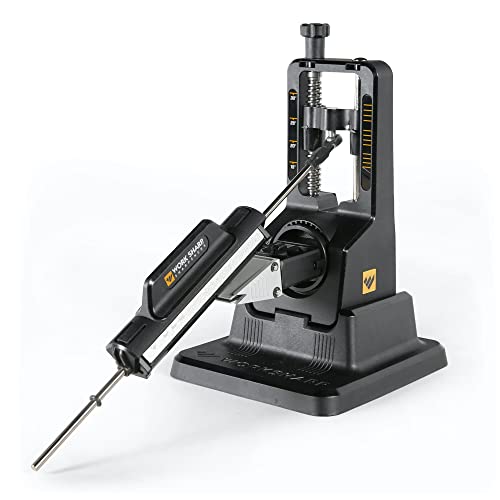
Work Sharp Precision Adjust Knife Sharpener Kit, Fixed Angle System
Included for 'SHARPAL 202H Precision Knife Sharpening System vs Work Sharp Precision Adjust Elite Knife: Which Should You Buy?' as a representative home product in this roundup; selection reflects the product set returned for this topic.
View on AmazonIt keeps the 15° to 30° angle adjustment and the V-block clamp, but ships with a simpler Tri-Brasive handle carrying 320 and 600 grit diamond plus a fine ceramic. That is enough to maintain most kitchen and pocket knives, and you can add Work Sharp’s upgrade abrasives later if you outgrow it.
Pros
- Same 15° to 30° guided system as the Elite at a lower cost
- Three-grit handle covers routine maintenance
- Upgrade path to more abrasives later
Cons
- No strop, serration rod or case in the base kit
- Same 15° minimum and lighter frame as the Elite
XARILK GEN3 Guided Knife Sharpening System — Best Metal-Frame Alternative Under the SHARPAL

XARILK GEN3 Guided Knife Sharpening System, Aluminum Alloy
Included for 'SHARPAL 202H Precision Knife Sharpening System vs Work Sharp Precision Adjust Elite Knife: Which Should You Buy?' as a representative home product in this roundup; selection reflects the product set returned for this topic.
View on AmazonRod-guided designs like this let you swap stones on a guide rod and are popular with people who want to experiment with different abrasives over time.
The included stones and angle range vary by kit version, so check the listing details for the exact abrasive set and the lowest angle it supports before buying, especially if you need to reach the very acute angles that make the SHARPAL attractive for Japanese blades.
Pros
- Aluminum-alloy frame for a rigid, metal-built platform
- Typically costs less than the SHARPAL 202H
- Rod-guided design is flexible for swapping stones
Cons
- Kit contents differ between versions
- Smaller brand with less published documentation than SHARPAL or Work Sharp
Work Sharp Professional Precision Adjust — Best Upgrade If You Like the Work Sharp Workflow
If the Elite’s light base and clamp are the only things holding you back, the Professional Precision Adjust is Work Sharp’s answer. It keeps the same 15° to 30° range and dry abrasives but moves to a weighted base, a metal V-block clamp and a digital angle indicator, which closes much of the rigidity gap with the SHARPAL 202H.

Work Sharp Professional Precision Adjust Knife Sharpener Kit - Complete Sharpening System for Kitchen, Pocket & Hunting Knives - Premium Angle-Guided Sharpening
Included for 'SHARPAL 202H Precision Knife Sharpening System vs Work Sharp Precision Adjust Elite Knife: Which Should You Buy?' as a representative home product in this roundup; selection reflects the product set returned for this topic.
View on Amazon- Angle range: 15° to 30°, micro-adjustable by knob
- Digital angle indicator accurate to within 0.25°
- Abrasives: 1 x 6 inch diamond plates in 220, 320, 400, 600 and 800 grit, a fine ceramic plate and a leather strop; ceramic rod for serrations
- Metal V-block clamp, clamp stabilizer for larger knives, weighted base
- About 7.5 lb; designed and calibrated by Work Sharp in Ashland, Oregon
Pros: sturdier base and clamp than the Elite; longer 6-inch plates speed up work on chef’s knives; digital indicator removes guesswork when you return to a knife.
Cons: still stops at 15°, so it cannot match the SHARPAL on thin Japanese edges; costs well above both systems in this comparison; no grit finer than the ceramic without add-ons.
Skip it if… you need angles below 15° or above 30°, or you sharpen only a few times a year.
Lansky Professional Sharpening System (LKCPR) — Best Budget Clamp-and-Rod Option
Lansky’s five-hone kit is the long-running budget version of the same idea: a flip-over clamp with fixed angle holes and hones on guide rods. It gives up fine adjustment and rigidity, but costs a fraction of either main system.

Lansky Professional Sharpening System with Coarse, Medium, Ultra Fine, and Serrated Medium Hones
Included for 'SHARPAL 202H Precision Knife Sharpening System vs Work Sharp Precision Adjust Elite Knife: Which Should You Buy?' as a representative home product in this roundup; selection reflects the product set returned for this topic.
View on Amazon- Fixed angles: 17°, 20°, 25° and 30°
- Hones: coarse 120, medium 280, fine 600, ultra-fine ceramic 1000, plus a triangular medium hone for serrations
- Multi-angle flip-over knife clamp with extra-long screws
- Honing oil and molded carry case included
Pros: very low entry cost; handles serrations; compact case.
Cons: only four angle settings; hand-held clamp is less stable than a bench base; changing an edge angle on the coarse hone is slow.
Skip it if… you sharpen thin, hard kitchen steels or want consistent results on long chef’s knives.
Best Guided Knife Sharpener by Budget: Where These Two Fit
The SHARPAL 202H and the Work Sharp Precision Adjust Elite sit in the middle of the guided-sharpener market. Seeing the tiers around them makes it easier to decide whether to spend less, or more.
Budget: entry guided systems
- Lansky Professional Sharpening System (LKCPR) — fixed 17°/20°/25°/30° · 5 hones, 120 to 1000 grit · serration hone
- Work Sharp Precision Adjust — 15° to 30° in 1° steps · 320 and 600 diamond + fine ceramic · same platform as the Elite
- XARILK GEN3 Guided Knife Sharpening System — aluminum-alloy frame · rod-guided · kit contents vary by version
What to expect at this tier:
- Fewer grits, usually stopping around 600 to 1000.
- Lighter or hand-held clamps; long blades need more care to keep the angle even.
- Good enough for keeping Western kitchen and pocket knives sharp.
Mid-range: the SHARPAL 202H and Work Sharp Elite
- Work Sharp Precision Adjust Elite — 15° to 30° · diamond 220 to 800 + ceramic + strop · serration rod
- SHARPAL 202H — 10° to 35° · diamond 220 to 1000 + whetstone 3000/6000 + strop · all-metal, 22 in blade capacity
What to expect at this tier:
- A complete coarse-to-polish progression with no extra purchases.
- Repeatable angles that let you return to the same bevel every session.
- A choice between portability and serrations (Work Sharp) or rigidity and low angles (SHARPAL).
Premium: professional guided systems
- Work Sharp Professional Precision Adjust — 15° to 30° · digital angle indicator, within 0.25° · 1 x 6 in diamond plates, metal clamp
What to expect at this tier:
- Heavier bases and metal clamps that stay put under hard pressure.
- Digital or finer angle readouts and larger abrasive plates.
- Better for people sharpening many knives, or sharpening for others.
Summary: for most home kitchens the Work Sharp Precision Adjust Elite is the value pick, the SHARPAL 202H is the pick for thin Japanese blades and polished edges, and the Work Sharp Professional Precision Adjust is the upgrade if you want more rigidity but can live with a 15° minimum.
Price and Value
Prices move often, so check both listings before you buy. For casual users who just want sharp kitchen cutlery and EDC folders, the Work Sharp offers better upfront value. However, if you require the expansive 10–35° angle capability for specialized blades, the premium for the SHARPAL is justified by its wider operating range and all-metal frame.
Final Recommendation
For most home cooks and knife enthusiasts, the Work Sharp Precision Adjust Elite is the overall winner thanks to its lower price point and dedicated focus on kitchen and pocket knife essentials. However, if your knife collection includes ultra-acute culinary blades or heavy-duty outdoor tools requiring acute 10° or obtuse 35° bevels, buy the SHARPAL 202H instead.
Frequently Asked Questions
Can I sharpen serrated bread knives with these systems?
Only the Work Sharp Precision Adjust Elite is set up for serrations, because its kit includes a ceramic rod for the scallops. The SHARPAL 202H kit has no serration tool and is listed for straight-edge knives, so bread knives are better handled with the Work Sharp or a tapered rod.
Do I need to use water or honing oil with these sharpeners?
The diamond and ceramic plates on both systems run dry, and the Work Sharp Precision Adjust Elite needs no water at all. The SHARPAL 202H’s 3000 and 6000 grit whetstones are the exception and need water, which is why a squeeze bottle comes with the kit. Avoid honing oil unless the abrasive maker calls for it; a soft brush or abrasive eraser is enough for cleaning.
Will the blade clamp scratch delicate knife finishes?
Clamping pressure can sometimes mar soft finishes or polished blade flats if metal makes direct contact with the blade. Placing a small strip of painter’s tape over the knife spine before securing it inside the clamp will protect the aesthetic finish on either system.
How difficult is it to set the exact angle on these sharpeners?
Both systems use guided rod mechanisms that make setting your target angle straightforward compared to freehand sharpening. The SHARPAL sets its angle by distance: you place the clamp a fixed distance from the cutting edge using the A or B scale, which gives repeatable bevels across its 10–35° span.
See also: our full roundup Best Knife Sharpening Systems in 2026.
Which system is easier for a complete beginner?
The Work Sharp Precision Adjust Elite has the gentler learning curve thanks to its quick clamp and simple dial. The SHARPAL 202H is not difficult, but its blade-flipping routine and wider adjustment range take a few sessions to master. If you are new to sharpening and own mostly Western knives, start with the Work Sharp.
Can these systems handle long chef’s knives and slicers?
Yes, but long blades are usually sharpened in overlapping sections rather than one continuous stroke, and you need to clamp near the balance point so the angle stays consistent from heel to tip. Use the marker trick on each section to confirm the bevel is being hit evenly along the whole length.
Do I really need to strop after sharpening?
It is not mandatory, but it makes a noticeable difference. Stropping removes the tiny burr left by the finest abrasive, which is what makes a freshly sharpened edge feel slightly “grabby.” Between full sessions, a few strop passes can also revive an edge that has started to feel dull without removing any real metal.
How often should I sharpen with a guided system?
For a home cook, a full progression is typically needed every few months, depending on how much you cook and what you cut on. Between those sessions, light stropping or a quick pass on the finest abrasive keeps the edge going. Cutting on glass, stone or ceramic boards dulls blades much faster than wood or soft plastic.
Will a guided sharpener remove too much metal from my knives?
Only if you start on a coarse grit you do not need. Reserve 220 to 325 grit for repairing chips or changing the bevel angle, and begin routine touch-ups at medium grit. Used this way, a guided system removes less metal over a knife’s lifetime than repeated pull-through sharpening.
Is the SHARPAL 202H worth it over the Work Sharp Precision Adjust Elite?
Yes, if you own thin Japanese knives or want a polished edge; otherwise the Work Sharp Elite does the job for less. The SHARPAL 202H’s extra cost buys a 10° minimum angle, 3000 and 6000 grit whetstones and an all-metal frame that holds long blades up to 22 inches.
Can the Work Sharp Precision Adjust Elite sharpen at 12 degrees?
No, the Work Sharp Precision Adjust Elite stops at 15° per side. Knives ground at 10° to 12°, such as many Japanese slicers and thin gyutos, would end up with a slightly thicker edge than the factory intended. Use the SHARPAL 202H, a whetstone or a system that goes below 15° for those blades.
Does the SHARPAL 202H sharpen serrated knives?
No, the SHARPAL 202H kit has no serration tool and is listed for straight-edge knives. Its flat plates can touch up the flat back side of a serrated blade, but the scallops need a tapered ceramic rod like the one included with the Work Sharp Precision Adjust Elite.
What is the difference between the Work Sharp Precision Adjust Elite and the Professional Precision Adjust?
The Professional Precision Adjust adds a weighted base, a metal V-block clamp, a digital angle indicator and larger 1 x 6 inch plates. Both share the same 15° to 30° range, dry diamond abrasives, ceramic and strop, so the upgrade is about rigidity and precision, not new angles.
SHARPAL vs Work Sharp: which is better?
The SHARPAL 202H is better for thin Japanese knives and polished edges; the Work Sharp Precision Adjust Elite is better for value, serrated knives and everyday kitchen and pocket blades. Choose by your lowest knife angle first, then by budget.
How does the SHARPAL 202H compare with other kits?
The SHARPAL 202H has the widest angle range of the guided kits in this guide, 10° to 35° per side. The Work Sharp Professional Precision Adjust adds a digital angle indicator but stops at 15°, the XARILK GEN3 is a lower-priced aluminum rod-guided system, and the Lansky Professional Sharpening System is a budget fixed-angle clamp kit with four preset angles.

Write Your Review
No reviews yet. Be the first to share your experience!