
The Short Answer
For most home cooks, a 7-inch santoku knife is the best size for daily prep. Its blade is long enough to slice vegetables, portion boneless meat, and handle larger foods, but it is still easier to control than a traditional 8-inch chef’s knife. A 7-inch blade typically measures about 17.8 cm.
Choose a 5-inch santoku, about 12.7 cm, if you have smaller hands, limited counter space, or mostly prepare individual portions. A 6- to 6.5-inch model, measuring roughly 15.2 to 16.5 cm, is a useful middle ground. The right size depends on more than blade length: handle fit, total knife length, weight, cutting-board size, and the foods you prepare every day all matter.
As an Amazon Associate we earn from qualifying purchases at no extra cost to you. Product prices and availability are accurate as of the date shown and are subject to change.
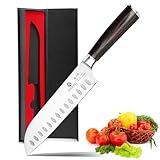


As a practical buying guide for 2026, start with a 7-inch santoku unless you know you prefer a compact knife. A well-balanced 7-inch model is generally the most versatile option for chopping onions, slicing peppers, mincing herbs, cutting boneless proteins, and preparing fruit.
Standard Sizes
| Santoku size | Blade length | Blade length in centimeters | Typical overall length | Best for |
|---|---|---|---|---|
| 5 inches | 5 in | 12.7 cm | 10.5–11.5 in (26.7–29.2 cm) | Small hands, compact kitchens, light prep |
| 6 inches | 6 in | 15.2 cm | 11.5–12.5 in (29.2–31.8 cm) | Everyday prep with a compact feel |
| 6.5 inches | 6.5 in | 16.5 cm | 12–13 in (30.5–33 cm) | Balanced, all-purpose home cooking |
| 7 inches | 7 in | 17.8 cm | 12.5–13.5 in (31.8–34.3 cm) | Most daily prep and larger vegetables |
Blade measurements usually run from the heel, where the blade meets the handle, to the tip. The overall length includes the handle and can vary significantly by design. Always check both measurements if you store knives in a drawer, block, or magnetic rack.
A 5-inch santoku is not simply a smaller version of a 7-inch knife. It gives you a shorter cutting path and often weighs less, which can make repetitive prep feel comfortable. However, the blade may not clear wide foods such as a large onion or half a cabbage in one smooth motion. A 7-inch knife provides more room for forward slicing and chopping while remaining shorter and more maneuverable than many chef’s knives.
Weight also affects the experience. Many 5-inch santokus weigh approximately 3 to 5 ounces, while 7-inch models commonly fall in the 5- to 8-ounce range. Forged construction, a thick bolster, and a full tang can increase weight. Neither heavy nor light is automatically better: the knife should feel balanced near the point where the blade meets the handle.
How to Measure Your Space
- Measure the storage location. For a knife drawer, measure the usable length, width, and depth rather than the outside dimensions. Leave at least 1 inch of clearance around the knife or its sheath so it can be removed safely.
- Check the handle-to-tip length. A 7-inch blade may create a knife that is about 12.5 to 13.5 inches long overall. Use the manufacturer’s listed overall length when checking whether it will fit.
- Account for a knife block. Measure the depth of each slot and the opening width. Some narrow slots accept a 5-inch santoku but may pinch or reject a wide 7-inch handle.
- Measure your cutting board. A board at least 12 by 16 inches gives a 7-inch santoku enough working room for typical prep. On a board smaller than 10 by 14 inches, a 5- or 6-inch knife may feel less crowded.
- Check countertop clearance. Place the knife, board, and a typical ingredient on the counter. You need enough room to keep your guiding hand away from the edge and to move the blade without striking a wall or appliance.
- Measure your hand. Compare the handle length with the distance from your wrist crease to the tip of your middle finger. A handle around 4 to 5 inches long suits many adults, but grip comfort matters more than a strict measurement.
By Room or Use Case
Small apartment kitchen
A 5- or 6-inch santoku is often the easiest choice when counter and storage space are limited. It fits compact boards and shallow drawers, and it is less likely to bump into a backsplash or nearby appliance. The OXO Good Grips 5 in Santoku Knife with Locking Sheath is an example of a compact format; its listed price is about $16.97. A protective sheath is especially useful when a knife must be stored in a drawer.
Family meal preparation
Choose a 7-inch santoku if you regularly prepare meals for three or more people. The longer blade handles several carrots, multiple onions, larger bell peppers, and boneless chicken breasts more efficiently. It also offers more space for a comfortable pinch grip. The imarku 7-inch Santoku is listed around $28.99, while the WICKWILLOW 7-inch Santoku is listed around $48.95. Price differences can reflect materials, construction, handle design, and included features, so blade size alone should not determine the purchase.
Vegetable-heavy cooking
A 6.5- or 7-inch santoku is usually the most comfortable size for frequent vegetable prep. The extra length helps with long slicing strokes, while the relatively tall blade supports a stable knuckle-guided grip. A santoku’s broad face can also make it convenient for transferring chopped ingredients from the board to a pan, although the knife should be lifted by the handle rather than used as a scraper with its sharp edge.
Meat, poultry, and fish prep
For boneless meat and poultry, a 7-inch santoku is a capable daily knife. Its shorter profile than many chef’s knives can feel precise when trimming or slicing small portions. A santoku is not the best tool for bones, frozen food, hard squash, or cutting through joints. For frequent fish filleting or raw-meat trimming, a dedicated flexible knife may be more appropriate than choosing a longer santoku.
Cooking for one or two
A 5- or 6-inch model can reduce unnecessary motion when preparing small portions. It is especially practical for garlic, herbs, fruit, one onion, and a single protein portion. If you sometimes cook larger meals, a 6.5-inch knife offers more capacity without feeling oversized. The Henckels Solution 2-Pc Santoku Knife Set, listed around $29.95, illustrates how a set may cover more than one prep size; check the individual blade lengths before buying because set configurations can vary.
Shared household kitchens
When several people use the same knife, a 6.5- or 7-inch santoku is often the safest compromise. It gives taller users enough blade area while remaining manageable for many home cooks. Look for a handle with a secure, nonslip texture and avoid an especially heavy bolster if users have different grip strengths.
Common Sizing Mistakes
- Choosing by blade length alone: Two 7-inch santokus can feel very different because of handle length, spine thickness, balance, and weight.
- Assuming longer means better: An 8-inch or longer knife can be efficient, but it may feel cumbersome on a small board or for a cook with smaller hands.
- Ignoring the overall length: A knife that fits the blade slot may still be too long for a drawer once the handle is included.
- Buying too small for the workload: A 5-inch santoku can be excellent for light prep, but it may require extra strokes for large vegetables and family-size meals.
- Confusing a santoku with a cleaver: The tall blade is useful for control and ingredient transfer, but a santoku is not designed for chopping bones or hard frozen foods.
- Overlooking handle fit: If your fingers crowd the handle or your thumb rests awkwardly, the correct blade size will not make the knife comfortable.
- Using weight as a quality shortcut: A heavier knife is not necessarily sharper or more durable. Prioritize balance, a comfortable grip, and appropriate care.
FAQ
Is a 7-inch santoku too big for daily use?
No. A 7-inch santoku is a common all-purpose size and is suitable for most daily kitchen prep. It may feel too large only if you have a very small cutting board, limited storage, or a strong preference for short blades.
Is a 5-inch santoku good for everyday cooking?
Yes, especially for one- or two-person households, smaller hands, and light vegetable or protein prep. It is less efficient for large produce and batch cooking, so consider a 6- or 6.5-inch knife if you want a compact blade with more reach.
What size santoku knife is best for daily prep?
For most cooks, the best answer is 7 inches, or about 17.8 cm. Choose 6 to 6.5 inches if you want a more compact middle ground, and choose 5 inches if control, storage, and small portions are your main priorities.
How much should a daily-use santoku cost?
Many capable home-use santokus cost roughly $15 to $60. Entry-level 5-inch knives may be near $17, while 7-inch forged or higher-specification models often range from about $30 to $50. The best value is the size and handle combination you can control comfortably, not simply the highest price.
Ready to decide? Our #1 pick for 2026 is the 5 inches.
Live price & availability on Amazon.




Write Your Review
No reviews yet. Be the first to share your experience!