
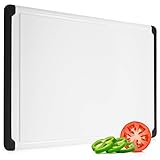
Quick answer: Our top pick in 2026 is the Basic plastic board — our #1 rated choice. See the full ranked comparison, alternatives and buying advice below.
The Short Answer
Yes—if you are willing to hand-wash it and pay a premium for a stable, knife-friendly surface. A synthetic rubber cutting board is worth it for serious home cooks who value grip, quiet chopping, and reduced knife wear more than the lowest possible price. It is not the best choice if you want a lightweight board, a dishwasher-safe board, or a large prep surface for under $40.
Unlike flexible plastic mats, synthetic rubber boards feel dense and substantial. Unlike wood, they do not require oiling, and they resist absorbing as much moisture. The trade-off is cost: medium models commonly run from about $50 to $90, while some larger or thicker versions cost more than $100.
As an Amazon Associate we earn from qualifying purchases at no extra cost to you.


What You Actually Get
A synthetic rubber cutting board is usually made from a dense, food-contact rubber compound rather than natural tree rubber. The material has a little give under a knife blade. That cushioning can make chopping quieter and may help preserve a sharp edge better than a hard glass, stone, or very rigid plastic board.
These boards are often associated with Japanese home and professional kitchens. Two representative sizes show how much the category varies. The Rubber Rubber NBD001 is a relatively compact 11.8 by 7.9 inches and 0.3 inch thick, with a listed price of $60.82. The Asahi Cookin Cut model is larger and thicker at 15 by 8.3 inches and 0.5 inch thick, priced at $75.99. Neither is an oversized family-style board; both prioritize a dense, manageable work surface over maximum coverage.
That sizing matters. A 12-by-8-inch board works for slicing fruit, trimming garnishes, cutting a chicken breast, or preparing a small meal. A 15-by-8-inch board is more practical for everyday vegetables and proteins, but it can still feel cramped when you need to chop several ingredients at once. For batch cooking, look for at least 18 by 12 inches, while remembering that a larger rubber board will be heavier and more expensive.
Most synthetic rubber boards are nonporous or relatively low-absorption compared with wood. They are also quieter than hard plastic when a knife contacts the surface. However, “rubber” does not mean maintenance-free. Food residue can collect around knife marks, and the board should be washed promptly, dried thoroughly, and inspected periodically for deep grooves or damage. Always follow the manufacturer’s cleaning instructions, particularly before using a dishwasher or harsh sanitizer.
Pros
- Excellent stability. Dense rubber typically stays planted on the counter better than a thin plastic board. That reduces sliding while you slice, although a damp towel underneath is still useful on a wet or polished countertop.
- Gentler on knives than hard surfaces. The slightly yielding surface is more forgiving to an edge than glass, marble, granite, or ceramic. It will not eliminate sharpening, but it can make a quality knife feel sharp for longer.
- Comfortable cutting feel. Rubber absorbs some impact and vibration, making repetitive chopping less harsh on the hands and quieter in an open kitchen.
- Low odor and flavor transfer when maintained properly. A good food-grade board should not impart a strong taste to food. Washing promptly is still important after cutting onions, garlic, fish, or spicy ingredients.
- No routine oiling. Unlike many wood boards, synthetic rubber does not need regular mineral-oil treatments to prevent drying. That simplifies ownership.
- Professional-style control. Cooks who use Japanese knives or do frequent prep often appreciate the combination of grip, precision, and a softer cutting surface.
- Durable enough for daily use. A thick, dense board can serve for years if it is not abused with cleavers, excessive force, or deep scraping.
Cons
- High upfront cost. Paying $60 to $80 for a medium board can feel excessive when a basic plastic board costs $10 to $25 and a solid wood board often starts around $30.
- Limited size at common price points. Many premium rubber boards are approximately 12 by 8 to 15 by 8 inches. That is adequate for compact prep but smaller than the 18-by-12-inch boards many cooks prefer.
- Potentially heavy and awkward. The same density that improves stability can make the board cumbersome to lift with one hand, especially in larger sizes or thicknesses.
- Cleaning can be less convenient. Some models should be hand-washed, and hot water, dishwashers, or abrasive cleaners may shorten their life. A board that cannot be cleaned according to your routine may not be a good purchase.
- Knife marks are normal. The surface can develop visible cuts over time. Light marks are cosmetic, but deep grooves can make cleaning harder and are a reason to replace the board.
- Not ideal for every tool. A soft, resilient surface is excellent for chef’s knives and utility knives, but repeated heavy cleaver work may damage it. Check the manufacturer’s guidance before using forceful chopping tools.
- Rubber texture is subjective. Some people like the controlled feel; others find it slightly draggy compared with slick plastic.
Who Should Buy It
Buy a synthetic rubber cutting board if you cook most days, sharpen or own good knives, and want a board that feels planted and quiet. It is particularly appealing to cooks who prepare vegetables, boneless meat, fish, herbs, and fruit with a chef’s knife. It also makes sense for apartment kitchens where reducing chopping noise matters.
Choose a thicker model if stability is your priority. A board around 0.5 inch thick generally feels more substantial than a 0.3-inch compact model, though thickness alone does not guarantee that it will not move. Measure your storage space before buying: rubber boards may not fit neatly in a narrow vertical slot or standard dish rack.
For a first purchase, a medium board around 15 by 8 inches is the most balanced choice. It gives you more usable space than a small 12-by-8-inch board without moving into the cost and weight of a professional-sized slab.
Who Should Skip It
Skip synthetic rubber if your main goal is the cheapest practical board. A $12 to $25 plastic board will handle ordinary food prep at a fraction of the price, and replacing it when heavily scored is inexpensive.
It is also a poor fit if you rely on the dishwasher for nearly everything. Some rubber products may tolerate dishwasher cleaning, but you should not assume that all do. Confirm the care instructions before purchase. Likewise, cooks who need one very large surface for bread, multiple vegetables, or big cuts of meat may get more value from an 18-by-12-inch wood or plastic board.
Cheaper Alternatives
| Option | Cost | Trade-off |
|---|---|---|
| Basic plastic board | $10–$25 | Lightweight and often easy to replace; can slide more, show deep knife scars, and feel harsher on an edge. |
| Thick polypropylene board | $20–$45 | More rigid and stable than a thin mat, but usually noisier and less cushioning than synthetic rubber. |
| Bamboo board | $20–$50 | Attractive and firm, but harder on knives and more dependent on proper drying and occasional oiling. |
| Edge-grain hardwood board | $35–$100 | Large, durable, and repairable by sanding; heavier and requires more care than plastic. |
| Flexible silicone cutting mat | $10–$30 | Easy to store and useful for light prep, but generally less stable and less satisfying for extensive chopping. |
FAQ
Is synthetic rubber better than plastic for knives?
Usually, yes. Synthetic rubber has a slightly yielding surface that is less punishing to a knife edge than hard plastic, especially rigid boards with a slick feel. The difference is not magical: knife angle, steel quality, cutting technique, and sharpening habits matter more. Still, rubber is a strong choice if preserving the feel of a sharp kitchen knife is a priority.
Are synthetic rubber cutting boards sanitary?
They can be, provided the board is made for food contact and cleaned correctly. Wash it after each use with the recommended soap and water, pay attention to cuts and corners, and let it dry fully. Do not continue using a board with deep grooves, cracks, a persistent odor, or an area that cannot be cleaned.
Can you put a synthetic rubber cutting board in the dishwasher?
It depends on the specific model. Some may be dishwasher-safe, while others can warp, swell, or deteriorate with repeated heat exposure. Check the care label or manufacturer’s instructions rather than relying on general assumptions about rubber. If you prefer automatic cleaning, choose a board explicitly rated for it.
What size synthetic rubber board should I buy?
For limited counter space, 12 by 8 inches is adequate for small tasks. For a primary everyday board, aim for approximately 15 by 10 inches or larger if your kitchen can accommodate it. A board measuring 18 by 12 inches is more comfortable for meal prep, but it will cost more, weigh more, and require a larger storage area.
Bottom line: A synthetic rubber cutting board is worth it when knife care, grip, and a quiet cutting experience justify spending roughly $60 or more. It is a premium tool, not a universal upgrade. If you value convenience, maximum size, or low cost above all else, plastic or wood will likely be the better buy.
Ready to decide? Our #1 pick for 2026 is the Basic plastic board.
Live price & availability on Amazon.





Write Your Review
No reviews yet. Be the first to share your experience!