
In a large kitchen, the hard part of washing the floor is rarely the dirt itself. It is the pushing. A wet and dry floor washer carries two water tanks, a motor and a brush roll, and dragging that weight back and forth across a big tiled or sealed floor, around an island and under a dining table, is real work by the final pass. Self-propulsion changes the equation: powered wheels sense the direction you move and add traction, so the machine pulls itself forward and eases back instead of being hauled. This guide compares three cordless washers whose makers describe genuine powered assistance, and it is careful about language, because not every easy-glide wheel is a drive system. One model here offers full bi-directional self-propulsion, one uses a smart glide wheel system, and one relies on forward traction with assistive wheels, and those differences are spelled out rather than blurred.
As an Amazon Associate, we earn from qualifying purchases.
Quick Picks
| Product | Best for | Key point |
|---|---|---|
| Tineco FLOOR ONE S7 Pro | Strongest self-propulsion | SmoothPower system assists both pushing and pulling |
| Dreame H14 Pro | Large kitchens with furniture | Lie-flat reach plus GlideWheel self-propelling wheels |
| Tineco FLOOR ONE Stretch S6 | Low furniture and edge work | Forward traction, lay-flat body and dual-sided edge cleaning |
How to Choose
First, verify what self-propelled actually means on the model in front of you. A true traction system uses powered wheels and sensors to assist your movement, and the strongest versions assist in both directions, so the return stroke is as light as the forward one. Simpler designs power the forward motion only, or add small assistive wheels that reduce friction without driving the machine. All three reduce effort compared with an unpowered washer, but they do not feel the same over a long session, so read the maker’s wording closely and be wary of listings that say effortless without describing a mechanism.
Runtime is the second limit in a large kitchen. Cordless washers in this class run for around forty minutes on a charge in their standard modes, which sounds generous until a big floor needs a slow second pass over cooking splashes near the hob. Think in terms of your floor area and your habits: a single open-plan kitchen diner is one job, while a kitchen plus hallway plus utility room in one session pushes any battery. Self-cleaning cycles also draw on the same battery and water, so a model that finishes the floor with little reserve may not complete its dock cleaning routine comfortably.
Tank capacity and separation come next. Washers that vacuum and wash at once keep clean and dirty water in separate tanks, so you are never spreading recovered water back over the floor. In a large kitchen the dirty tank fills with crumbs, sauce and grit as well as water, and a tank that needs emptying mid-room breaks your rhythm.
Then consider reach and edges. A body that reclines flat reaches under furniture without moving it, while dual-sided edge cleaning reduces the hand-finishing strip along walls. Heated drying of the brush roll also matters, because a damp roller left in a closed machine develops odours quickly.
Best Options
1. Tineco FLOOR ONE S7 Pro

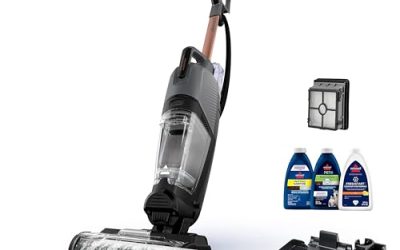
The S7 Pro is the clearest example of the category in this guide. Tineco describes its SmoothPower system as bi-directional self-propulsion: the machine detects the movement of its rear wheels and assists whether you are pushing forward or pulling back, which is exactly the motion a large kitchen demands as you work in lanes and reverse out of corners. Around that drive system sits a complete wet and dry washer that vacuums and washes hard floors in one pass, using continuous fresh water washing with dirty water recovery, and a stated runtime of forty minutes. Dual-sided edge cleaning helps along kick boards, and the self-cleaning cycle finishes with centrifugal drying of the roller. For a big kitchen, the practical effect is consistency: the last lane takes no more arm effort than the first. It is the pick when reducing pushing effort is the whole point of the purchase.
Specs
- Cordless wet and dry floor washer for hard floors; SmoothPower bi-directional self-propulsion system; 40-minute runtime as listed; dual-sided edge cleaning; LED display; balanced-pressure water flow; self-cleaning with centrifugal drying process; sold by Tineco on Amazon US
Best for: Large kitchens where powered assistance in both directions matters most
Watch out for: The full self-propulsion and display features make it the most complex machine here, and runtime still sets a hard limit on very large multi-room sessions
2. Dreame H14 Pro

The H14 Pro approaches effort from two directions at once. Its GlideWheel system uses intelligent drive wheels to provide forward and backward assistance, described by Dreame as smart self-propelling wheels, and its body reclines to a full lie-flat position so the machine slides under kitchen furniture instead of you moving chairs and stools out of its path. Suction is rated at 18,000 Pa, the brush washes with heated water during the dock self-cleaning cycle, and hot air drying follows, which suits a kitchen where the washer lives in a warm corner. App control of solution distribution is a distinguishing extra, and runtime is listed at up to forty minutes. Choose the H14 Pro when the kitchen is large and furnished, because its combination of driven wheels and low reach attacks both halves of the job: the pushing across open floor and the awkward work underneath everything.
Specs
- Cordless wet and dry vacuum washer; 18,000 Pa suction; GlideWheel self-propelling drive wheels with forward and backward assistance; 180-degree lie-flat design, body height about 14 cm laid flat and brush head about 9.8 cm; runtime up to 40 minutes; heated water brush washing and hot air drying on the dock; smart app control with automatic solution distribution; dual-edge cleaning
Best for: Large, furnished kitchens where under-unit reach matters as much as traction
Watch out for: App-based controls add setup and another thing to maintain, and the lie-flat talent is wasted if your kitchen has no low furniture to clean beneath
3. Tineco FLOOR ONE Stretch S6

The Stretch S6 is the honest third tier of propulsion in this guide, and it is labelled as such. Its Amazon listing describes forward traction, and Tineco adds mini assistive wheels intended to make pushing and pulling easier in both directions, but this is assistance that lightens the machine’s movement rather than the fuller powered self-propulsion of the S7 Pro. What the Stretch S6 offers instead is reach: the body lays flat through 180 degrees to clean under low kitchen units, a swivel design helps it turn in confined gaps, and dual-sided edge cleaning works close to walls on both sides. Runtime is listed at forty minutes, and the FlashDry self-cleaning system uses heated air to dry the roller after the dock cycle. In a large kitchen with long runs of low cabinetry, that flat reach can save more total effort than a stronger drive system, because the alternative is kneeling with a hand mop under every unit. Buy it for its shape and edge work, with propulsion as a welcome helper rather than the headline.
Specs
- Cordless wet and dry vacuum washer; forward traction with mini assistive wheels for push and pull movement; 180-degree lay-flat design; 40-minute runtime as listed; dual-sided edge cleaning; FlashDry self-cleaning with heated drying; digital display; ZeroTangle brush technology as listed
Best for: Kitchens with long runs of low units and cabinets to clean beneath
Watch out for: Its traction assistance is lighter than the S7 Pro’s bi-directional self-propulsion, so on a very large open floor the difference in arm effort is noticeable over a full session
Which One Fits
- Effort is the main problem: the Tineco S7 Pro, for true bi-directional powered assistance.
- A large kitchen full of furniture: the Dreame H14 Pro, for driven wheels plus lie-flat reach and heated brush care.
- Long low cabinets and tight edges: the Tineco Stretch S6, for its flat body and dual-sided edge cleaning.
- A simple open-plan floor with few obstacles: any of the three will finish it; choose by how much pushing help you want, not by suction figures alone.
Common Mistakes
- Believing every effortless claim means self-propulsion, when some models only have smoother wheels.
- Buying for runtime alone and forgetting that self-cleaning cycles use battery and water after the floor is done.
- Letting the brush roll sit damp after use instead of running the drying cycle, which invites odours in a warm kitchen.
FAQ
Does self-propelled mean the washer cleans by itself?
No. A self-propelled floor washer is still guided by hand like an upright vacuum. The powered wheels add traction in the direction you move, so pushing and pulling take far less effort, but you choose the route, the pace and the number of passes over each spill.
How long does a cordless floor washer run in a large kitchen?
Models in this guide list runtimes of up to forty minutes in standard use. That covers a large kitchen comfortably for most households, but slow extra passes, higher modes and the dock self-cleaning cycle all draw on the same battery, so very large multi-room sessions may need planning.
Can these washers be used on every kitchen floor?
They are designed for sealed hard floors such as tile, sealed wood, laminate and vinyl. Unsealed wood, delicate stone and floors that cannot tolerate water need a different method. Check the floor maker’s guidance as well as the washer’s, because water recovery reduces wetness but does not make the process dry.
What is the difference between traction assistance and full self-propulsion?
Full self-propulsion powers the wheels in the direction of travel, in the strongest cases both forwards and backwards. Traction assistance and assistive wheels reduce the force needed to move the machine but do less of the work. Both help, yet over a long session on a large floor the powered systems feel noticeably lighter.
Final Verdict
The Tineco FLOOR ONE S7 Pro is the defining self-propelled pick, because its assistance works in both directions across the whole clean. The Dreame H14 Pro is the better choice for furnished kitchens that need reach as much as drive, and the Stretch S6 earns its place through flat access and edge work with lighter traction help. In a large kitchen, match the machine to where your effort actually goes, and the weekly wash becomes a routine rather than a project.

Write Your Review
No reviews yet. Be the first to share your experience!