
A small manufacturing team counts parts every day. Fasteners, fittings, washers, screws, and small components move from bins to kits, from kits to assemblies, and from assemblies to finished goods. Counting by hand is slow and error prone, and a wrong count shows up later as a short kit, a stalled assembly, or a stock record that does not match the shelf.
An industrial counting scale counts by weight. The team samples a known number of parts, the scale learns the average piece weight, and then it counts the rest of the bin by weighing it. This guide covers counting scales that suit a small manufacturing team: bench designs that fit a shared workbench, readability fine enough for light parts, and features that help a small team keep counts repeatable without a dedicated counting station.
How to Choose an Industrial Counting Scale for a Small Manufacturing Team
Capacity and Readability Together
Capacity and readability have to be chosen together. A scale with a large capacity but coarse readability cannot count light parts accurately, because one part may weigh less than the smallest change the scale can show. A scale with fine readability but a small capacity cannot hold a full bin. For a small manufacturing team, a bench scale in the 30 kg range with 1 g readability covers most hardware and components, while a finer 0.1 g readability suits lighter parts such as small screws, electronic components, and precision fittings.
Sample Size and Average Piece Weight
Counting by weight depends on the sample. A larger sample gives a better average piece weight, because it smooths out small differences between individual parts. A small team should use the largest practical sample size, and re-sample whenever a new batch of parts arrives, since piece weight can drift between suppliers or production runs. The scale should make sampling easy, with a clear counting mode and a display that shows the sample count.
Memory and Product Libraries
A small team counts the same parts again and again. A product library that stores piece weights for the parts you count most often saves time, because the team does not have to re-sample every time. A library of 30 items covers the core parts for many small shops. If the team counts hundreds of different parts, a larger library or a computer connection matters more.
Connectivity and Record Keeping
Counts need a record. A scale with an RS-232 port can send counts to a printer or a computer, which helps when counts go into a stock system or a job file. A printer is useful when a count ticket travels with a kit or a bin. If the team records counts by hand, a clear display that shows weight, unit weight, and count together matters more than connectivity.
Portability and Power
A small shop often shares one counting scale between benches. A scale with a rechargeable battery and a handle can move between benches without finding a power outlet. A stainless steel platform wipes clean between parts, which matters when the same scale counts oily hardware in the morning and clean electronic components in the afternoon.
Top Picks
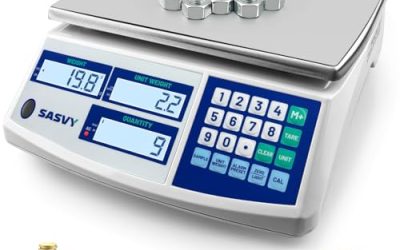
SASVY Counting Scale, 88 lb, 40 kg, 0.1 g

The SASVY Counting Scale combines high capacity with fine readability, which suits a small manufacturing team that counts both heavy bins and light parts. Its 88 lb, 40 kg capacity takes full bins of hardware, and its 0.1 g readability helps with light components where a coarser scale would miss the difference between one part and the next.
- 88 lb, 40 kg capacity with 0.1 g readability
- Counting mode for parts, fasteners, and small components
- Bench design for a shared manufacturing workbench
- Units for weighing in lb, kg, and g
Best for: Small manufacturing teams that need one scale to cover both heavy bins and light parts.
Ohaus Ranger Count 3000 RC31P30 Counting Scale, 30 kg

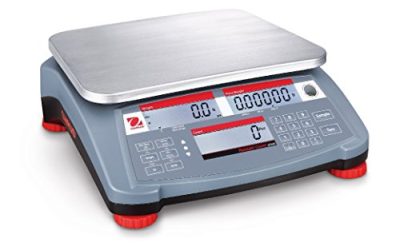
The Ohaus Ranger Count 3000 RC31P30 is a professional bench counting scale built for demanding inventory work. Its 30 kg capacity and 1 g readability handle bins of hardware, fasteners, and components, and its high internal counting resolution supports accurate counts of small, light parts. Three backlit displays show weight, unit weight, and count at a glance, and a 30-item library stores piece weights for the parts you count most often.
- 30 kg capacity with 1 g readability for bins of hardware and components
- High internal counting resolution for accurate counts of light parts
- Three backlit displays showing weight, unit weight, and count together
- 30-item library for storing part numbers and piece weights
- RS-232 connectivity for printers and computers
- Rechargeable battery and metal housing for shop use
Best for: Small manufacturing teams that count the same parts every day and want a library and clear displays.
Bonvoisin Industrial Counting Scale, 30 kg, 66 lb, 1 g

The Bonvoisin 30 kg counting scale is a practical bench counter for parts and coins, with kilogram, gram, and pound units and a straightforward counting workflow. Its 30 kg capacity takes full bins of fasteners and fittings, and its RS-232 interface connects to a printer or computer for count records. An alarm function can flag quantities that fall above or below a set limit, which helps when checking kits or packed quantities.
- 30 kg, 66 lb capacity with 1 g readability
- Counting mode for parts, coins, and small components
- Units in kg, g, and lb
- RS-232 interface for printer and computer connections
- Quantity alarm function for checking packed counts
Best for: Small manufacturing teams that check kits and packed quantities and want an alarm for counts outside the set range.
My Weigh CTS-6000 Digital Counting Scale

The My Weigh CTS-6000 is a precision counting scale for small, light inventory where accuracy matters most. Its 6,000 g capacity and 0.1 g resolution suit small parts, electronic components, and laboratory stock, and its three backlit displays keep total weight, piece weight, and count visible at once. Counting and batching features support packing fixed quantities, and the stainless steel platform and RS-232 port fit a professional bench.
- 6,000 g capacity with 0.1 g resolution for small, light parts
- Three backlit displays for weight, piece weight, and count
- Counting and batching features for packing fixed quantities
- Stainless steel platform that wipes clean between counts
- RS-232 serial port for data output
- Rechargeable battery and AC adapter included
Best for: Small manufacturing teams that count small, high-value parts where fine resolution matters most.
Comparison
| Product | Key Feature | Best For |
|---|---|---|
| SASVY Counting Scale, 88 lb, 0.1 g | High capacity with fine readability | One scale for heavy bins and light parts |
| Ohaus Ranger Count 3000 RC31P30, 30 kg | 30-item library and three displays | Repeated counts of the same parts |
| Bonvoisin Industrial Counting Scale, 30 kg, 1 g | Quantity alarm and RS-232 output | Checking kits and packed quantities |
| My Weigh CTS-6000 Counting Scale | 6,000 g capacity with 0.1 g resolution | Small, high-value parts |
Buying Guide
Build a Repeatable Counting Workflow
A scale alone does not fix inventory accuracy; the workflow around it does. Start each count by taring the empty container, then sample from the middle of the bin rather than the top, because pieces at the top may not represent the whole batch. Use the largest practical sample size, and re-sample whenever a new batch of parts arrives, since piece weight can drift between suppliers or production runs. Record the sample size and the piece weight alongside the count so the result can be checked later.
Match the Scale to the Part
Start with your lightest and heaviest parts. The lightest part sets the readability you need, and the heaviest bin sets the capacity you need. A scale that covers both ends of that range is the right scale for the team. If one scale cannot cover both, put the fine scale at the bench where light parts are counted, and the larger scale where full bins are counted.
Compare Bench, Platform, and Dual-Platform Designs
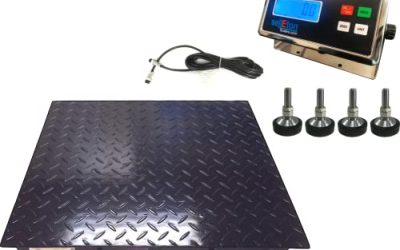
A bench counting scale suits a small team that counts at a workbench. A platform design suits larger bins that do not fit on a bench. A dual-platform design lets the team count light parts on the bench platform and heavy bins on a larger platform, using one indicator. For a small shop, a bench scale is usually enough, and a second platform can be added later if bins get larger.
Check the Environment
A counting scale needs a stable bench, away from vibration, drafts, and forklift traffic. A scale placed near a door or a fan will give readings that drift, and a scale on a wobbly bench will give counts that cannot be repeated. Give the scale a dedicated spot on a solid bench, and keep it clean between counts.
Think About Throughput
A small team counts in batches, often at the end of a job or before a shipment. The scale should be ready to use, with the piece weights for common parts already stored, so counting does not become a bottleneck. A scale that takes a long time to warm up or that needs re-sampling for every part will slow the team down. A library, a clear display, and a simple counting mode keep throughput high.
Frequently Asked Questions
How accurate is counting by weight?
Counting by weight is accurate when the sample is good and the parts are consistent. Use a large sample, sample from the middle of the bin, and re-sample when a new batch arrives. Light parts need finer readability, and a scale with high internal counting resolution helps with small, light components.
What sample size should I use?
Use the largest practical sample size. A larger sample gives a better average piece weight, because it smooths out small differences between individual parts. If the scale supports preset sample sizes, use the largest one that fits the parts you are counting.
Can one counting scale handle a whole small shop?
One bench counting scale can handle most of a small shop if its capacity covers full bins and its readability covers the lightest parts. If the lightest parts need 0.1 g readability and the heaviest bins need 30 kg capacity, a scale that covers both, such as the SASVY 88 lb model, is a good fit. If not, use a fine scale for light parts and a larger scale for full bins.
Do I need a printer or computer connection?
A printer helps when a count ticket travels with a kit or a bin. A computer connection helps when counts go into a stock system. If the team records counts by hand, a clear display that shows weight, unit weight, and count together matters more than connectivity.
Conclusion
A small manufacturing team needs a counting scale that fits a shared bench, counts light parts accurately, and keeps the workflow repeatable. The SASVY 88 lb scale covers both heavy bins and light parts with fine readability. The Ohaus Ranger Count 3000 RC31P30 adds a 30-item library and three clear displays for repeated counts. The Bonvoisin 30 kg scale brings an alarm function and RS-232 output for kit checks. The My Weigh CTS-6000 delivers the fine resolution that small, high-value parts demand. Build a repeatable workflow, match the scale to the lightest and heaviest parts, and keep the scale on a stable bench, and counting becomes a reliable step in manufacturing rather than a source of errors.
Disclosure: As an Amazon Associate, we earn from qualifying purchases.


Write Your Review
No reviews yet. Be the first to share your experience!