
Industrial counting scales sit at the intersection of weighing and counting. Instead of tallying parts by hand, an operator weighs a sample, the scale works out the average weight of one piece, and every further piece is counted by weight alone. That simple idea saves hours in warehouses, workshops, and production lines, and it removes the errors that creep in when people count hundreds of identical items by eye.
This guide covers industrial counting scales as a whole category: bench models for small parts, high-capacity models for bulk hardware, and precision models for light components. The picks below span capacities from 3 kg to 100 lb, so you can see how readability, capacity, and build quality trade against each other.
What to Look For in an Industrial Counting Scale
Capacity and Readability
Capacity sets the heaviest load a scale can take, and readability sets the smallest weight change it can show. These two figures decide which parts a scale can count. A 3 kg scale with fine readability counts tiny screws and electronic parts precisely, while a 100 lb scale counts full cartons of hardware. The lightest piece you count regularly should weigh many times more than the readability, or the count will wander. Check both figures before choosing, not just the headline capacity.
Internal Counting Resolution
Beyond the display, counting scales have an internal resolution that governs how finely they can divide a total weight into pieces. A high internal resolution, such as 1 to 1,500,000 on professional models, lets the scale distinguish pieces that differ by tiny amounts. This matters most for very light parts, where a small difference in unit weight multiplied across a thousand pieces becomes a large counting error. If your parts are light, internal resolution deserves as much attention as capacity.
Displays and Controls
A counting scale needs to show three things at once: total weight, unit weight, and piece count. Models with three separate displays make this easy, because the operator can see all three without switching modes. A full numeric keypad speeds up entering sample sizes and tare weights, and dedicated sample and tare keys keep the workflow moving. Backlit displays help in dim stockrooms, and a clear, logical keypad layout reduces mistakes during long counting sessions.
Build Quality and Platform
Industrial counting scales live on busy benches, so the housing and platform matter. A metal housing resists knocks and dust, a stainless steel platform resists corrosion and cleans easily, and slip-resistant feet keep the scale steady. The platform should be large enough for the containers you use, whether that is a small tray of components or a large bin of fasteners. A platform that is too small forces you to count in batches, which slows the work down.
Memory, Connectivity, and Power
A product library stores piece weights for parts you count often, so you can recall them instead of sampling again. Connectivity through RS-232 or USB links the scale to a printer or computer for records, and a second platform connection on some professional models lets one indicator count from a large remote platform as well as its own bench. A rechargeable battery adds portability, letting the scale move to the stock instead of bringing the stock to the scale.
Top Picks
Ohaus Ranger Count 3000 RC31P3 Counting Scale, 3 kg

The Ohaus Ranger Count 3000 RC31P3 is a compact counting scale for small, light parts. Its 3 kg capacity and fine readability suit screws, washers, electronic components, and other small items where precision matters more than bulk capacity. The Ranger Count 3000 line is built around a metal housing, three backlit displays, and a 30-item library, and this smallest model brings those professional features to a bench that handles delicate, low-weight stock.
- 3 kg capacity for small, light parts and components
- High internal counting resolution for accurate counts of tiny pieces
- Three backlit displays showing weight, unit weight, and count
- 30-item library for storing part numbers and piece weights
- Metal housing with slip-resistant feet for bench durability
- RS-232 connectivity for printers and computers
Best for: Small parts, fasteners, and electronic components where fine precision matters most.
Adam Equipment Cruiser CCT 48UH Bench Counting Scale, 100 lb

The Adam Equipment Cruiser CCT 48UH is a high-capacity bench counting scale with unusually fine readability for its size. Its 100 lb, 48 kg capacity takes full cartons and heavy bins, while its 0.001 lb, 0.5 g readability keeps counts accurate for lighter parts within those loads. It stores up to 140 piece weights, includes a rechargeable battery, and its self-optimizing software refines the average piece weight as counting continues.
- 100 lb, 48 kg capacity with 0.001 lb, 0.5 g readability
- Internal counting resolution of 1 to 600,000
- Stores up to 140 piece weights for fast recall
- Rechargeable battery for portable use around the warehouse
- RS-232 interface for data output
- Full numeric keypad and backlit display
Best for: High-capacity counting where full cartons meet the need for fine readability.
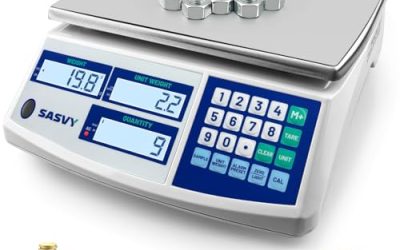
SASVY Counting Scale, 66 lb, 30 kg, 0.1 g

The SASVY 66 lb counting scale balances capacity and readability for general industrial use. Its 30 kg capacity handles bins of hardware, and its 0.1 g readability is fine enough for lighter parts, coins, and pieces. It works in lb, oz, kg, and g, runs on a built-in battery, and suits benches where one scale must cover a wide mix of stock without swapping equipment.
- 66 lb, 30 kg capacity with 0.1 g readability
- Weighing units in lb, oz, kg, and g
- Built-in battery for portable counting
- Designed for small parts, coins, pieces, and tickets
- Stainless steel platform that is easy to clean
Best for: General workshop and stockroom counting across a wide mix of parts.
Bonvoisin Industrial Counting Weight Scale, 30 kg, 0.5 g

The Bonvoisin 30 kg counting scale with 0.5 g readability is a practical bench counter for small parts, coins, and pieces, with a data cable for connecting to a printer or computer. Its finer readability than the 1 g version of the same line suits lighter parts, and its alarm function flags quantities above or below a set limit. The kilogram and gram units cover most industrial stock, and the built-in battery keeps it mobile.
- 30 kg capacity with 0.5 g readability for lighter parts
- Counting mode for parts, coins, and small components
- Data cable included for printer and computer connections
- Quantity alarm function for checking packed counts
- Units in kg and g
- Built-in battery for use away from a fixed bench
Best for: Light to medium parts where 0.5 g readability and a data connection improve accuracy and records.
| Product | Key Feature | Best For |
|---|---|---|
| Ohaus Ranger Count 3000 RC31P3, 3 kg | Compact precision with 30-item library | Small parts and electronic components |
| Adam Equipment Cruiser CCT 48UH, 100 lb | 100 lb capacity with 0.5 g readability | Full cartons and heavy bins |
| SASVY Counting Scale, 66 lb, 30 kg, 0.1 g | 30 kg capacity with 0.1 g readability | General mixed stock counting |
| Bonvoisin Counting Weight Scale, 30 kg, 0.5 g | 0.5 g readability with data cable | Light parts with printed records |
Buying Guide
Start With Your Lightest and Heaviest Parts
List the lightest part you count regularly and the heaviest full container you weigh. The lightest part decides the readability you need, and the heaviest container decides the capacity. A scale that meets both ends of that range is the right one. If no single scale covers both, plan for two: a precision bench scale for small parts and a high-capacity scale for bulk loads. This is common in warehouses that handle both electronic components and bulk hardware.
Compare Bench, Platform, and Dual-Platform Designs
Bench counting scales are compact and sit on a workbench, making them a good fit for parts rooms and packing stations. Platform counting scales use a large separate platform for heavy cartons and pallets. Some professional indicators support a second platform, so one counting unit can switch between its own bench and a large remote platform. If you count both small parts and heavy cartons, a dual-platform setup may be more practical than two separate scales.
Check the Environment
Dusty workshops, damp stockrooms, and food production areas each demand different build quality. A sealed metal housing and a stainless steel platform handle dust and moisture better than a plastic body. Match the materials to the room, not just to the parts.
Think About Throughput
If you count a few bins a day, any reliable counting scale will do. If you count hundreds of bins per shift, speed matters: a large product library, fast stabilization, and automatic piece weight optimization all save time.
Frequently Asked Questions
What is the difference between a counting scale and a regular bench scale?
A counting scale calculates piece counts from weight, using a sample to establish the average weight of one piece. A regular bench scale only shows total weight. Counting scales also include sample size settings, piece weight memory, and displays that show the count alongside the weight, which a plain bench scale does not provide.
How do I set the average piece weight?
Count out a sample of identical pieces, place them on the scale, and enter the sample size. The scale divides the total weight by the number of pieces and stores the result as the average piece weight. Larger samples give a better average, especially when pieces vary slightly in weight.
Can a counting scale count mixed parts in one bin?
No, counting by weight only works when all pieces in the load are identical, or close enough that their weights are effectively the same. Mixed parts must be separated before counting.
What capacity do I need for bulk hardware?
Bulk hardware in full bins often weighs 15 to 40 kg, so a 30 kg or 48 kg scale covers most bench work. For cartons and sacks, a 100 lb scale is a safer choice. Always leave headroom above your heaviest regular load, because weighing at the very top of a scale’s range reduces accuracy and strains the load cell.
Conclusion
For small, light parts, the Ohaus Ranger Count 3000 RC31P3 brings professional counting features to a compact 3 kg bench scale. For heavy cartons that still need fine counting, the Adam Equipment Cruiser CCT 48UH pairs a 100 lb capacity with 0.5 g readability and a large piece weight memory. For everyday mixed stock, the SASVY 66 lb scale balances capacity and readability with portable battery power. For light parts with a need for records, the Bonvoisin 30 kg scale adds 0.5 g readability and a data cable.
Disclosure: As an Amazon Associate, we earn from qualifying purchases.


Write Your Review
No reviews yet. Be the first to share your experience!