
Our Short List of 3

- Best for: Hand and machine swirl removal.
- 15.2 fluid ounces
- Micro-abrasive technology
- Fine grit, aluminium oxide or silicon carbide abrasive
- Removes swirls, scratches, oxidation and water spots
- Best for: Professional sanding mark removal.
- 1 quart, 32 fluid ounces
- Removes P1200 or finer sand scratches and surface defects
- Aluminium oxide abrasive, fine grit
- Designed for use at 1200 to 2000 RPM with a foam compounding pad

- Best for: Light restoration of faded paint.
- 10.5 ounces, 298 grams, paste format
- Light cut polishing compound
- Restores lightly oxidised and faded finishes
- Removes light swirl marks, minor scratches and oxidation
All 4 Picks at a Glance
| Product | Specs | Action |
|---|---|---|
| Meguiar’s Ultimate Compound |
| Check price on Amazon |
| 3M Perfect-It EX AC Rubbing Compound |
| Check price on Amazon |
| Turtle Wax T-241A Polishing Compound |
| Check price on Amazon |
 Chemical Guys V36 Cutting Polish |
| Check price on Amazon |
A cutting compound is the liquid that removes swirls, scratches and oxidation from car paint by levelling the clear coat a fraction at a time, restoring gloss that washing alone cannot bring back. The real decision is cut level: a compound that is too aggressive leaves haze and fresh marks, while one that is too gentle never touches the defects. The four compounds below cover the full range, from a light hand polish for faded paint to a professional machine compound for sanding marks.
This guide is for car owners restoring a dull finish by hand, for detailers working with a machine polisher, and for anyone preparing paint for wax or ceramic protection. The compounds were chosen from the names and specifications listed on their Amazon product pages, with abrasive type, grit, size and application details taken from those listings.
Quick Picks
As an Amazon Associate we earn from qualifying purchases
| Product | Best for | Key spec from title |
|---|---|---|
| Meguiar’s Ultimate Compound | Hand and machine swirl removal | 15.2 fl oz with micro-abrasive technology |
| 3M Perfect-It EX AC Rubbing Compound | Professional sanding mark removal | 1 quart, removes P1200 scratches |
| Turtle Wax T-241A Polishing Compound | Light restoration of faded paint | 10.5 oz paste for light defects |
| Chemical Guys V36 Cutting Polish | Machine cutting with a fine finish | 16 oz, removes 2000-2500 grit marks |
How to Choose
Match the Cut Level to the Defect
Cut level is the first decision, because it decides which defects a compound can remove and how much clear coat it takes with them. Light swirls, haze and mild oxidation respond to a fine-cut compound such as the Turtle Wax paste or the Meguiar’s Ultimate Compound, which level the surface gently. Deeper scratches and sanding marks need a heavier cut, such as the 3M Perfect-It EX, which is rated for P1200 grit scratches and above. Using too heavy a cut on light defects wastes clear coat and leaves haze that needs a second, finer step to correct, so start with the lightest compound that will do the job.
Choose Hand or Machine Application
Some compounds are made for hand use and some for machine polishers, and the wrong pairing gives poor results. Hand compounds such as the Turtle Wax paste spread easily with a cloth and suit small areas, spot repairs and owners without a polisher. Machine compounds such as the 3M and Chemical Guys products are designed to work with a dual-action or rotary polisher, where the pad and speed do the cutting. Meguiar’s Ultimate Compound works both ways, which makes it the flexible choice for a first purchase. If you own a polisher, favour a machine compound; if you work by hand, check the listing says so.
Read the Abrasive Type and Grit
The abrasive is what does the cutting, so its type and grit describe the compound’s character. Aluminium oxide is the common abrasive in this group, cutting steadily without breaking down too fast, while diminishing abrasives such as those in the Chemical Guys V36 start coarse and break down finer as you work, leaving a glossier finish. Grit numbers help compare: a 1200-grit rating suits sanding mark removal, while 2000 to 2500-grit ratings suit finer defect removal. A compound that states its abrasive and grit openly is easier to place in a correction sequence than one that hides them.
Check Size, Safety and Finish
Size matters because paint correction uses more product than buyers expect, especially on a large car. A 15.2-ounce bottle covers a car or two by hand, while a quart suits machine work across several vehicles. Check whether the compound is safe on clear coat and single-stage paint, because some heavy compounds are too aggressive for older single-stage finishes. Look for a dust-free or low-dusting formula, which keeps the working area cleaner and the pad cutting longer. Always test a compound on a hidden area first, and keep it away from rubber trim and unpainted plastic.
The 4 Best Options
Meguiar’s Ultimate Compound
- Best for: Hand and machine swirl removal.
- 15.2 fluid ounces
- Micro-abrasive technology
- Fine grit, aluminium oxide or silicon carbide abrasive
- Removes swirls, scratches, oxidation and water spots
Hand and machine swirl removal.
Shake the bottle well before use, since the abrasives settle.
The Meguiar’s Ultimate Compound fits buyers who want one bottle that handles swirls, scratches, oxidation and water spots by hand or by machine. Its micro-abrasive technology cuts quickly yet finishes with a high gloss, so it removes defects without leaving the haze that heavier compounds cause. The formula is safe on single-stage paint and clear coats, and the fine grit suits everything from light swirls to moderate scratches. At 15.2 fluid ounces it covers a whole car by hand with product to spare, and the cream consistency spreads evenly without drying too fast.
Watch out for: Shake the bottle well before use, since the abrasives settle.
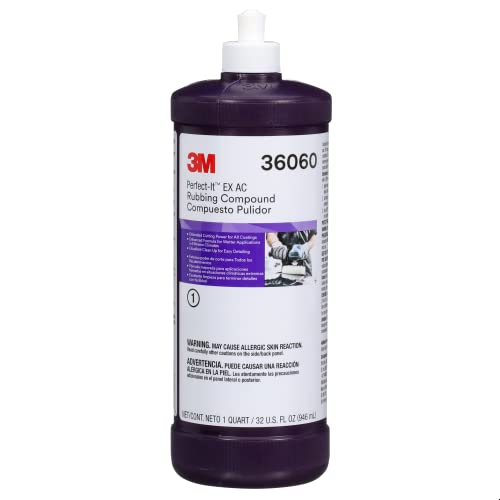
3M Perfect-It EX AC Rubbing Compound
- Best for: Professional sanding mark removal.
- 1 quart, 32 fluid ounces
- Removes P1200 or finer sand scratches and surface defects
- Aluminium oxide abrasive, fine grit
- Designed for use at 1200 to 2000 RPM with a foam compounding pad
Professional sanding mark removal.
This is a machine compound, so it needs a polisher and pad to work properly.
The 3M Perfect-It EX AC fits detailers and body shops who need to remove sanding marks before polishing. It is the highest-performing rubbing compound in the 3M range for P1200 and finer sand scratches, cutting fast without sticking or leaving a residual film on the paint. The formula works across a broad range of conditions and pairs with a foam compounding pad at 1200 to 2000 RPM, forming the first step of the 3M Perfect-It paint finishing system. The one-quart size suits machine work across several panels or vehicles.
Watch out for: This is a machine compound, so it needs a polisher and pad to work properly.
Turtle Wax T-241A Polishing Compound
- Best for: Light restoration of faded paint.
- 10.5 ounces, 298 grams, paste format
- Light cut polishing compound
- Restores lightly oxidised and faded finishes
- Removes light swirl marks, minor scratches and oxidation
Light restoration of faded paint.
It will not remove deep scratches, so test the defect depth first.
The Turtle Wax T-241A fits owners restoring lightly oxidised and faded paint by hand, because its light-cut paste is gentle enough for a first attempt yet strong enough to bring back a shine. The 10.5-ounce paste spreads with a cloth and works the paint without the risk of a heavy compound, making it a good choice for older cars and for buyers who have never corrected paint before. It targets light swirl marks, minor scratches and oxidation, leaving a clean surface ready for wax. The paste format gives control over how much product goes on each panel.
Watch out for: It will not remove deep scratches, so test the defect depth first.
Chemical Guys V36 Cutting Polish
- Best for: Machine cutting with a fine finish.
- 16 fluid ounces
- Water-based formula
- Optical-grade diminishing abrasives
- Removes 2000-2500 grit sanding scratches, swirls and holograms
Machine cutting with a fine finish.
Keep the pad flat and work small sections, since the abrasives cut fast.
The Chemical Guys V36 fits machine users who want a compound that cuts and finishes in one step. Its optical-grade diminishing abrasives remove 2000 to 2500 grit sanding scratches, swirls and holograms, then break down finer as you work to leave a deep, glossy finish without fillers. The water-based formula gives a long working time with minimal dust, and it works with a rotary or dual-action machine on clear coat, ceramic clear coat and single-stage paint. The 16-ounce bottle is sized for a full car correction with a machine.
Watch out for: Keep the pad flat and work small sections, since the abrasives cut fast.
Which One Fits Your Situation
First Time Correcting Paint by Hand
Choose the Turtle Wax T-241A if you have never corrected paint and want to start safely. The light-cut paste removes haze and light swirls without the risk of a heavy compound, and the paste format gives you control over each panel. It is the forgiving choice for an older car whose paint has faded in the sun.
Swirls and Scratches on a Daily Driver
Choose the Meguiar’s Ultimate Compound if your car carries the usual swirls, scratches and water spots of daily use. It works by hand or machine, cuts fast enough for real defects, and finishes with a gloss that needs no second step. The 15.2-ounce bottle covers a whole car, making it the most flexible single purchase here.
Sanding Marks After Bodywork
Choose the 3M Perfect-It EX AC if you are finishing bodywork and need to remove sanding marks before polishing. Its rating for P1200 and finer scratches matches the sanding stage, and it integrates with the 3M finishing system for the steps that follow. This is a professional compound for machine use, not a hand polish.
Machine Correction With a Fine Finish
Choose the Chemical Guys V36 if you use a machine polisher and want a compound that finishes well enough to skip a separate polishing step. The diminishing abrasives cut through defects and refine the surface as they break down, leaving a deep gloss. The water-based formula keeps dust down and working time long.
Common Mistakes
- Starting with too heavy a cut and removing clear coat that cannot be replaced.
- Using a machine compound by hand and getting poor, uneven results.
- Skipping a test spot and discovering the compound is too aggressive for the paint.
- Working in direct sun, where the compound dries before it can cut properly.
- Forgetting to protect rubber trim and plastic from compound splatter.
Frequently Asked Questions
Will a cutting compound remove deep scratches?
A cutting compound levels the clear coat, so swirls, light scratches and oxidation respond well. A scratch you can feel with a fingernail has usually cut through the clear coat into the colour layer, and no compound removes it without taking the surrounding clear coat down to the same depth.
Can I use a cutting compound by hand?
Yes, but the results depend on the compound. Light-cut products such as the Turtle Wax paste and the Meguiar’s Ultimate Compound are made for hand use and work well on small areas. Heavier machine compounds such as the 3M Perfect-It EX need a polisher to cut evenly, and working them by hand gives slow, patchy results.
How often should I use a cutting compound?
Rarely. Each use removes a thin layer of clear coat, and a car only has a limited amount to spare. Most cars need correction once every year or two at most, and many need it only once. Between corrections, protect the finish with wax or a sealant and wash carefully to avoid new swirls.
Do I need to wax after using a cutting compound?
Yes. A cutting compound strips the surface bare, removing oxidation, old wax and protection along with the defects. The fresh paint it reveals is unprotected and will oxidise again quickly without a sealant or wax on top. Apply a wax, sealant or ceramic coating after compounding, and let the paint cure first if the car has just been resprayed.
Write Your Review
No reviews yet. Be the first to share your experience!