
Our Short List of 3

- Best for: Most home cooks butterflying and slicing chicken breast every week.
- Blade length: 6 inches
- Blade shape: Curved, flexible
- Blade material: Stainless steel
- Handle material: Thermoplastic rubber (Fibrox Pro)

- Best for: Cooks who want a forged, substantial feel for frequent chicken prep.
- Blade length: 6 inches
- Blade type: Flexible boning knife
- Blade material: High-carbon German steel
- Construction: Precision-forged, per the listing
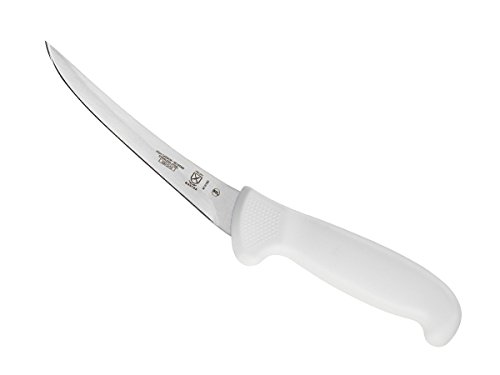
- Best for: Straightforward trimming and slicing with easy edge maintenance.
- Blade length: 6 inches
- Blade shape: Curved
- Blade material: High-carbon Japanese steel
- Construction type: Stamped, per the listing
All 5 Picks at a Glance
| Product | Specs | Action |
|---|---|---|
| 1. Victorinox Fibrox Pro 6-Inch Curved Boning Knife, Flexible Blade |
| Check price on Amazon |
| 2. Mercer Culinary Genesis 6-Inch Flexible Boning Knife (M20206) |
| Check price on Amazon |
| 3. Mercer Culinary Ultimate White 6-Inch Curved Boning Knife (M18180) |
| Check price on Amazon |
 4. Dexter-Russell Sani-Safe 6-Inch Curved Boning Knife (S131F-6PCP) |
| Check price on Amazon |
 5. Cutluxe 6-Inch Curved Boning Knife |
| Check price on Amazon |
Cutting a raw chicken breast well is a different job from general chopping. The breast is thick at one end, thin at the other, slippery on the surface, and easy to tear if the blade is wide or stiff. Butterflying it open, trimming the tenderloin and fat, and then slicing it into even cutlets all call for a narrow blade that can lie almost flat against the meat and follow a shallow, controlled path instead of ploughing through it.
That is why every pick below is a 6-inch boning knife, not a chef’s knife or santoku. These blades are thin, narrow and flexible or curved by design, built for separating meat and trimming poultry. If you mostly need one all-purpose knife, a general kitchen knife guide is the better starting point. If chicken breast is a weekly staple and uneven thickness is your recurring problem, one of these specialist blades is the tool that actually fixes it.
Quick Picks
As an Amazon Associate we earn from qualifying purchases.
| Product | Best for | Key spec from title |
|---|---|---|
| Victorinox Fibrox Pro 6-Inch Curved Boning Knife, Flexible Blade | Most chicken breast work | 6-inch curved flexible blade |
| Mercer Culinary Genesis 6-Inch Flexible Boning Knife (M20206) | Forged feel and daily use | 6-inch forged flexible boning knife |
| Mercer Culinary Ultimate White 6-Inch Curved Boning Knife (M18180) | Simple curved trimming | 6-inch curved boning knife |
| Dexter-Russell Sani-Safe 6-Inch Curved Boning Knife (S131F-6PCP) | Wet-hand, high-volume prep | 6-inch curved boning knife, Sani-Safe series |
| Cutluxe 6-Inch Curved Boning Knife | Forged balance with a sheath | 6-inch curved filet knife for meat cutting |
How to Choose
Blade thinness and flex come first
A chicken breast rewards a blade that gives a little. A flexible boning knife can bend slightly as you butterfly a breast, keeping the edge flat and level so both halves end up close to the same thickness. A stiff, wide chef’s knife tends to ride up or dig in, which is how one side ends up paper-thin and the other stays thick. Curved blades help in a different way: the curve lifts the handle clear of the board and lets the edge travel along the meat in a smooth arc. For boneless breast work, flexible or curved is the right starting point, and a narrow profile matters as much as flex, because a narrow blade drags less through soft raw meat and is easier to steer in a shallow cut.
Blade length matched to a breast, not a roast
Six inches is the practical sweet spot for this job. A typical breast is wide enough that a very short paring knife forces you into several short, sawing strokes, and every change of direction is a chance for the thickness to wander. A 6-inch blade can cross most breasts in one or two long, level strokes, which is what even cutlets require. Much longer slicing blades bring their own problem: the extra length is harder to keep flat inside a butterfly cut, and the tip can wander out through the far side. All five picks here sit at 6 inches for exactly that reason. If you regularly work with unusually large breasts, technique matters more than extra length — open the thick end first, then level the whole piece.
Steel and edge holding on raw meat
Raw chicken is soft, so edge retention here is less about power and more about staying cleanly sharp through repetitive, shallow slicing. High-carbon stainless and German or Japanese steels in these listings are chosen for easy honing and resistance to staining in a wet, protein-heavy environment. A blade that dulls quickly starts to tear rather than slice, and torn breast meat cooks unevenly and looks ragged. Look for steel you can maintain with a honing rod and occasional sharpening rather than exotic hardness you cannot service at home. Just as important is washing and drying the blade promptly after raw poultry work, both for hygiene and to protect the edge from sitting in moisture.
A handle that stays put in wet hands
No part of this job is dry. Your hands, the board and the meat itself are all wet, and a smooth polished handle becomes a safety problem long before it becomes a comfort problem. Textured synthetic handles — the Fibrox, Santoprene and polypropylene grips in this list — are popular for poultry work because they keep some bite when wet and tolerate thorough washing. Wood-look pakkawood handles feel steadier and more balanced for some cooks, but they ask for hand washing and prompt drying. Whichever material you choose, the grip should fill the hand without forcing a tight squeeze, because a relaxed grip is what lets you keep the blade level through a long butterfly cut.
The 5 Best Options
1. Victorinox Fibrox Pro 6-Inch Curved Boning Knife, Flexible Blade
- Best for: Most home cooks butterflying and slicing chicken breast every week.
- Blade length: 6 inches
- Blade shape: Curved, flexible
- Blade material: Stainless steel
- Handle material: Thermoplastic rubber (Fibrox Pro)
Most home cooks butterflying and slicing chicken breast every week.
The flexibility that helps on breast meat feels less reassuring on firmer joints, so keep a sturdier knife for whole-bird breakdown.
The curved, flexible profile is the closest match to what chicken breast actually asks for. The curve helps the edge follow the surface as you open a breast out flat, and the flex lets you correct the angle mid-cut instead of committing to a line that is drifting too deep. The textured Fibrox handle is the other half of the appeal: it is built for wet, commercial-style prep, so a slippery palm is less likely to shift your grip halfway through a cut. For most home cooks who butterfly breasts for cutlets or slice them into even strips, this is the most direct answer in the list, and the narrow blade also trims fat and the small tenderloin cleanly.
2. Mercer Culinary Genesis 6-Inch Flexible Boning Knife (M20206)
- Best for: Cooks who want a forged, substantial feel for frequent chicken prep.
- Blade length: 6 inches
- Blade type: Flexible boning knife
- Blade material: High-carbon German steel
- Construction: Precision-forged, per the listing
Cooks who want a forged, substantial feel for frequent chicken prep.
Mercer directs hand washing for Genesis knives, so it does not suit a dishwasher-only routine.
Mercer’s Genesis boning knife brings a forged build to a job usually served by lighter stamped blades. The listing describes it as precision-forged from high-carbon German steel with a taper-ground edge, and states its best use plainly: separating meat from the bone, including deboning chicken and trimming fat and sinew. For chicken breast, that translates to a flexible 6-inch blade with a bit more substance behind it, which some cooks find easier to keep steady during long, level slicing strokes. The Santoprene handle is a soft, non-slip material suited to wet hands, and the forged construction suits someone who expects to use the same knife daily rather than occasionally.
3. Mercer Culinary Ultimate White 6-Inch Curved Boning Knife (M18180)
- Best for: Straightforward trimming and slicing with easy edge maintenance.
- Blade length: 6 inches
- Blade shape: Curved
- Blade material: High-carbon Japanese steel
- Construction type: Stamped, per the listing
Straightforward trimming and slicing with easy edge maintenance.
The listing marks it as not dishwasher safe, despite the utilitarian handle, so plan on hand washing.
The Ultimate White takes the simpler, lighter route: a stamped, one-piece blade in high-carbon Japanese steel with a curved profile that gives a better working angle when cutting close and flat. Mercer describes that steel as easy to maintain and quick to resharpen, which suits breast work well, because the edge needs frequent light maintenance rather than rare heavy grinding. The white polypropylene handle has textured finger points for grip, and its plain, sealed look makes thorough washing after raw poultry straightforward to check visually. It is the least elaborate knife here, and for straightforward trimming and slicing of boneless breasts, that simplicity is a genuine advantage rather than a compromise.
4. Dexter-Russell Sani-Safe 6-Inch Curved Boning Knife (S131F-6PCP)
- Best for: Batch prep of many breasts, where grip and easy sanitation lead.
- Blade length: 6 inches
- Blade shape: Curved, flexible
- Blade material: DEXSTEEL stain-free high-carbon steel, per the listing
- Handle: Textured white polypropylene, Grip-Tex
Batch prep of many breasts, where grip and easy sanitation lead.
The plain white commercial styling is functional rather than decorative, and no sheath is stated in the listing.
Dexter-Russell’s Sani-Safe boning knife is built around hygiene and grip, two things that matter more in raw poultry prep than in almost any other kitchen task. The listing describes a curved, flexible 6-inch blade in the maker’s DEXSTEEL stain-free high-carbon steel, individually ground and honed, with an impervious blade-to-handle seal intended to stop material collecting at the junction. The textured white Grip-Tex polypropylene handle is designed to stay slip-resistant through long sessions. The listing also states NSF certification and US manufacture. If you prep several breasts at once for meal preparation, this is the pick shaped by commercial poultry work rather than by home-knife styling.
5. Cutluxe 6-Inch Curved Boning Knife
- Best for: Cooks who prefer forged balance and want covered storage included.
- Blade length: 6 inches
- Blade material: High-carbon German steel
- Hardness: 56+ Rockwell, per the listing
- Edge angle: Hand sharpened at 14 to 16 degrees per side
Cooks who prefer forged balance and want covered storage included.
The pakkawood handle needs hand washing and drying, and the forged build is heavier in feel than the stamped picks.
Cutluxe offers the most conventional forged-knife package in this group. Its curved 6-inch blade is described as forged from high-carbon German steel at 56+ Rockwell hardness, hand sharpened at 14 to 16 degrees per side, with a full tang and a triple-riveted pakkawood handle, and a sheath included in the box. For chicken breast, the curve and the fine edge angle suit smooth butterflying and thin, even slicing, while the fuller handle gives a more familiar, balanced feel to cooks coming from a chef’s knife. The included sheath is a practical extra for drawer storage, keeping the fine edge covered between uses instead of knocking against other utensils.
Which One Fits Your Situation
You butterfly breasts for even cutlets every week
Start with the Victorinox curved flexible boning knife. Keeping both halves of a butterflied breast at the same thickness is the whole task, and a curved blade that can flex and correct mid-cut is the most forgiving shape for it. Lay your free hand flat on top of the breast, keep the blade parallel to the board, and let the full 6-inch length do the work in long strokes rather than sawing. That combination of shape and technique is what produces cutlets that finish cooking at the same time instead of one edge drying out while the centre catches up.
You prep chicken in batches for the freezer or the week
Choose between the Dexter-Russell Sani-Safe and the Mercer Genesis. Batch work means wet hands for a long stretch and a lot of washing between birds, so the Dexter’s sealed, textured grip is built for exactly that rhythm. The Genesis suits batch work differently, with a forged blade and a soft Santoprene handle for cooks who find a little more weight steadier over many repetitions. Either way, work breast by breast, wash and dry the blade when you pause, and slice everything to one target thickness before you pack it away, so portions cook interchangeably later.
You mainly trim fat, tenders and uneven edges
The Mercer Ultimate White curved boning knife fits this narrower job well. Most trimming is short, shallow work around the edges of a breast, removing the tenderloin, tidying the thin tail end and taking off surface fat, and a light stamped curved blade is easy to manoeuvre for those small corrections. Its steel is described as quick to resharpen, which matters because trimming dulls an edge quietly through constant contact with the board. Keep the chef’s knife for portioning afterwards if you like; the boning knife’s role here is the tidy, precise preparation that makes the later slicing even.
You want one specialist knife that still feels familiar
Pick the Cutluxe curved boning knife. Its full tang, triple-riveted pakkawood handle and forged German steel will feel closer to the knives already in most kitchens than the textured commercial handles above, while the curved 6-inch blade is still a genuine specialist shape for breast meat rather than a general-purpose compromise. The included sheath also solves the storage question that puts some people off buying a single loose knife. It asks for hand washing and a little more care than the synthetic-handled picks, which is the trade for that familiar feel.
Common Mistakes
- Using a wide chef’s knife to butterfly a breast, then pressing harder when it wanders — width and stiffness cause the uneven cut, not a lack of force.
- Sawing back and forth in short strokes instead of using long, level strokes, which leaves ridges and mixed thicknesses across the slice.
- Choosing a blade that is too long for the board and the breast, so the tip exits the far side before the cut is finished.
- Ignoring grip: a smooth handle plus wet hands is how a shallow slicing cut turns into a slip, so texture matters for this job specifically.
- Leaving the knife unwashed after raw chicken while finishing other prep — wash, dry and put it away as soon as the poultry work is done.
Frequently Asked Questions
Is a boning knife really better than a chef’s knife for chicken breast?
For this specific job, yes. A boning knife is narrow, thinner and usually flexible or curved, so it can lie flat inside a butterfly cut and follow the surface of the breast without dragging or tearing. A chef’s knife is the better all-purpose tool and still portions cooked breast well, but its wider, stiffer blade makes level raw slicing harder to control. Most cooks keep both and reach for each where it belongs.
Should the blade for chicken breast be flexible or stiff?
Flexible or semi-flexible suits boneless breast best. Butterflying and evening out thickness involve shallow, guided cuts where a little give helps the edge stay on line and adjust as the meat changes shape under your hand. A stiff blade gives more push for work around joints and bone, which is a different task. Since a breast has no bone to work around, control and flatness matter more than push, and flex serves both.
How do I get slices of chicken breast the same thickness?
Chill the breast until it is firm but not frozen, place your palm flat on top, and cut horizontally with the blade kept parallel to the board, using long strokes and the full length of a 6-inch blade. Then check the thick end and, if needed, cover the piece and gently pound only that end to match the rest. Starting with a narrow boning knife rather than a wide blade removes most of the wandering that creates uneven slices in the first place.
How should I wash a knife after cutting raw chicken?
Wash it promptly in hot soapy water, including the junction between blade and handle, then dry it fully and store it covered or separated from other utensils. Follow the maker’s direction for your specific knife: several picks here are hand-wash only even when their handles look dishwasher tolerant. Prompt washing is both a food-safety habit and edge care, since a blade left sitting wet after poultry work dulls and stains faster.





Write Your Review
No reviews yet. Be the first to share your experience!