
Our Short List of 3
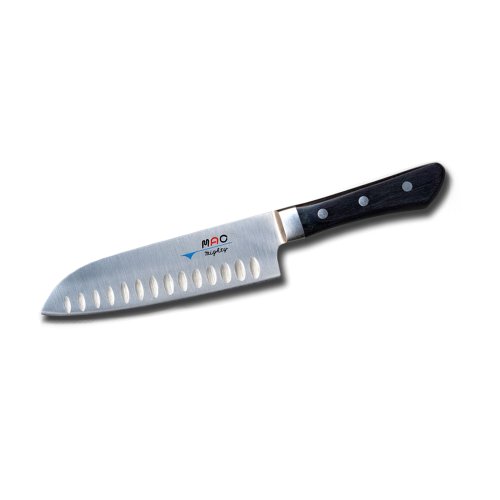
- Best for: Home cooks who mostly push-cut vegetables and want Japanese sharpness with a familiar handle.
- 6.5-inch blade with a hollow (dimpled) edge
- 2.5 mm blade thickness
- Sub-zero tempered alloy steel
- Bolstered construction with a Pakkawood handle

- Best for: First good-knife buyers and vegetable-heavy cooks who want a featherweight blade.
- 6.5-inch blade with a plain edge
- 2.0 mm blade thickness
- High-carbon steel
- No bolster, Pakkawood handle

- Best for: Busy households, beginners, and anyone who wants a santoku they can hand to guests without worrying.
- 7-inch blade, 6.7 inches per Victorinox, with a Granton (scalloped) edge
- Stamped stainless steel construction
- Fibrox textured handle, non-slip when wet
- Made in Switzerland
All 5 Picks at a Glance
| Product | Specs | Action |
|---|---|---|
| MAC Professional 6.5-Inch Hollow Edge Santoku (MSK-65) |
| Check price on Amazon |
| MAC Superior 6.5-Inch Santoku (SK-65) |
| Check price on Amazon |
| Victorinox Fibrox Pro 7-Inch Granton Santoku |
| Check price on Amazon |
 Shun Classic 7-Inch Santoku (DM0702) |
| Check price on Amazon |
 Wüsthof Classic 7-Inch Hollow Edge Santoku (4183-7) |
| Check price on Amazon |
A santoku asks you to cut differently from a chef’s knife, and that is the whole decision. Its shorter, flatter edge and rounded sheep’s-foot tip reward a straight push-cut through onions, carrots, herbs, and boneless meat, rather than the rocking motion of a curved chef’s knife. If your prep is mostly vegetables and you find an eight-inch chef’s knife long or unwieldy, a santoku in the six-and-a-half to seven-inch range feels like the knife your hand was waiting for, while a cook who rocks through garlic and minces herbs may miss the curved belly.
This guide is for home cooks who chop vegetables most nights, cooks with smaller boards or smaller hands who want a nimble daily blade, and gift buyers looking for one beautiful knife rather than a set. Every knife below was picked from its Amazon product listing title and listed specifications, so the blade length, steel, edge style, handle material, and country of origin in each section come from what the listing itself states.
Quick Picks
As an Amazon Associate we earn from qualifying purchases.
| Product | Best for | Key spec from title |
|---|---|---|
| MAC Professional 6.5-Inch Hollow Edge Santoku (MSK-65) | Vegetable-heavy cooks who push-cut every day | 6.5-inch hollow-edge blade |
| MAC Superior 6.5-Inch Santoku (SK-65) | A first good knife that stays light in the hand | 6.5-inch plain-edge blade, 2.0 mm thick |
| Victorinox Fibrox Pro 7-Inch Granton Santoku | Busy households and first-time knife buyers | 7-inch Granton-edge blade, Fibrox handle |
| Shun Classic 7-Inch Santoku (DM0702) | Cooks who want a Damascus showpiece | 7-inch VG-MAX Damascus blade, 16-degree edge |
| Wüsthof Classic 7-Inch Hollow Edge Santoku (4183-7) | Cooks who want forged German heft | 7-inch hollow-edge forged blade, 58 HRC |
How to Choose
Blade length and board space
Santoku blades usually measure six and a half or seven inches, and that half inch matters more than it sounds. A six-and-a-half-inch blade turns easily on a crowded board and suits smaller hands, while a seven-inch blade covers more of a large onion or a head of cabbage in one stroke. Check your board too: a santoku needs enough flat surface for the whole edge to land, so a board much shorter than the blade forces awkward diagonal cuts. If your kitchen runs on a compact board or you prep in a small space, the shorter length is the safer choice.
Steel hardness and how you maintain it
Harder Japanese steel takes a finer edge and holds it longer, which is why thin blades glide through ripe tomatoes and herbs without crushing them. The trade is brittleness: hard steel can chip if you twist the blade, pry with the tip, or cut through bone and frozen food. Softer German steel dulls sooner but forgives rough handling and responds well to a honing steel before each session. Be honest about your habits before choosing, because a knife that matches your maintenance routine will cut better a year from now than a harder blade you never sharpen.
Edge style and food release
A plain edge gives you the cleanest, most predictable cut and the simplest sharpening, since the whole edge meets the stone in one line. Hollow-ground and Granton edges add shallow scallops or dimples along the blade face that break the suction between steel and food, so thin slices of potato, cucumber, and onion fall away instead of clinging. That release helps most when you slice starchy vegetables in volume. If you mostly dice and chop rather than slice thin, a plain edge does the same work with less to think about.
Handle, balance, and care
The handle decides whether a knife disappears into your hand or fights it. Resin-infused wood handles such as Pakkawood feel warm and shaped, textured synthetic handles stay grippy when wet, and a full bolster adds weight at the balance point while making the heel harder to sharpen. A knife should feel balanced at the pinch grip, with the blade neither diving forward nor pulling back toward your wrist. Nearly every knife in this guide needs hand washing and prompt drying, plus storage in a block, on a magnetic strip, or in a sheath rather than loose in a drawer.
The 5 Best Options
MAC Professional 6.5-Inch Hollow Edge Santoku (MSK-65)
- Best for: Home cooks who mostly push-cut vegetables and want Japanese sharpness with a familiar handle.
- 6.5-inch blade with a hollow (dimpled) edge
- 2.5 mm blade thickness
- Sub-zero tempered alloy steel
- Bolstered construction with a Pakkawood handle
Home cooks who mostly push-cut vegetables and want Japanese sharpness with a familiar handle.
The hard, thin steel can chip if you pry, twist, or cut through bone, and the bolstered handle feels blocky to some grips.
The MAC Professional MSK-65 is the santoku for cooks who push-cut vegetables all week and want a thin, eager blade that keeps its edge between sharpenings. Its dimpled hollow edge helps sliced potatoes and cucumbers release instead of sticking, and the bolstered Pakkawood handle gives it a familiar Western feel for anyone moving over from a German chef’s knife. At six and a half inches it steers easily through onions, herbs, and boneless chicken without feeling short on a normal board.
Watch out for: The hard, thin steel can chip if you pry, twist, or cut through bone, and the bolstered handle feels blocky to some grips.
MAC Superior 6.5-Inch Santoku (SK-65)
- Best for: First good-knife buyers and vegetable-heavy cooks who want a featherweight blade.
- 6.5-inch blade with a plain edge
- 2.0 mm blade thickness
- High-carbon steel
- No bolster, Pakkawood handle
First good-knife buyers and vegetable-heavy cooks who want a featherweight blade.
The steel can develop small rust spots if left wet in the sink, and slices cling more without dimples.
The MAC Superior SK-65 is the lightest knife here, a two-millimetre blade that feels almost weightless and slices tomatoes, onions, and herbs with very little pressure. Because it has no bolster, the full edge is easy to sharpen from heel to tip, and the plain edge suits cooks who dice and chop more than they slice thin. It makes a strong first good knife and an equally strong second knife beside a heavier German blade for days when the prep is mostly vegetables.
Watch out for: The steel can develop small rust spots if left wet in the sink, and slices cling more without dimples.
Victorinox Fibrox Pro 7-Inch Granton Santoku
- Best for: Busy households, beginners, and anyone who wants a santoku they can hand to guests without worrying.
- 7-inch blade, 6.7 inches per Victorinox, with a Granton (scalloped) edge
- Stamped stainless steel construction
- Fibrox textured handle, non-slip when wet
- Made in Switzerland
Busy households, beginners, and anyone who wants a santoku they can hand to guests without worrying.
The stamped blade feels light and utilitarian, and the softer steel needs honing more often than Japanese steel.
The Victorinox Fibrox Pro is the santoku to buy when the knife will be used by everyone in the house and nobody wants to baby it. Its stamped stainless blade is softer and thicker than the Japanese picks, so it tolerates bumps, twists, and the occasional hard squash without complaint, while the Granton scallops help thin slices release. The textured Fibrox handle stays secure when hands are wet or greasy, which is exactly when a knife needs to stay put.
Watch out for: The stamped blade feels light and utilitarian, and the softer steel needs honing more often than Japanese steel.
Shun Classic 7-Inch Santoku (DM0702)
- Best for: Cooks who care about looks as much as cutting, gift buyers, and owners of other Shun Classic knives.
- 7-inch blade with a plain edge
- VG-MAX core with 68-layer Damascus stainless cladding
- 16-degree edge angle per side
- D-shaped Pakkawood handle
Cooks who care about looks as much as cutting, gift buyers, and owners of other Shun Classic knives.
There is no hollow edge, so wet slices can stick, and the hard steel can chip on bone or frozen food.
The Shun Classic DM0702 is the knife to choose when looks matter as much as cutting, because its rippled Damascus cladding turns a daily tool into something you notice every time you pick it up. Under the pattern sits a VG-MAX core ground to a sixteen-degree edge on each side, which slices cleanly through vegetables and boneless meat, while the D-shaped Pakkawood handle works for both left- and right-handed cooks. Shun also offers free sharpening and honing, a genuine perk for cooks who do not sharpen at home.
Watch out for: There is no hollow edge, so wet slices can stick, and the hard steel can chip on bone or frozen food.
Wüsthof Classic 7-Inch Hollow Edge Santoku (4183-7)
- Best for: Owners of Wüsthof Classic knives and cooks who want heft for hard vegetables like squash and sweet potatoes.
- 7-inch blade with a hollow (Granton-style) edge
- High-carbon stainless steel, 58 HRC
- PEtec precision edge technology
- Forged, full tang, full bolster, triple-riveted construction
Owners of Wüsthof Classic knives and cooks who want heft for hard vegetables like squash and sweet potatoes.
The full bolster makes sharpening the heel harder over time, and the knife is noticeably heavier than the Japanese picks.
The Wüsthof Classic 4183-7 is the santoku for cooks who like weight in the hand and want German durability in a flatter, push-cut shape. Forged from a single piece of high-carbon stainless steel with a full tang, a full bolster, and a triple-riveted handle, it powers through dense squash and root vegetables where lighter blades hesitate, and the hollow-edge grooves keep thin slices from clinging. Its softer steel takes honing well and resists chipping, so it suits a cook who is rough on knives.
Watch out for: The full bolster makes sharpening the heel harder over time, and the knife is noticeably heavier than the Japanese picks.
Which One Fits Your Situation
You chop vegetables every night
Pick the MAC Professional MSK-65. Its thin, dimpled blade is built for the push-cut rhythm of nightly vegetable prep, the hollow edge keeps starchy slices from sticking, and the bolstered Western-style handle feels natural from the first onion. It holds its edge well between sharpenings, so it stays pleasant through a week of dinners rather than fading by Wednesday.
You want one beautiful knife as a gift
Pick the Shun Classic DM0702. The Damascus cladding makes it feel like a gift the moment it comes out of the box, and the sixteen-degree VG-MAX edge cuts as good as it looks. The D-shaped handle suits either hand, and Shun’s free sharpening service means the recipient never has to learn whetstone technique to keep it keen.
You share a kitchen with beginners
Pick the Victorinox Fibrox Pro. Its grippy handle stays secure with wet hands, the forgiving stamped steel tolerates the bumps and twists that chip harder blades, and the Granton edge still releases slices cleanly. It is the knife you can hand to a guest or a teenager without hovering, and the lifetime warranty covers defects for the long run.
You already own German knives and want a Japanese edge
Pick the MAC Superior SK-65. Its two-millimetre blade and plain edge show you what thin Japanese steel does differently, gliding through tomatoes and herbs with far less pressure than a German blade, while the Pakkawood handle keeps the feel familiar. With no bolster to work around, it is also the easiest knife here to sharpen, so it teaches good habits.
Common Mistakes
- Buying a santoku to rock-chop like a chef’s knife, then blaming the flat edge when herbs bruise instead of mincing cleanly.
- Choosing the hardest steel available without a sharpening plan, so a premium blade ends up duller than a softer one that gets honed regularly.
- Cutting through bone, frozen food, or hard squash rind with a thin Japanese blade, which is the fastest way to chip the edge.
- Leaving a high-carbon blade wet in the sink, where rust spots form long before the next wash.
- Storing knives loose in a drawer, which dulls edges against other utensils and turns every reach into a cut risk.
Frequently Asked Questions
What size santoku knife should I buy?
Seven inches suits most home cooks and most boards, giving enough edge to cross a large onion in one stroke. Choose six and a half inches if your board is compact, your hands are smaller, or you prep in a tight space, since the shorter blade turns more easily. Either length handles daily vegetable prep, so board size and hand comfort should decide.
Is a santoku better than a chef’s knife?
Neither shape is better in general; they suit different cutting styles. A santoku excels at straight push-cuts and slicing vegetables, fish, and boneless meat, while a chef’s knife with a curved belly rocks through herbs and garlic and handles larger jobs like carving. Many cooks keep both, reaching for the santoku for vegetables and the chef’s knife for everything else.
What is a Granton or hollow edge?
A Granton or hollow edge has shallow scallops or dimples ground into the blade face near the edge. They break the suction between steel and food, so thin slices of potato, cucumber, and onion fall away instead of clinging to the blade. The feature helps most when slicing in volume and matters less for dicing and chopping.
How do I care for a santoku knife?
Hand wash with mild soap and dry the blade right away, especially high-carbon Japanese steel that can spot if left wet. Hone softer German steel before use and sharpen harder Japanese steel a few times a year, either on a whetstone or through a professional service. Store the knife in a block, on a magnetic strip, or in a sheath, and use wood or soft plastic boards.


Write Your Review
No reviews yet. Be the first to share your experience!