
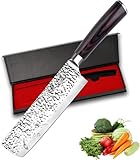
- Top Pick: HOSHANHO 7 Inch Nakiri Knife, Ultra Sharp Japanese Kitchen Chef Knife
- Best Value: PAUDIN Nakiri Knife – 7" Razor Sharp Meat Cleaver and Vegetable Kitchen Knife, High Carbon Stainless Steel, Multipurpose Asian Chef Knife for Home and Kitchen with Ergonomic Handle
- Premium Choice: Sunnecko Nakiri Knife – 7" Chef Knife for Meat Cleaver Vegetable Chopping
A sharp nakiri knife can make vegetable prep faster, cleaner, and more controlled—but shoppers often focus on the wrong specifications. A dramatic “razor sharp” claim does not tell you how long the edge will last. A high hardness number does not guarantee a comfortable handle. And a heavier, cleaver-like profile is not automatically better for chopping.
The best choice depends on your cutting habits, hand size, sharpening routine, and budget. A nakiri is a Japanese-style vegetable knife with a straight or nearly straight edge, a broad blade, and a squared-off tip. It excels at push-cutting, slicing, and chopping produce; it is not designed for splitting bones, prying, or heavy rocking cuts. Use the following guide to decide what actually matters before buying one in 2026.
As an Amazon Associate we earn from qualifying purchases at no extra cost to you.


Decide These 3 Things First
- Choose your preferred size. Most nakiri knives measure 6 to 7 inches at the blade. A 6-inch knife is easier to control, while a 7-inch model offers more cutting capacity for cabbage, squash, and large onions.
- Set a sharpening and maintenance routine. If you will sharpen at home, look for a durable stainless steel blade and a conventional double bevel. If you rarely sharpen, prioritize edge retention and a retailer with a useful return policy.
- Define your real budget. A serviceable nakiri can cost $25 to $40, a well-balanced midrange model usually falls between $45 and $80, and premium options commonly begin around $90. Price alone is not a substitute for good geometry or a comfortable handle.
Size and Blade Geometry
For most home cooks, a 6.5- to 7-inch blade is the safest starting point. It provides enough length for a large cutting board without feeling unwieldy. A 6-inch blade suits smaller hands, compact kitchens, and cooks who make precise cuts rather than large-volume batches. Blades longer than 7 inches can be useful for meal prep, but they may feel front-heavy and are less convenient on a crowded board.
Look for a blade height of roughly 1.75 to 2.25 inches. More height gives your knuckles clearance and makes the knife feel substantial, while a narrower blade can be nimble but may force your fingers closer to the board. A spine thickness of approximately 1.5 to 2.2 millimeters is typical for a nimble nakiri. Thicker blades can feel sturdy, but excessive thickness may wedge through dense carrots or sweet potatoes.
The edge should be straight or have only a very slight belly. This shape is intended for a push cut: move the blade forward and down instead of rocking it dramatically. An edge angle around 10 to 15 degrees per side is common on sharper Japanese-style knives. Angles closer to 15 degrees per side generally provide a little more durability for everyday home use.
Blade Material and Edge Retention
High-carbon stainless steel is usually the most practical material for a home nakiri. It can offer good sharpness and edge retention while resisting the staining and rust associated with reactive carbon steel. Many affordable knives use unnamed or broadly described stainless alloys, so do not assume “high carbon” identifies a specific grade or guarantees superior performance.
When a steel type is provided, common stainless options include VG-10, AUS-8, AUS-10, 9Cr18MoV, and similar kitchen-grade alloys. Hardness around 56 to 60 HRC is a useful range for general use. Harder blades may stay sharp longer, but they can be more brittle and less forgiving of twisting or contact with bones. Softer steel is often easier to sharpen and may tolerate beginner mistakes better.
Consider how you wash the knife, too. A dishwasher cycle can expose the blade and handle to heat, detergent, impact, and prolonged moisture. Even a corrosion-resistant knife should be hand-washed, dried immediately, and stored so its edge cannot strike other utensils.
Construction: Forged, Stamped, and Tang Design
“Forged” is not automatically better than “stamped.” Forging can produce a substantial, balanced knife, but a carefully made stamped blade may be lighter, thinner, and excellent at vegetable prep. Judge the actual blade thickness, balance, finish, and handle rather than relying on the construction label.
A full tang extends the blade steel through the handle and is often associated with strength and a solid feel. It is not essential for a light vegetable knife, but it can improve durability and balance. Look for a handle attached with two or more secure rivets, with no gaps where food or water can collect.
A bolster—the thicker section between blade and handle—can protect fingers, but a large bolster may make sharpening the heel difficult and add unnecessary weight. For a nakiri, a minimal bolster or no bolster often makes more of the edge usable. A visible, even grind and a straight edge are more important than decorative hammering or a polished logo.
Comfort, Balance, and Cutting Performance
Comfort depends on your hand, not just the listed dimensions. A handle length of about 4.5 to 5 inches accommodates many adults, while an oval or gently contoured shape is easier to control than a very angular handle. The grip should feel secure when dry and should not force your index finger against a sharp transition near the blade.
Typical nakiri weights range from 5.5 to 9 ounces. Lighter knives can feel quick during repetitive chopping; heavier models may provide momentum through firm vegetables. Balance near the pinch grip—roughly at or just ahead of the bolster—usually gives the best combination of control and stability.
Do not confuse a thick blade with a strong blade. A nakiri should glide through vegetables rather than wedge them apart. If the product description shows a very thick spine, a pronounced meat-cleaver profile, or language about chopping bones, it may be a general-purpose cleaver rather than a refined nakiri. Also check whether the knife is double-beveled. A symmetrical edge is simpler for most cooks to maintain than a single-bevel design.
Price Tiers: What You Get for Your Money
Budget, $20 to $40: Expect a stainless blade, basic synthetic or wood-look handle, and acceptable sharpness out of the box. Quality control can vary, so inspect the edge and handle as soon as it arrives. The Sunnecko 7-inch model, listed at $24.99, and the PAUDIN model, listed at $32.99, fit this general price category. These prices are examples and can change.
Midrange, $45 to $80: This tier is often the sweet spot for home cooks. You may get a better-specified steel, cleaner finishing, improved balance, and a more comfortable handle. The HOSHANHO 7-inch model is listed at $64.99, making it an example of this range.
Premium, $90 and above: Higher prices may buy a known steel, more consistent grinding, a refined handle, and better finishing. They do not make the knife maintenance-free. The imarku model listed at $79.99 sits near the top of the midrange rather than clearly in premium territory. Compare the actual materials and support before paying extra for Damascus-style patterns or ornate packaging.
Warranty, Returns, and Delivery
A kitchen knife requires no assembly, but delivery and after-sale support still matter. Choose a seller that clearly states the return window—30 days is a useful minimum—and explains what happens if the blade arrives bent, scratched, dull, or loose in the handle. A warranty of one to five years can be reassuring, although warranty coverage may exclude misuse, sharpening, rust, or dishwasher damage.
Check the package contents before using the knife. A sheath or edge guard is useful if the knife will be stored in a drawer, but it should not trap moisture against the blade. During shipping, the blade should be protected by a rigid guard or secure packaging. If the box arrives crushed or the knife has visible damage, photograph it before discarding the packaging.
Spec Checklist
| Spec | Budget | Mid | Premium |
|---|---|---|---|
| Blade length | 6 to 7 in. | 6.5 to 7 in. | 6 to 7 in. |
| Blade height | 1.75 to 2.25 in. | 1.9 to 2.25 in. | 1.8 to 2.2 in. |
| Spine thickness | 1.8 to 2.5 mm | 1.5 to 2.2 mm | 1.5 to 2 mm |
| Steel hardness | 54 to 58 HRC | 56 to 60 HRC | 58 to 62 HRC |
| Weight | 6.5 to 10 oz. | 5.5 to 9 oz. | 5 to 8.5 oz. |
| Typical price | $20 to $40 | $45 to $80 | $90 to $200+ |
| Return policy | At least 30 days | 30 to 60 days | 30 to 90 days |
Red Flags
- Unrealistic sharpness promises: Claims such as “never needs sharpening” are marketing, not a maintenance plan.
- No steel or hardness information: A listing does not need to reveal every manufacturing detail, but it should identify the blade material clearly enough to compare it.
- Conflicting measurements: Watch for a title that says 7 inches while the specifications list a 6-inch blade or confusing total length with cutting length.
- “Meat cleaver” positioning: A nakiri can handle vegetables and some boneless proteins, but bone chopping suggests the wrong tool and may indicate a thick, heavy profile.
- Unclear edge description: Look for double bevel, edge angle, or at least a clear statement that the knife is intended for right- and left-handed users.
- Loose or slick handles: Avoid handles with visible gaps, rough seams, exposed tang edges, or an excessively polished surface that becomes slippery when wet.
- Dishwasher instructions: A seller that encourages dishwasher cleaning is not prioritizing long-term edge and handle care.
FAQ
Is a nakiri knife better than a chef’s knife for vegetables?
It can be, especially for straight push cuts and repetitive chopping. The wide blade offers knuckle clearance and can transfer chopped food from the board. A chef’s knife is more versatile for rocking cuts, herbs, carving, and occasional proteins. Many kitchens benefit from owning both.
What is the best nakiri blade length?
For most home cooks, 6.5 to 7 inches is the best compromise. Choose 6 inches if you have smaller hands, limited counter space, or prefer a lighter knife. Choose 7 inches if you regularly prepare large vegetables or batch-cook.
How often should a nakiri be sharpened?
Honing does not replace sharpening, and many Japanese-style knives should not be treated with an aggressive honing steel. Depending on use, a home cook may need sharpening every two to six months. Use a whetstone or a reputable professional service, and stop using the knife if the edge chips or the blade develops a bend.
Can a nakiri knife cut meat?
It can slice boneless meat, but it is primarily a vegetable knife. Do not use it on bones, frozen food, hard pits, or other items that require twisting or forceful chopping. For those tasks, use a dedicated cleaver or boning knife designed for the job.
Ready to decide? Our #1 pick for 2026 is the Blade length.
Live price & availability on Amazon.





Write Your Review
No reviews yet. Be the first to share your experience!