
Choosing a silicone spatula looks simple until you are standing in front of dozens of nearly identical sets. The biggest mistake is buying based only on a large temperature number or a bright color. A spatula labeled “600°F heat resistant” may still have a handle that becomes uncomfortable, a thin edge that folds under thick dough, or a glued joint that traps food.
Other common errors include choosing a set with five tools when you really need one sturdy turner, overlooking the difference between a scraper and a flipper, and assuming that all silicone is equally flexible. The best choice depends on your cookware, cooking habits, storage space, and how much force the tool must handle. Use the guide below to compare materials, dimensions, construction, and real-world value before you buy.
As an Amazon Associate we earn from qualifying purchases at no extra cost to you. Product prices and availability are accurate as of the date shown and are subject to change.

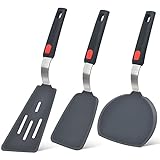
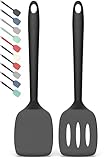
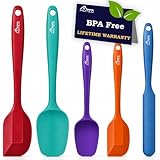
Decide These 3 Things First
- What will you cook? A flexible scraper is useful for batter, sauces, and jars, while a broad, firm turner is better for eggs, pancakes, and burgers.
- What cookware do you own? Silicone is generally safer for nonstick and enameled surfaces than metal, but the working head still needs a thin, controlled edge.
- How often will you use it? Occasional cooks may prefer an inexpensive multipack. Daily cooks should prioritize a one-piece design, a comfortable grip, and a head that does not bend excessively.
Once those decisions are clear, compare the following factors. A low-cost set can be perfectly useful, but it should meet the same basic requirements as a more expensive model.
Size and Shape
Size determines whether a spatula feels precise or awkward. For scraping bowls and folding ingredients, look for a head approximately 2 to 2.5 inches wide and 8 to 10 inches long overall. A smaller head reaches into narrow jars and small saucepans, while a wider head covers more surface area when spreading frosting or batter.
For stovetop turning, a head around 3 to 4 inches wide and 7 to 9 inches long is more practical. A slotted turner lets oil and sauces drain and usually feels lighter. A solid turner is better for delicate foods that might break through slots. For pancakes, fish, and grilled sandwiches, an angled leading edge is helpful because it slides underneath food more easily.
Check the total length, not just the silicone head. A spatula measuring 12 to 14 inches can keep your hand farther from a hot pan, but it may be cumbersome in a small skillet or crowded utensil drawer. Heads thicker than about 0.2 inches tend to feel sturdier for heavy mixtures, while very thin heads are more flexible for scraping.
Material and Heat Ratings
Look for food-contact silicone with a clearly stated temperature range. Many everyday spatulas are rated from approximately 400°F to 450°F, while higher-rated products commonly claim 500°F to 600°F. These figures describe the manufacturer’s stated limit, not a recommendation to leave the tool resting in a hot pan.
For ordinary stovetop cooking, a rating of at least 400°F is usually sufficient. If you frequently stir candy, caramel, deep-frying oil, or food in a very hot cast-iron skillet, a stated rating of 500°F or more provides a wider margin. Never assume the entire tool has the same rating: a silicone head may tolerate high heat while a nylon handle, adhesive, or decorative coating cannot.
“BPA-free” is useful information, but it does not by itself prove durability or temperature performance. Prefer listings that identify the working material as food-grade silicone and provide care instructions. Silicone should remain relatively odor-free and should not become sticky, chalky, or visibly cracked after normal washing. A strong chemical smell that persists after cleaning is a reason to return the product.
One-Piece Construction
The joint between the handle and the head is one of the most important buying details. A one-piece silicone spatula has no seam, rivet, or separate head for food to collect around. It is usually easier to clean and less likely to loosen over time.
Two-piece designs can still work well when the silicone head is thick and securely attached to a rigid internal handle. Look closely at product photographs for gaps wider than about 1 millimeter, exposed metal, or a head that appears to slide over the handle. If the head is removable, confirm whether it is intended to go in the dishwasher and whether the handle has a sealed end.
For a scraper, a reinforced internal core can make the tool more useful with thick cookie dough, mashed potatoes, or nut butter. The core should not be exposed at the edge or tip. A turner needs enough stiffness to lift food without folding in half, but it should still have a flexible leading edge that follows the pan.
Comfort and Cooking Performance
Handle comfort matters more than many shoppers expect. A useful handle is generally 4.5 to 6 inches long, with a diameter around 0.75 to 1.25 inches. Very narrow handles may feel tiring during prolonged stirring; oversized handles can be difficult for smaller hands to control.
Look for a gently contoured grip with a matte or lightly textured finish. Smooth silicone can become slippery when coated with oil. A hanging hole is convenient, but it should not create a sharp edge or weaken the handle near the head. If you cook with small pans, choose a lighter tool weighing roughly 1 to 3 ounces. Heavier, reinforced turners may weigh 3 to 5 ounces and can feel more stable when lifting dense foods.
Flexibility should match the task. A scraper that bends about 30 to 45 degrees under moderate hand pressure can conform to a bowl. A turner should flex mainly at the front third of the head rather than folding along its entire length. If the product listing offers no close-up image of the edge, customer photos can help reveal whether it is floppy, thick, or uneven.
Price Tiers and Set Value
Budget silicone sets commonly cost about $8 to $15 for three to five pieces. Examples in this range include sets similar to the ChefAide five-piece set at $8.99, the Coukre two-piece set at $9.99, and the HOTEC five-piece set at $8.97. These are attractive for a first kitchen or backup drawer, but inspect the exact dimensions and construction because piece counts often include small tools.
Midrange sets usually cost $16 to $30 for two to five pieces. A product such as the Beijiyi three-piece set, listed at $17.99, represents the type of purchase where shoppers may get higher stated heat resistance, more substantial handles, or more useful turner shapes. The extra cost is worthwhile when the set replaces several specialized tools rather than adding duplicates.
Premium silicone spatulas and professional-style individual tools often cost $12 to $25 each, or approximately $30 to $60 for a coordinated set. At this level, pay for better construction, balanced weight, replaceable or removable parts only when they are genuinely useful, and a clearly documented warranty. Do not pay more simply for additional colors or a higher temperature claim without supporting care information.
Warranty and Product Support
A basic kitchen tool may not include a formal warranty, but a reliable seller should still provide a return window of at least 30 days. For a premium set, look for a one-year warranty or a clear replacement policy covering cracks, separation, or manufacturing defects.
Read the exclusions. Normal staining, heat damage caused by direct contact with an oven rack, and knife cuts are often excluded. Keep the order confirmation and photograph a defect before discarding the product. A brand that publishes an email address, care instructions, and a specific return process is generally easier to deal with than a listing that provides only a generic product description.
Delivery and Assembly
Most silicone spatulas arrive ready to use, so assembly should not be a deciding feature. If a set requires attaching handles or inserting heads, check that the connection is secure before the first use. Do not use a tool with a loose head, exposed wire, or a gap that cannot be thoroughly cleaned.
For online purchases, check the delivered dimensions and package count. Some multipacks include miniature 6-inch spatulas intended for jars rather than full-size cooking tools. Delivery packaging should protect the heads from permanent bends. A slight temporary curve is usually harmless, but a sharply creased edge may prevent the spatula from contacting a pan evenly.
Spec Checklist
| Spec | Budget | Mid | Premium |
|---|---|---|---|
| Typical price | $8–$15 per set | $16–$30 per set | $30–$60 per set or $12–$25 each |
| Stated heat rating | 400°F–450°F | 450°F–550°F | 500°F–600°F, with full material details |
| Useful set size | 2–5 pieces | 2–5 task-specific pieces | Individual tools or 3–6 coordinated pieces |
| Overall length | 10–13 inches | 11–14 inches | 11–15 inches, depending on use |
| Scraper head width | 1.75–2.5 inches | 2–2.75 inches | 2–3 inches |
| Construction | Attached head; inspect seam | Reinforced or one-piece design | Seamless one-piece or exceptionally secure core |
| Warranty or returns | At least 30-day return window | 30-day return window, possible limited warranty | 30-day return window plus approximately 1-year warranty |
Red Flags
- Only a temperature number: A 600°F claim without material details, care instructions, or handle limitations is incomplete.
- Unclear product dimensions: “Large” and “ergonomic” do not tell you whether the tool is suitable for a skillet or jar.
- Loose or uneven joints: Gaps, exposed cores, and sliding heads can trap food and fail prematurely.
- Excessive flexibility: A turner that folds under light pressure will be frustrating for heavy foods.
- Persistent odor or stickiness: Wash the item according to instructions, but return it if the problem remains.
- Unrealistic piece counts: A 10-piece set may include several tiny tools and offer less value than a durable two-piece set.
- No clear return information: Kitchen tools should be easy to replace if the head arrives warped or damaged.
FAQ
What heat rating should a silicone spatula have?
For general stovetop cooking, choose at least 400°F. A rating of 450°F to 600°F is useful for high-heat tasks, but do not leave any spatula resting in a hot pan or touching an exposed heating element. Always follow the product’s care instructions.
Are silicone spatulas safe for nonstick cookware?
Yes, silicone is typically a good choice for nonstick surfaces because it is softer than metal. Use a clean, intact edge and avoid cutting, scraping burned residue aggressively, or using a spatula with an exposed internal core.
Is a one-piece silicone spatula better?
Usually. One-piece construction minimizes seams where food and moisture can collect and often improves durability. A well-made two-piece model can also perform well if the head is securely fitted and the joint is easy to clean.
Should I buy a set or one individual spatula?
Buy a set if you need several shapes for scraping, spreading, stirring, and turning. If you mainly cook on the stovetop, one sturdy turner and one flexible scraper may be more useful than a five-piece assortment. Compare the actual sizes and functions rather than the number of pieces alone.
Ready to decide? Our #1 pick for 2026 is the Typical price.
Live price & availability on Amazon.





Write Your Review
No reviews yet. Be the first to share your experience!