
- Top Pick: HOSHANHO 7 Inch Nakiri Knife, Ultra Sharp Japanese Kitchen Chef Knife
- Best Value: PAUDIN Nakiri Knife – 7" Razor Sharp Meat Cleaver and Vegetable Kitchen Knife, High Carbon Stainless Steel, Multipurpose Asian Chef Knife for Home and Kitchen with Ergonomic Handle
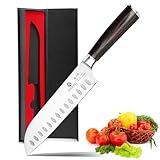
- Premium Choice: imarku Santoku Knife 7 Inch with Sharp Japanese High Carbon Stainless Steel
Choosing between a nakiri and a santoku for vegetable chopping is less about finding the “best” Japanese-style knife and more about matching the blade to your cutting habits, counter space, and tolerance for maintenance. Both are excellent home-kitchen options, but they behave differently on a cutting board.
A nakiri is purpose-built for vegetables, with a straight edge and squared-off blade that encourages an up-and-down chopping motion. A santoku is a more versatile all-rounder, combining a relatively straight cutting edge with a gently curved tip for slicing, chopping, and light mincing. The real decision is whether you want maximum vegetable efficiency or one knife that can handle vegetables, boneless proteins, herbs, and everyday prep.
As an Amazon Associate we earn from qualifying purchases at no extra cost to you. Product prices and availability are accurate as of the date shown and are subject to change.



Quick Verdict
Choose a nakiri if vegetables make up most of your cooking and you prefer fast, controlled chopping. Its broad, flat blade makes it easy to cut carrots, onions, cabbage, zucchini, and potatoes in a clean vertical motion. It also transfers chopped food conveniently from the board to a pan.
Choose a santoku if you want one compact knife for vegetables plus boneless meat, fish, fruit, herbs, and general kitchen work. Its pointed tip is more useful for detail work, while its modest curve supports a wider range of cutting techniques.
For many households, a santoku is the safer first purchase. For a dedicated vegetable cook, a nakiri can feel more natural and efficient almost immediately.
Side by Side
| Consideration | Nakiri | Santoku |
|---|---|---|
| Primary purpose | Vegetable chopping and slicing | Vegetables, herbs, fruit, boneless meat, and fish |
| Typical blade size | 6.5 to 7 inches long; about 1.75 to 2.25 inches tall | 6.5 to 7 inches long; about 1.5 to 2 inches tall |
| Typical weight | 5 to 8 ounces, depending on steel and handle | 5 to 8.5 ounces, depending on construction |
| Comfort | Broad blade and balanced chopping motion; excellent for repetitive prep | Compact, nimble, and comfortable for mixed tasks |
| Durability | Strong for normal produce; avoid bones, frozen foods, and twisting | Strong for everyday prep; the tip needs care around hard food |
| Price range | About $30 to $80 for common home models | About $25 to $75 for common home models |
| Maintenance | Hand-wash, dry promptly, and sharpen a relatively straight edge | Hand-wash, dry promptly, and maintain both edge and pointed tip |
| Space needed | About 12 to 14 inches of drawer or magnetic-strip length | About 12 to 14 inches of drawer or magnetic-strip length |
| Look | Distinctive squared-off, cleaver-like silhouette | Familiar rounded-tip profile with a versatile chef-knife appearance |
| Best for | Vegetable-heavy cooking and straight-down chopping | One-knife kitchens and cooks who switch between ingredients |
Where Nakiri Wins
The nakiri’s greatest advantage is contact with the cutting board. A typical nakiri has a nearly straight edge from heel to front, so more of the blade meets the board during a vertical chop. That makes it particularly effective for dense vegetables such as sweet potatoes, carrots, onions, and winter squash, provided the food is stable and the blade is used without forceful twisting.
Its tall blade also gives your knuckles extra clearance. The broad surface can guide straight cuts and makes it easier to scoop sliced vegetables into a bowl. When preparing several pounds of produce for soup, stir-fry, or meal prep, that extra blade height is practical rather than decorative.
Nakiri knives are also approachable for cooks who have not mastered a rocking motion. Instead of lifting the handle and rolling the edge forward, you can use a simple push cut or straight chop. This can feel more predictable in a small kitchen where the cutting board is close to the counter edge or wall.
There are trade-offs. A nakiri’s squared front is not designed for piercing packaging, trimming around joints, or delicate tip work. It is also not a substitute for a cleaver: do not use it on bones, frozen food, or hard materials. The flat profile rewards a stable cutting board and regular sharpening, because dullness is especially noticeable when making repeated straight cuts.
In the current home market, a 7-inch option such as the HOSHANHO 7 Inch Nakiri Knife, listed at $64.99, sits toward the upper end of the referenced price range. A lower-cost choice such as the PAUDIN Nakiri Knife at $32.99 shows how widely prices can vary without changing the basic nakiri design.
Where Santoku Knife for Vegetable Chopping Wins
A santoku is usually the better compromise for a household that wants one primary knife. Its edge is fairly flat near the heel but curves gently toward the tip, allowing both push cuts and a limited rocking motion. That flexibility helps when moving from diced onions to minced herbs, sliced chicken breast, or boneless fish.
The pointed front is useful for starting cuts, removing pepper stems, separating lettuce leaves, and making small incisions. It is not as agile as a paring knife, but it covers more detail work than a squared nakiri. For cooks who prepare vegetables alongside proteins at nearly every meal, that versatility can eliminate the need to buy and store multiple knives.
Santokus are often comfortable in smaller hands because their 6.5- to 7-inch blades are shorter than many Western chef’s knives. They are also easy to maneuver on a 12-by-16-inch cutting board, a common size in apartments and compact kitchens. Dimples or hollow-ground sections on some models may reduce sticking with potatoes or cucumbers, although the pattern is not a guarantee that food will never cling.
The imarku Santoku Knife 7 Inch with Sharp Japanese High Carbon Stainless Steel is listed at $28.99, while the Cutluxe Santoku Knife, 7-inch Meat & Vegetable Chopping Knife, is listed at $29.98 and includes a sheath. These products illustrate why a santoku can be an economical entry point for an all-purpose kitchen knife.
A santoku does have limits. Its tip is more vulnerable to damage from prying or twisting, and its curved edge may not place as much steel on the board during a strict up-and-down chopping motion. If nearly every meal begins with a large pile of vegetables, a nakiri may feel faster and more stable.
Cost Over 5 Years
The purchase price is only part of the cost. A reasonable five-year ownership estimate should include sharpening, storage, and possible replacement. For a $30 knife used regularly, assume one professional sharpening each year at $10 to $20, or roughly $50 to $100 over five years. A $65 knife may have the same sharpening cost, but replacing it once because of loss, rust, or accidental damage changes the total substantially.
| Five-year scenario | Estimated total | Assumption |
|---|---|---|
| Budget nakiri or santoku | $80 to $140 | $30 to $40 purchase plus five sharpenings at $10 to $20 each |
| Mid-priced knife | $120 to $185 | $55 to $85 purchase plus sharpening and a basic $10 to $20 guard |
| Replacement scenario | Add $30 to $85 | A second knife is needed because the original is lost or damaged |
Home sharpening can reduce the long-term cost, but a decent whetstone or guided sharpener may cost $25 to $80 initially. Whichever profile you choose, hand-washing, prompt drying, and storing the blade in a block, tray, or sheath are usually more important to longevity than paying for a premium finish.
Which One for Your Home
Small apartment
Pick a santoku if storage and counter space are limited. Its versatility means one 7-inch knife can handle most meal preparation, reducing the need for separate chef’s and utility knives. A blade guard or compact drawer tray is preferable to leaving it loose in a crowded utensil drawer.
Family with kids or pets
Choose based on your prep volume, but prioritize safe storage over blade style. A nakiri is excellent for processing large amounts of produce, while a santoku is better when meals involve a changing mix of vegetables and boneless proteins. Either knife should be kept in a secured block, locked drawer, or high magnetic strip that children and pets cannot reach.
Rental kitchen
A santoku is generally the practical choice because it does more jobs without requiring extra storage. Renters may also prefer a model in the $25 to $40 range, where replacing a misplaced knife is less painful. If vegetables are the center of your cooking and you already own a separate protein knife, a nakiri makes sense instead.
Long-term home
Buy the knife that matches your repeated habits rather than the room itself. A dedicated vegetable cook should choose a nakiri, especially if daily prep involves cabbage, carrots, onions, and root vegetables. A household with varied cooking styles will likely get more value from a santoku. In either case, handle comfort, balance, and a properly sized cutting board matter more than decorative blade patterns.
FAQ
Is a nakiri better than a santoku for vegetables?
It can be, particularly for straight-down chopping and high-volume vegetable preparation. The nakiri’s flat edge and tall blade create a stable, board-focused cutting experience. A santoku remains better if you also need one knife for herbs, fruit, boneless meat, and fish.
Can a santoku replace a nakiri?
For most home cooks, yes. A santoku can chop, slice, and dice vegetables effectively. It simply offers a more rounded set of abilities rather than specializing in board-contact chopping. If you routinely prepare large quantities of produce, you may notice the nakiri’s advantage in comfort and rhythm.
Which knife is easier to sharpen?
A nakiri is usually simpler because its edge is nearly straight and its squared front has no delicate point to work around. A santoku is still straightforward to sharpen, but you need to maintain its changing curve and avoid applying pressure to the tip. A professional sharpener can handle either profile.
Should I buy a 6-inch or 7-inch blade?
A 6-inch blade is easier to control on a small board and may suit smaller hands. A 7-inch blade offers more cutting capacity for large onions, cabbage, and meal prep while remaining compact compared with a traditional 8-inch chef’s knife. For most adults, 6.5 to 7 inches is a useful middle ground.
Ready to decide? Our #1 pick for 2026 is the Primary purpose.
Live price & availability on Amazon.





Write Your Review
No reviews yet. Be the first to share your experience!