
- Top Pick: Cheese Grater Handheld, HIA Flat Coarse Stainless Steel Graters for Kitchen, Food Grater with Anti-Slip Handle, Perfect for Potato, Vegetable, Butter, Parmesan Cheese
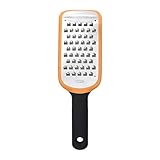
- Best Value: OXO Good Grips Etched Coarse Grater with Handle, Orange
- Premium Choice: Cheese Grater With Container Box Grater Stainless Steel Kitchen Black
When choosing between a flat grater and a box grater for shredded cheese, the real decision is not simply which one makes finer shreds. It is whether you value compact storage and quick cleanup or stability, capacity, and versatility. A flat grater is easy to tuck into a drawer and works well when you need a modest amount of cheese. A box grater takes up more room but gives you a steady surface, several shred sizes, and enough capacity for a casserole, pizza night, or large salad.
Both styles are manual tools, so neither uses electricity or has a wattage rating. The better choice depends on your kitchen size, how much cheese you typically grate, and whether you also want to process vegetables, butter, chocolate, or Parmesan. Here is how the two designs compare for everyday home cooking in 2026.
As an Amazon Associate we earn from qualifying purchases at no extra cost to you. Product prices and availability are accurate as of the date shown and are subject to change.



Quick Verdict
Choose a flat grater if you want the lowest-cost, easiest-to-store option for small portions of shredded cheese. Most flat graters measure about 10 to 13 inches long, weigh roughly 2 to 5 ounces, and slide into a utensil drawer. They are especially convenient for grating cheese directly over tacos, pasta, eggs, or a baked potato.
Choose a box grater if you regularly shred 4 ounces or more at once, want multiple grating surfaces, or prefer a tool that stays upright on the counter. A typical box grater is approximately 9 to 12 inches tall, 4 to 5 inches wide, and weighs 8 to 16 ounces. Its larger body catches more cheese and offers better control for bulk preparation.
For a single person or a compact kitchen, a flat grater is usually the more practical purchase. For families, frequent cooks, and anyone preparing shredded cheese for casseroles or meal prep, a box grater is generally worth the extra storage space.
Side by Side
| Factor | Flat Grater | Box Grater |
|---|---|---|
| Comfort | Light and simple, but usually requires one hand to hold it steady | More stable on a counter; the handle and base can improve control |
| Durability | Fewer parts and less metal, with fewer areas to bend or separate | Sturdy models last well, though corners, handles, and welded seams can wear |
| Price range | About $6 to $18 | About $9 to $30, with premium models costing more |
| Maintenance | Quick to rinse and wipe; sharp holes can trap cheese | More surfaces to clean, and the interior may need extra attention |
| Space needed | Usually 10 to 13 inches long and less than 2 inches deep | Usually 9 to 12 inches tall and about 4 to 5 inches wide |
| Look | Minimal, utilitarian, and easy to store out of sight | More substantial; stainless steel or black finishes can look countertop-ready |
| Resale | Limited resale value because inexpensive replacements are common | Better potential if it is a recognizable, well-maintained stainless steel model |
| Capacity | Best for small portions, generally up to about 2 ounces at a time | Better for larger amounts, often 4 to 8 ounces before emptying |
| Best for | Small kitchens, quick garnishes, and direct-to-plate grating | Families, batch cooking, multiple shred sizes, and frequent use |
Where Flat Grater Wins
The biggest advantage of a flat grater is its small footprint. A model can hang from a utensil rail, rest in a narrow drawer, or fit beside a cutting board without competing with a blender or stand mixer. That matters in an apartment kitchen where every few inches of storage counts.
Flat graters are also efficient for small jobs. If you need a handful of cheddar for scrambled eggs or a dusting of Parmesan for pasta, you can grate directly over the bowl or plate. There is no box to empty and no interior chamber where cheese collects. A handle and anti-slip tip make the process more comfortable, although you still need to maintain a firm angle against the work surface.
Entry-level prices are appealing. For example, the Cheese Grater Handheld HIA Flat Coarse Stainless Steel Grater is listed at $6.99, placing this style near the low end of the typical $6-to-$18 range. A coarse flat surface is useful for cheddar, Monterey Jack, mozzarella, potatoes, and butter. Look for etched or stamped stainless steel, a comfortable handle, and a non-slip end rather than focusing only on the lowest price.
A flat grater may also be easier to replace if it becomes dull or develops surface discoloration. Its simple construction has fewer seams and no separate base. However, its light weight can become a disadvantage when grating a hard block of cheese. You may need to hold the grater with one hand while pushing the cheese with the other, which can feel less secure than using a box grater.
Where Box Grater for Shredded Cheese Wins
A box grater is the stronger choice when shredded cheese is a regular ingredient rather than an occasional garnish. Its upright sides provide more cutting area, and the container-like shape catches cheese as it falls. You can shred a whole block without repeatedly stopping to clear the grater or move the cheese into a bowl.
Stability is another major benefit. Many box graters have a rubberized or coated base that grips the counter. The wide shape lets you use a longer downward stroke, which is often easier on the wrist when preparing several cups of cheese. A built-in handle gives you an additional point of control, although a sturdy cutting board or damp towel beneath the base is still useful on slick counters.
Most box graters include at least three or four surfaces: coarse shredding, fine shredding, slicing, and small-hole grating. That versatility can replace several single-purpose tools. The OXO Good Grips Etched Coarse Grater with Handle, Orange, is priced at $14.99 and illustrates the common handled format. A container-style option, Cheese Grater With Container Box Grater Stainless Steel Kitchen Black, is listed at $9.98. The Spring Chef Stainless Steel XL Cheese Grater for Kitchen, Black, is listed at $13.99 and represents the larger-capacity box-grater category.
The tradeoff is cleaning. Cheese can collect inside the box, around the base, or in the corners. Rinsing promptly is important because dried cheese is harder to remove from sharp perforations. If the manufacturer permits dishwasher cleaning, check whether repeated cycles may dull the cutting surfaces or affect non-slip components. Hand washing and immediate drying are often the safest approach for long-term sharpness.
Cost Over 5 Years
Assuming ordinary home use, the purchase price difference is modest. A flat grater costing $6 to $18 works out to roughly $1.20 to $3.60 per year over five years if it remains usable for the full period. A box grater costing $9 to $30 works out to approximately $1.80 to $6 per year.
Those figures do not include replacement cheese, shipping, or the value of your time. They also assume the tool lasts five years, which is reasonable for a basic stainless steel grater when it is dried after washing and stored without bending the surface. A higher-priced box grater may be more economical if it replaces a separate slicer and fine grater. Conversely, buying a box grater with features you never use is not a savings over a $7 flat tool.
For most buyers, capacity and convenience matter more than a few dollars of purchase-price difference. If you grate cheese once a week in small amounts, the flat design offers the better value. If you prepare large meals several times a week, the box grater can save enough time and cleanup frustration to justify its price.
Which One for Your Home
Small apartment
Pick a flat grater when drawer and cabinet space are limited. It can fit beside spatulas and measuring spoons, and it is adequate for one or two servings. Choose a handle with a non-slip grip so the lighter tool feels secure on a compact counter.
Family with kids or pets
A box grater is usually the better option because it stays more stable and handles larger batches. Store it in a high cabinet or drawer, however: both designs have sharp cutting surfaces, and a box grater’s exposed sides can be especially easy for children to touch accidentally. A model with a covered container may also reduce loose shreds on the counter.
Rental
Choose based on storage rather than built-in kitchen features. A flat grater is a sensible low-commitment purchase for a temporary home and costs little to replace. If the rental lacks counter space but includes a deep cabinet, a compact box grater may still be practical for frequent cooking.
Long-term home
Buy the format that matches your routine, not the size of your kitchen. A household that hosts often or makes homemade pizza, enchiladas, and casseroles will benefit from a sturdy box grater. A long-term home cook who mostly finishes individual portions with Parmesan or cheddar may prefer the speed and simplicity of a flat model.
FAQ
Is a flat grater or box grater better for shredded cheese?
A box grater is better for large quantities because it is stable and catches the shreds. A flat grater is better for small quantities and direct-to-plate use. Neither is universally superior; portion size and storage space are the deciding factors.
Can a flat grater shred mozzarella and cheddar?
Yes. Use a coarse surface for cheddar, mozzarella, Monterey Jack, and similar semi-soft cheeses. Chilling soft cheese for 15 to 30 minutes can make it firmer and easier to shred cleanly.
Are box graters difficult to clean?
They take somewhat longer to clean because they have multiple sides and an interior. Rinse immediately after use, brush from the back when possible, and dry the grater fully. Avoid reaching into the cutting surface with a bare finger.
How long should a cheese grater last?
A quality stainless steel grater can last five years or longer with regular home use. Replace it when the holes become noticeably dull, the metal bends, rust appears, or the handle and base no longer remain secure.
Ready to decide? Our #1 pick for 2026 is the Comfort.
Live price & availability on Amazon.





Write Your Review
No reviews yet. Be the first to share your experience!