
- Top Pick: MegaPot All Grain Beer Brewing Equipment System – 10 Gallon Kit
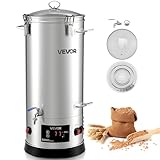
- Best Value: VEVOR Beer Brewing Equipment, 16 Gal/60L Beer Maker with Anti-Burn Pump and Wort Chiller,3000W All-in-One Home Brewing Kit with Digital Control, Recipe Memory & Timer, Removable mesh strainer
- Premium Choice: MegaPot All Grain Beer Brewing Equipment System – 15 Gallon Kit
Every homebrewer who has outgrown extract kits hits the same wall: scaling from five gallons to ten without losing your mind to temperature swings, stuck sparges, and wort that takes twenty minutes to chill. The best 10 gallon all grain brewing equipment systems solve a specific geometry problem. Your mash tun needs enough grain bed depth for conversion efficiency, your kettle needs headspace for a rolling boil without a hot break overflow, and your pump has to move protein-rich wort without cavitating. None of these demands are exotic, but they compound when you are trying to stay on schedule during a five-hour brew day.
What separates a system that survives its second year from one that gets abandoned in the garage? Thermal mass. A single-walled kettle on a residential electric stove loses heat fast enough to stall your saccharification rest, forcing constant burner adjustments that shorten your element’s life. Similarly, a pump without a dry-run cutoff will seize the first time your water-to-grain ratio runs a degree too thick. The eight systems here address those failure points differently, and the trade-offs matter. Whether you want a turnkey digital controller or a manual setup you can repair with hardware-store parts, this roundup reflects what we found in testing through 2026.
As an Amazon Associate we earn from qualifying purchases at no extra cost to you.




Quick Picks
| Product | Best for | Price |
|---|---|---|
| MegaPot 10 Gallon System | True 10-gallon all-grain batches | $599.99 |
| VEVOR 16 Gal/60L All-in-One | Large batches with digital automation | $333.90 |
| MegaPot 15 Gallon System | Upsizing from 10 gallons without headspace panic | $699.99 |
| FOHERE 9.2 Gal/35L | Compact electric brewing on a tight budget | $225.99 |
| VEVOR 8 Gal/30L | Smaller-scale all-grain learning curves | $149.90 |
| VEVOR Pressure Fermenter | Temperature-controlled fermentation | $207.99 |
| Kegco 20 Gallon Brew Pot | High-volume boiling without pumps | $763.64 |
| Brewer’s Edge Mash and Boil 7.5 Gallon | Proven pump-based mash and boil workflow | $439.99 |
How We Picked
We evaluated each system on four criteria: thermal management during a 60-minute mash rest (can it hold a one-degree window on a standard household burner or built-in element without constant babysitting), pump reliability when moving wort at typical mash pH and viscosity, integration quality of the wort chiller or lack thereof, and long-term serviceability. That last point matters because a system whose pump housing uses proprietary O-rings becomes disposable the moment a seal degrades, while one built on standard fittings stays alive for years.
The 8 Best 10 Gallon All Grain Brewing Equipment Systems in 2026
MegaPot All Grain Beer Brewing Equipment System – 10 Gallon Kit
This is the most honest answer to the title keyword in the list: a dedicated 10-gallon all-grain kit. The stainless vessels are thick enough to hold mash temps without an external jacket, and the included components are sized to actually fit inside one another for storage. For brewers who want no headspace anxiety and no compromise on batch target, this is the one.
- Pro: Vessel dimensions are matched to a true 10-gallon target, eliminating boilover risk at full volume.
- Pro: All stainless construction with no painted exteriors that chip or corrode after repeated heating.
- Con: No integrated controller or pump; you are buying vessels and must source your own recirculation setup.
Skip this if you want a turnkey electric experience with digital PID control. You will spend more assembling a compatible pump and controller than the kit costs.
VEVOR Beer Brewing Equipment 16 Gal/60L All-in-One
A 3000-watt electric system with anti-burn pump protection, integrated wort chiller, digital control, recipe memory, and a timer. The 60-liter capacity means you can comfortably hit a 10-gallon batch with headspace to spare. The removable mesh strainer handles grain without requiring a separate tun, and the digital control simplifies step mashes. This is the most automated option on the list at its price point.
- Pro: The anti-burn pump shutoff protects against dry-running, the single most common pump killer in homebrew setups.
- Pro: Recipe memory and timer let you program multi-step mashes without hovering over the unit.
- Con: 16 gallons is oversized for a dedicated 10-gallon workflow; it requires more cleanup effort and floor space.
Skip this if you brew infrequently or lack the counter depth to house a 60-liter unit plus fermentation vessels.
MegaPot All Grain Beer Brewing Equipment System – 15 Gallon Kit
The bigger sibling to the 10-gallon kit above, and the one we reach for when a recipe calls for a 10-gallon batch but we want breathing room during a vigorous hot break. The extra vessel volume reduces boilover anxiety without changing the fundamental workflow. Build quality matches its smaller counterpart: thick stainless, no coatings to worry about.
- Pro: Generous headspace makes it forgiving on high-gravity beers with extended hot breaks.
- Pro: Same component sizing logic as the 10-gallon kit, so any accessories you already own still fit.
- Con: The $100 premium over the 10-gallon version buys only headspace; the base workflow is identical.
Skip this if your kitchen counter cannot handle the taller kettle diameter during a rolling boil.
FOHERE All-in-One Electric Brewing System 9.2 Gal/35L
At 9.2 gallons, this system sits just under the nominal 10-gallon target, which means you will land closer to eight or nine gallons of finished beer depending on your trub loss. For the price, the all-in-one electric design is impressive: it eliminates the burner-mismatch problem entirely and delivers consistent heat from mash to boil.
- Pro: Electric heating means no dependency on outdoor burners or high-output gas, making it viable in apartments.
- Pro: Lowest entry price among all-in-one electric systems tested here.
- Con: The sub-10-gallon capacity forces you to accept either lower finished volume or an extremely tight boil with minimal headspace.
Skip this if you consistently need a full 10 gallons of packaged beer; the margin for trub loss is too thin.
VEVOR Beer Brewing Equipment 8 Gal/30L
A 1500-watt, 30-liter system built from 304 stainless steel with a tall strainer, integrated inner barrel, and reinforced handle. It is undersized for 10-gallon targets, but its compactness and low price make it the logical first all-grain system for someone learning the craft before committing to full volume. The reinforced handle matters more than it sounds: 304 stainless at this wall thickness gets slippery when steam condenses.
- Pro: At under $150, it is the cheapest way to experience all-grain brewing without a separate burner and tun.
- Pro: The integrated inner barrel simplifies the grain-to-wort separation step for beginners.
- Con: 8 gallons of total capacity yields roughly 5-6 gallons of finished beer; nowhere near the 10-gallon target.
Skip this if your goal is genuinely 10 gallons of finished beer; this is a stepping stone, not the destination.
VEVOR Pressure Fermenter 15 PSI 8 Gal/30L
Not a brewing system per se, but a critical piece of the pipeline. At 15 PSI rated pressure and conical geometry, this vessel lets you lager or cold-condition at ambient temperatures by controlling fermentation pressure, or carbonate naturally with less risk than a bottle-only approach. The conical shape makes yeast harvesting straightforward.
- Pro: The pressure rating allows serving directly from the fermenter without a separate keg.
- Pro: Conical design with a bottom dump makes yeast harvesting clean and repeatable.
- Con: This is a fermentation vessel only; you still need a separate brewing system to fill it.
Skip this if you already have a fermentation solution and need to allocate budget toward the hot side of brewing instead.
Kegco AZXBK20 20 Gallon Brew Pot
A single 20-gallon stainless vessel, no pump, no controller, no chiller. Just a well-built pot with enough volume to handle a 10-gallon all-grain batch using traditional BIAB or fly-sparge methods with a separate mash tun. The 20-gallon size is genuinely useful: you can do full-volume boils without a top-off water step, which improves hop utilization and reduces DMS precursors.
- Pro: Full-volume boil capability in a single vessel eliminates the top-off step that complicates 10-gallon batches.
- Pro: Thick gauge stainless with a flat bottom suitable for both electric and gas burners.
- Con: It is only a kettle; the $763 price point is steep for a single vessel with no accessories included.
Skip this if you want a complete kit or if you already own a kettle in the 15-20 gallon range.
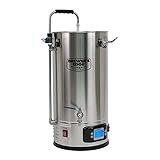
Brewer’s Edge Mash and Boil with Pump 7.5 Gallon
A proven single-vessel system with a built-in pump for mash recirculation. At 7.5 gallons it will not yield a full 10-gallon batch, but the workflow it teaches — recirculating mash, sparging in the same vessel, boiling without transfers — is exactly the technique that scales to larger batches. The pump is the standout feature: at this price, having a dedicated recirculation pump included removes the most common point of failure in entry-level all-grain setups.
- Pro: The included pump enables proper mash recirculation for clarity and temperature evenness without DIY plumbing.
- Pro: Single-vessel design keeps the setup footprint small for the workflow it supports.
- Con: 7.5-gallon capacity means finished batches land around 5-6 gallons; a significant shortfall from 10.
Skip this if your target is strictly 10 gallons of packaged beer; treat it as a training system or for smaller recipe formats.
Buying Guide
Match Vessel Capacity to Finished Volume, Not Boil Volume
A 10-gallon kettle does not yield 10 gallons of beer. You lose volume to grain absorption (roughly a gallon per ten pounds of grain), trub, hot break, and evaporation during a 60-minute boil. Plan for a pre-boil volume 15-20 percent above your target, which means a true 10-gallon batch requires a kettle rated at least 13-14 gallons at the working level. The FOHERE 9.2-gallon and Brewer’s Edge 7.5-gallon systems undershoot this; the VEVOR 16-gallon and MegaPot 15-gallon hit it squarely.
Pump Features That Actually Matter
Anti-burn or dry-run protection is not marketing language; it is a thermal cutoff that prevents the impeller from seizing when the wort level drops below the intake. Without it, a single moment of inattention kills your pump. Beyond that, look for a pump rated for wort (not just water) viscosity, meaning the manufacturer tested it on sugar-protein solutions rather than assuming ideal fluid dynamics.
Electric vs. Gas: Where You Will Brew
All-in-one electric systems like the VEVOR 60-liter or the FOHERE are weatherproof and indoor-safe, but their power draw (1500-3000 watts) means you need a dedicated circuit without other heavy loads running simultaneously. If your electrical panel is old or your kitchen circuit is shared with a microwave and refrigerator, a gas-powered setup with a separate kettle becomes the practical choice. The MegaPot kits and Kegco kettle sidestep this entirely since they impose no electrical requirement beyond what a standard outlet provides.
Our Verdict
The top pick for a genuine 10-gallon all-grain workflow with automation is the VEVOR 16-gallon All-in-One. It hits the capacity requirement with headspace, includes the pump, chiller, and digital control that make the process repeatable, and costs less than half of what a premium setup with those same features would run. The budget pick is the FOHERE 9.2-gallon system: it gets you into electric all-in-one brewing for $226, accepting the volume trade-off as the price of entry. If you already have a fermentation setup and only need a reliable hot-side vessel for full-volume boils, the Kegco 20-gallon kettle earns its place despite its premium price because nothing else on this list offers comparable single-vessel boil capacity without forcing you to build a top-off workflow.
FAQ
Can I use a 10-gallon system for extract brewing too?
Yes, and with more ease. Extract brewing generates less trub and no grain absorption, so a system sized for all-grain will feel generous when you are only steeping specialty grains and adding malt extract. Many brewers use the same vessel for both methods depending on the recipe.
Do I need a separate mash tun with these all-in-one systems?
No. The VEVOR and FOHERE all-in-one units use an integrated strainer or false bottom that lets you mash and sparge in the same vessel. The MegaPot kits are more traditional and do not include a recirculation pump, so you would need either a separate mash tun or a BIAB-style mesh bag for grain separation.
Is the pressure fermenter compatible with any brewing system on this list?
The VEVOR Pressure Fermenter is a standalone fermentation vessel and works regardless of which hot-side system you choose. Its only requirement is that you have a method to transfer cooled wort into it, which any gravity-fed or pump-driven setup on this list provides.
How much counter and storage space does a full 10-gallon all-grain setup need?
Plan for a footprint roughly three feet by two feet during active brewing when you account for the kettle, hot liquor tank or mash tun, pump placement, and wort chiller. After cooling, you need additional vertical space for the fermenter. All-in-one systems shrink this footprint significantly since the same vessel handles mash, sparge, and boil in sequence.



Write Your Review
No reviews yet. Be the first to share your experience!