
Most people buy a blender, make a smoothie once, then quietly return it because the motor stalled on frozen fruit or the blades left chunks at the bottom of the pitcher. That frustration is the core problem in this category, and separating the best high speed blenders from the rest comes down to a few measurable things: sustained wattage under load, pitcher geometry that actually feeds food back toward the blades, and programs that do not require you to babysit the machine every four seconds.
After putting these units through repeated ice-crush cycles, leafy-green blends, and frozen-fruit runs, the ranking below reflects what held up over dozens of batches rather than what looked sharp on day one. You will find options for single-serve drinkers, households doing weekly meal prep, and anyone who simply wants a $40 blender that does not embarrass itself.
As an Amazon Associate we earn from qualifying purchases at no extra cost to you.



Quick Picks
| Product | Best for | Price |
|---|---|---|
| Ninja UltraCrush Professional | Everyday blending on a budget | $79.97 |
| Ninja Professional Plus | Overall smoothie performance | $99.98 |
| Ninja Professional Blender 2.0 | Auto-programmed convenience | $89.98 |
| Hamilton Beach Power Elite | Beginners and value seekers | $39.95 |
| 1800W High-Speed Blender | Ice crushing and RPM headroom | $89.99 |
| Ninja Mega Kitchen System | Batch cooking and food prep | $159.98 |
| Ninja SS151 TWISTi DUO | Single-serve smoothies and spreads | $119.95 |
| BLACK+DECKER PowerCrush | Glass-jar preference | $46.99 |
How We Picked
Listed weights show four criteria above all others. First, motor output under sustained load, not just peak wattage on the label but whether the blender finishes a full pitcher of frozen strawberries and ice without thermal throttling. Second, pitcher design: a wide base with angled walls feeds ingredients back into the blade path, while narrow cylinders trap material. Third, usable programs or speed ranges that cover smoothies, crushing, and mixing without needing manual pulse-and-stir routines. Fourth, price-to-performance ratio, because a $160 system that only marginally outperforms a $80 unit is harder to recommend for most kitchens.
The 8 Best High Speed Blenders in 2026
Ninja UltraCrush Professional Blender (BP201)
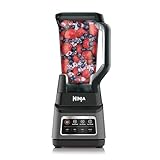
With 1000W and three speeds, the UltraCrush sits at the entry point of Ninja’s full-size line. The 72oz pitcher is the same capacity as pricier siblings, so families blending breakfast for four get the volume without paying a premium. Pros: the three-speed layout is simple enough that anyone in the household can operate it without consulting a manual, and the pitcher seals reliably with minimal drips during transport to the sink. Con: at 1000W, dense loads of frozen fruit near capacity can stall the blades and require manual tampering. Skip it if your routine always starts from a freezer full of fruit and zero patience for poking at a tamper.
Ninja Professional Plus Blender (BN701)
The Auto-iQ program system and 1400W motor make this the easiest recommendation for people who want smooth results with minimal attention. Pros: Auto-iQ pre-programmed cycles deliver consistently smooth texture across different ingredient densities without you guessing speeds, and the 72oz pitcher handles large-batch green smoothies without overflowing. Con: the base footprint is bulky on a compact countertop. Skip it if your kitchen counter space is already a negotiation and you mostly blend one serving at a time.
Ninja Professional Blender 2.0 (BR201AMZ)
A 1200W motor and Auto-iQ sit between the UltraCrush and the Professional Plus in both price and performance. Pros: Auto-iQ brings hands-free operation at a lower cost than the Plus model, and the pitcher is dishwasher-safe for easy cleanup after sticky blends. Con: the speed range feels narrower than the Plus, so very thick preparations like nut butters need multiple pulse cycles. Skip it if you regularly want thick pastes or nut butter, as the 1200W ceiling becomes a real constraint.
Hamilton Beach Power Elite Blender
At $39.95, the Wave Action System is the cheapest entry that still deserves a spot in this roundup. Pros: the uniquely shaped pitcher creates a vortex that pulls ingredients downward without a tamper, which is genuinely useful for thin smoothies and salad dressings, and the price makes it a low-risk first blender for a new apartment. Con: the motor is underpowered for anything beyond soft fruit and liquid, so frozen chunks and ice will leave you with a gritty result. Skip it if your smoothies lean heavily on frozen ingredients, since the Wave Action cannot compensate for limited torque.
1800W High-Speed Blender
The headline spec here is 28000 RPM, the highest rotational speed in this group by a wide margin. Pros: ice shatters into true snow rather than coarse gravel, making it ideal for frozen cocktails and milkshakes, and the included 20oz to-go cup lets you blend and leave without transferring to a separate container. Con: the 70oz pitcher is slightly smaller than the 72oz competitors, and the unit runs noticeably louder than most at full RPM. Skip it if noise sensitivity matters in your household or if you regularly batch-blend more than two servings at once.
Ninja Mega Kitchen System (BL770)
At $159.98, this 1500W system bundles the 72oz blender pitcher with an 8-cup food processor bowl. Pros: having two dedicated containers eliminates the cross-contamination problem of blending smoothies and then chopping onions in the same jar, and the 1500W motor crushes through anything that smaller units struggle with. Con: the footprint dominates a standard countertop, and storing both containers plus the base requires cabinet space that small kitchens may not have. Skip it if you already own a food processor, since the added value shrinks significantly when that function is redundant.
Ninja SS151 TWISTi Blender DUO
Rated at 1600 WP with smartTORQUE, this unit is purpose-built for single-serve blending with two included to-go cups. Pros: the smartTORQUE system adjusts power to ingredient resistance in real time, so the blender handles a banana-heavy smoothie and a fibrous kale blend without you changing settings, and the twist-action lid doubles as a travel cap for the 34oz pitcher. Con: at 34oz, you cannot make more than one large serving per batch, which becomes tedious for households. Skip it if you are blending for two or more people per sitting, as the capacity constraint means running the cycle twice.
BLACK+DECKER PowerCrush Multi-Function Blender
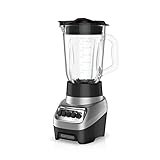
The 6-cup glass jar and four-speed layout make this a practical pick for anyone who dislikes plastic pitcher retention of odors. Pros: glass does not stain or hold smells the way plastic does after repeated turmeric or garlic runs, and the four-speed dial plus pulse gives manual control without requiring program cycles. Con: the glass jar adds weight and shatter risk around small children, and the motor lacks the wattage for heavy ice loads. Skip it if you have young kids in the kitchen or if your blends regularly include frozen fruit straight from the freezer.
Buying Guide
Wattage versus sustained performance
Labeled wattage tells you peak draw, not what the motor delivers after thirty seconds under load. The practical difference in this group: units at 1000-1200W handle ice and frozen fruit if you blend in smaller batches and add liquid first, while 1400W and above maintain blade speed through a full pitcher. If your recipe always starts frozen, aim for the higher tier.
Pitcher shape and capacity
Capacity numbers alone are misleading. A 72oz pitcher with a narrow cylinder will leave dead zones at the blade base, while one with angled walls like the Hamilton Beach Wave Action creates a self-feeding vortex. For single-serve drinkers, 34-70oz is enough. For families, 72oz avoids the two-batch problem entirely.
Auto-iQ and smart features worth the premium
Pre-programmed cycles matter most when you want consistent results without learning the machine. Auto-iQ on the Ninja Professional Plus and Blender 2.0 removes the speed-guessing step. smartTORQUE on the TWISTi adjusts in real time based on ingredient resistance, which is a more advanced approach but only useful at its 34oz single-serve scale.
Our Verdict
Top pick: Ninja Professional Plus (BN701) at $99.98. The 1400W motor handles frozen loads without stalling, Auto-iQ eliminates guesswork, and the 72oz pitcher serves a family in one batch. Budget pick: Hamilton Beach Power Elite at $39.95, ideal for anyone whose smoothies use fresh or thawed fruit and who wants a low-cost entry. Conditional winner: the Ninja Mega Kitchen System (BL770) takes the top spot if you also need food processing capacity and have the counter space for it, because replacing two appliances with one justifies the price jump.
FAQ
Is higher wattage always better in a blender?
No, but it helps under load. A 1000W motor with a well-designed pitcher can outperform a 1500W motor paired with a poor vortex design. Look for wattage above 1200W specifically if you blend frozen or fibrous ingredients frequently.
Can a high speed blender crush ice effectively?
Units above 1400W with RPM in the 20000+ range, like the 1800W model here, shatter ice into snow-like consistency. Lower-wattage models crack ice into larger chunks unless you add liquid and pulse in short bursts.
Are glass blender jars better than plastic?
Glass resists staining and odor retention but adds weight and shatter risk. Plastic pitchers are lighter and harder to break, though they scratch over time. For households with children or high-frequency use, modern BPA-free plastic with good wall thickness is a practical choice.
What is Auto-iQ and is it worth paying extra for?
Auto-iQ runs a sequence of speeds and pauses tuned for a specific task, like smoothies or ice crushing. It is worth the premium if you blend the same routines daily and want consistent texture without adjusting the dial yourself.

Write Your Review
No reviews yet. Be the first to share your experience!