
The best home soft serve machines for most kitchens are the Cuisinart ICE-45 if you want the lowest-cost, smallest setup, and the Cuisinart ICE-48 if you want faster repeat batches without pre-freezing a bowl; dedicated countertop commercial-style machines are better only for frequent parties and higher budgets.
- Quick comparison: the leading home-friendly options
- What “soft serve” means at home
- Best picks by situation
- Cuisinart ICE-45 versus ICE-48
- Serving consistency depends more on the base than the button
- Setup time and a realistic cost-per-use calculation
- Cleaning, wear, and ownership realities
- How much counter space do you really need?
- Bottom line
Quick answer: For most people in 2026, the best home soft serve machines for easy frozen treats is the Cuisinart ICE-45 Mix It In — our #1 rated choice. See the full ranked comparison, alternatives and buying advice below.
Quick comparison: the leading home-friendly options
| Machine or type | Approx. batch capacity | Freezing system | Mix-in handling | Typical footprint | Best for |
|---|---|---|---|---|---|
| Cuisinart ICE-45 Mix It In | 1.5 quarts | Freezer bowl; freeze bowl about 12–24 hours first | Built-in topping dispensers; add-ins are released into the serving cup | About 10.5 x 9.5 inches; roughly 16 inches high | Occasional users and smaller counters |
| Cuisinart ICE-48 | 1.5 quarts | Self-freezing compressor | Integrated mix-in dispensers and dispensing spout | About 12 x 9 x 16.5 inches | Frequent use and no freezer-bowl planning |
| Compressor ice-cream maker with a soft-serve nozzle | Usually 1–2 quarts | Self-freezing compressor | Usually manual; chunky pieces can obstruct the nozzle | Typically 11–15 inches wide and 14–18 inches deep | People who value temperature control over automatic toppings |
| Commercial countertop soft-serve machine | Often 4–8 quarts of mix in the hopper | Refrigerated hopper and freezing cylinder | Manual toppings; some models support two flavors or twist | Often 18–24 inches wide and 25–32 inches deep | Large gatherings, events, or near-daily use |
Dimensions vary by revision, so measure the machine with its drip tray, lid clearance, and ventilation space included. A unit that technically fits a 12-inch-deep counter may still be impractical if its rear vents are pressed against a wall.
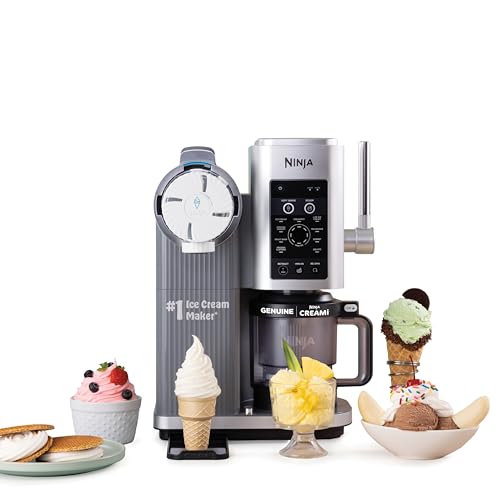
Ninja Creami Scoop & Swirl 13-in-1 Ice Cream and Soft Serve Maker, NC701
Included for 'Best Home Soft Serve Machines for Easy Frozen Treats' because the listing specifies NC701, details this guide uses to compare options.
View on Amazon
1.0 Qt Soft Serve Ice Cream Machine with Freezer Bowl, Homemade Swirl Ice Cream Maker Machine for Frozen Yogurt & Sorbet, 15–30 Min Fast Churn, Easy to Clean, Compact Countertop Appliance
Included for 'Best Home Soft Serve Machines for Easy Frozen Treats' because the listing specifies 30 Min Fast Churn and Easy to Clean, details this guide uses to compare options.
View on Amazon
GreenPan Frost Ice Cream Maker & Slushie Machine, Soft Serve, Sorbet, Margaritas, Milkshakes, Frozen Yogurt, No Pre-Freezing, Ready in 15 Mins, 6 Modes, 7 Textures, Self-Cleaning, Family Size, Blue
Included for 'Best Home Soft Serve Machines for Easy Frozen Treats' because the listing specifies Soft Serve and Sorbet, details this guide uses to compare options.
View on Amazon
Slushie Machine, 50OZ Soft Serve Ice Cream Maker with 6 Presets, Black
Included for 'Best Home Soft Serve Machines for Easy Frozen Treats' because the listing specifies 50OZ Soft Serve Ice Cream Maker with 6 Presets and Black, details this guide uses to compare options.
View on AmazonWhat “soft serve” means at home
Home machines generally make soft ice cream in one of two ways. A freezer-bowl machine freezes a liquid base in a pre-chilled bowl while a paddle churns it. This is inexpensive and relatively quiet, but the bowl must be frozen solid and the finished texture is time-sensitive. A compressor machine contains its own refrigeration system, so it can start when needed and make successive batches, although compressors add weight, noise, heat, and cost.
Neither category behaves exactly like a busy ice-cream-shop machine. Commercial equipment continuously scrapes a refrigerated freezing cylinder and is designed to hold mix at serving temperature. Home units usually produce a small batch, dispense it for a limited period, and then require the remainder to be transferred to a freezer before it becomes too firm.
Best picks by situation
| Your situation | Most suitable choice | Why | What to accept |
|---|---|---|---|
| Budget-conscious, occasional treats | Cuisinart ICE-45 | Lower purchase cost and compact storage compared with compressor models | You must freeze the bowl in advance and keep batches modest |
| Weekly use or spontaneous desserts | Cuisinart ICE-48 | Built-in refrigeration removes freezer-bowl scheduling | Higher cost, more countertop weight, and longer cleaning |
| Small kitchen with little permanent counter space | Freezer-bowl machine | The bowl can live in the freezer and the motor base can be stored away | Freezer space becomes part of the machine’s footprint |
| Party serving for more than six people | Commercial-style countertop unit | Larger hopper and more consistent dispensing during a serving window | Size, price, cleaning time, and electrical requirements rise sharply |
| Very thick or chunky mix-ins | Any machine with separate topping dispensing | Pieces do not have to travel through the freezing cylinder or narrow nozzle | Large pieces still need chopping; do not force them into the mix path |
Cuisinart ICE-45 versus ICE-48
ICE-45: the easier entry point
The ICE-45 uses a freezer bowl and is aimed at simple, small-batch serving. Its main advantage is the built-in topping system: dry ingredients such as sprinkles, small candies, or finely chopped nuts can be added as the dessert is dispensed rather than mixed through the frozen base. That separation helps prevent hard pieces from jamming the paddle or outlet.
Its limitation is planning. A freezer bowl needs enough uninterrupted time at a genuinely cold freezer temperature. If the bowl contains liquid that sloshes when tilted, it is not ready. The machine also cannot make an unlimited stream of portions: after one batch, the bowl must be refrozen.
ICE-48: better for repeat use
The ICE-48 adds a compressor, dispensing mechanism, and integrated mix-in operation. It is the more practical choice when the machine will be used weekly or when different people want servings at different times. There is no overnight bowl-freezing step, and the base can be chilled and processed when convenient.
Self-freezing does not mean instant serving. Allow time for the mix to cool and thicken, and expect the first portion to be softer or less uniform while the freezing chamber reaches its operating temperature. Compressor models also need clear ventilation and should sit level before use, especially after being transported.
Serving consistency depends more on the base than the button
A soft-serve machine can only dispense a base with the right balance of water, sugar, fat, and solids. A low-sugar, low-fat mixture may freeze hard and emerge in broken ribbons. An overly watery base can remain loose and drip. Follow the machine’s recipe guidance first, then adjust one variable at a time.
- Chill the prepared base thoroughly before processing, even in a compressor machine.
- Strain fruit purées and remove seeds or fibrous pieces that can interrupt smooth flow.
- Chop candy and nuts finely; reserve large pieces for sprinkling on top.
- Do not overfill the freezing chamber. Churning expands the mixture and needs headroom.
- Serve soon after dispensing. For longer storage, use a shallow, covered container to reduce the time needed to soften later.
Setup time and a realistic cost-per-use calculation
For a freezer-bowl model, the active setup may take only 10–15 minutes, but the total preparation window is closer to 12–24 hours because of bowl-freezing. A compressor model may take about 10 minutes to assemble and load, followed by roughly 20–45 minutes of processing depending on the recipe, starting temperature, and portion size.
Suppose a freezer-bowl machine costs $100 and is used 30 times. The equipment cost is about $3.33 per use before ingredients. A $300 compressor machine used 100 times costs about $3 per use. This does not prove that the compressor is the better bargain: it only shows why frequency matters. If you make soft serve six times a year, the cheaper machine may remain the sensible purchase; if you make it twice a month, the saved preparation and repeat-batch flexibility become more valuable.
Cleaning, wear, and ownership realities
Cleaning is not an afterthought because dairy, sugar, and fruit residue can collect around seals and dispensing valves. Unplug the machine, remove detachable parts according to the manual, and wash food-contact components promptly with warm water and dish soap. Wipe the motor base rather than immersing it. Do not scrape a freezer bowl with metal utensils, which can damage its surface.
The parts most likely to show wear are the paddle, dispensing lever, rubber gasket, O-rings, and plastic gear or drive coupling. A lever that becomes difficult to operate, a persistent drip after closing, or a paddle that slips under load can indicate residue, an incorrectly seated seal, or a replacement part requirement. Keep a record of compatible replacement seals before the original becomes unavailable.
Compressor machines need additional care: keep vents unobstructed, clean dust from the exterior intake area, and allow the machine to rest between demanding cycles if the manual recommends it. Never pack a warm, wet machine into a cupboard; trapped moisture encourages odors and makes the next cleanup harder.
How much counter space do you really need?
Measure width, depth, and height with the lid open. Then add at least 2–3 inches around ventilation areas where the manual permits, plus room for a mixing jug and serving cups. A 16-inch-tall unit may not fit beneath low cabinets if the lid or ingredient chute must be opened during operation.
For most households, a 10–12-inch-wide freezer-bowl machine is easier to store than a compressor unit. A 12-inch-wide compressor machine can weigh roughly 25–35 pounds, making daily cupboard storage inconvenient. Commercial-style machines often need a dedicated counter position rather than temporary setup; their wider bodies, deep drip trays, and ventilation requirements can consume more useful space than the headline dimensions suggest.
Bottom line
Choose the Cuisinart ICE-45 for affordable, occasional soft serve with separate topping dispensing and manageable storage. Choose the Cuisinart ICE-48 when eliminating freezer-bowl preparation is worth paying for a heavier compressor machine. Move to a commercial countertop model only when you regularly serve groups and are prepared for substantially more space, cleaning, noise, and maintenance. For the best results with any of them, prioritize a cold, smooth base and treat mix-ins as a controlled finishing step rather than an invitation to overload the dispensing path.
Ready to decide? Our #1 pick for 2026 is the Cuisinart ICE-45 Mix It In.
Live price & availability on Amazon.

Write Your Review
No reviews yet. Be the first to share your experience!