
The best drone under $1,000 for most photographers is the DJI Mini 4 Pro, while the DJI Air 3S is the stronger choice for serious image quality, and the Potensic Atom 2 is the best value for beginners who want a capable camera without spending the full budget.
- Quick picks for different buyers
- Best drones under 1000 compared
- DJI Mini 4 Pro: the safest recommendation for most photographers
- DJI Air 3S: the better camera platform under the budget
- Potensic Atom 2: value without giving up a mechanical gimbal
- DJI Mini 3 and DJI Neo: choose based on how you shoot
- Decision matrix: which drone fits your situation?
- What the advertised range and flight time mean in practice
- Ownership details that affect the real value
- Regulatory-friendly features to prioritize
- Bottom line
Quick answer: For most people in 2026, the best drones under $1,000 for photography and flight is the DJI Mini 4 Pro — our #1 rated choice. See the full ranked comparison, alternatives and buying advice below.
Quick picks for different buyers
- Best all-rounder: DJI Mini 4 Pro — under-250-gram portability, a 48MP camera, vertical shooting, and comprehensive obstacle sensing.
- Best image quality and flight performance: DJI Air 3S — larger 1-inch primary sensor, dual cameras, longer endurance, and stronger wind performance.
- Best value: Potensic Atom 2 — a compact 4K drone with a 3-axis gimbal and a lower typical market price.
- Best for casual, close-range flying: DJI Neo — lightweight, simple, and designed around quick aerial clips rather than maximum camera control.
- Best for a very small travel kit: DJI Mini 3 — excellent battery efficiency and image quality, although its obstacle-avoidance system is less advanced than the Mini 4 Pro’s.
Best drones under 1000 compared
| Drone | Camera | Maximum advertised flight time | Obstacle sensing | Transmission claim | Approximate takeoff weight |
|---|---|---|---|---|---|
| DJI Mini 4 Pro | 1/1.3-inch, 48MP, 4K/60 HDR video | 34 minutes standard battery | Omnidirectional sensing plus downward sensing | Up to 20 km in ideal FCC conditions | Under 249 g with standard battery |
| DJI Air 3S | 1-inch 50MP wide camera plus 70mm-equivalent telephoto camera | 45 minutes | Omnidirectional sensing and forward-facing LiDAR-assisted sensing | Up to 20 km in ideal FCC conditions | Approximately 724 g |
| Potensic Atom 2 | 1/2-inch, 48MP, 4K/30 video | 32 minutes | Limited compared with omnidirectional systems; downward positioning sensors | Up to 10 km, depending on region and conditions | Under 500 g |
| DJI Mini 3 | 1/1.3-inch, 48MP, up to 4K/30 video | 38 minutes standard battery | Downward sensing; no full obstacle-avoidance coverage | Up to 10 km with compatible DJI transmission system | Under 249 g with standard battery |
| DJI Neo | 1/2-inch, 12MP, up to 4K/30 video | 18 minutes | Downward sensing; not a replacement for full obstacle avoidance | Up to 10 km in ideal conditions with a compatible controller | Approximately 135 g |
Advertised flight times are measured in controlled conditions. Wind, cold weather, rapid climbing, sport mode, and leaving a safety reserve can reduce usable airtime substantially. A practical planning figure is roughly 70% to 80% of the published maximum.

DJI Mini 4K Camera Drone Combo, Drone with 4K UHD Camera for Adults, Under 249 g, 3-Axis Gimbal Stabilization, 10km Video Transmission, Auto Return, 2 Batteries for 62-Min Max Flight Time, QuickShots
Included for 'Best Drones Under $1,000 for Photography and Flight' because the listing specifies Drone with 4K UHD Camera for Adults and Under 249 g, details this guide uses to compare options.
View on Amazon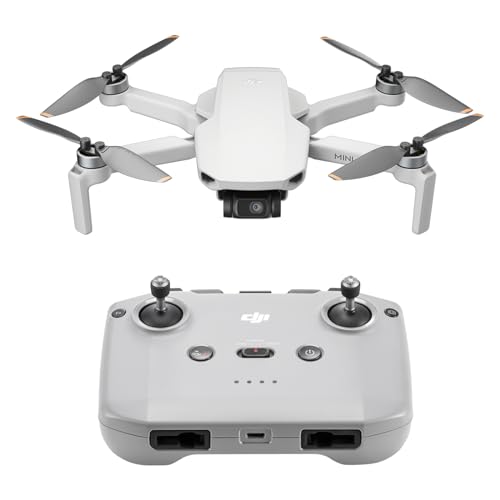
DJI Mini 4K, Drone With 4K UHD Camera, Under 249 g
Included for 'Best Drones Under $1,000 for Photography and Flight' because the listing specifies Drone With 4K UHD Camera and Under 249 g, details this guide uses to compare options.
View on Amazon
Holy Stone HS175D GPS Drone with 4K Camera for Adults, Under 249g, Foldable RC Quadcopter with Auto Return, 46 Mins Long Flight, Follow Me, Brushless Motor, Circle Fly, Waypoint Fly, Altitude Hold
Included for 'Best Drones Under $1,000 for Photography and Flight' because the listing specifies Under 249g and Foldable RC Quadcopter with Auto Return, details this guide uses to compare options.
View on Amazon
SKYROVER X1 Drone with Camera Combo with Screen Controller, 4K/60fps Video, 8K Photo, 360° Obstacle Avoidance, Under 249g, 9.32-Mi Transmission, AI Night Shot, 96-Min Flight Time with 3 Batteries
Included for 'Best Drones Under $1,000 for Photography and Flight' because the listing specifies 4K/60fps Video and 8K Photo, details this guide uses to compare options.
View on AmazonDJI Mini 4 Pro: the safest recommendation for most photographers
The Mini 4 Pro combines a folding design with a 1/1.3-inch camera that records high-resolution stills and 4K/60 HDR video. Its vertical shooting mode is useful for social-media content, while its obstacle-sensing system monitors multiple directions and supports automated return-to-home and tracking features.
Its biggest advantage is regulatory convenience in the United States: the aircraft remains below 250 g with the standard battery, so recreational users generally avoid aircraft registration solely because of weight. That does not remove airspace restrictions, the recreational knowledge requirement, or the duty to keep the drone within visual line of sight. The optional extended battery can raise the aircraft above 250 g, changing the regulatory picture.
The standard controller is adequate, but a controller with an integrated screen is more convenient in bright sunlight and avoids depending on a phone battery. The main compromises are a smaller camera sensor than the Air 3S and less wind resistance than a heavier aircraft.
DJI Air 3S: the better camera platform under the budget
The Air 3S is the head-to-head winner when low-light quality, subject separation, and stable flight matter more than minimum size. Its 1-inch primary sensor gathers more light than the Mini 4 Pro’s sensor, and the second camera provides a compressed telephoto perspective that can make landscapes, architecture, and distant subjects look more natural.
It also offers longer advertised endurance and a heavier airframe that is more settled in wind. The trade-off is ownership friction: at roughly 724 g, it must be treated as a registered aircraft in the United States, and its larger batteries, charger, and controller take more room in a travel bag. A complete kit can also approach or exceed the $1,000 ceiling depending on the controller and number of batteries.
Choose it if you frequently photograph at dawn, dusk, in breezy locations, or from distances where the telephoto camera is valuable. Choose the Mini 4 Pro if carrying convenience and simpler weight-related compliance matter more.
Potensic Atom 2: value without giving up a mechanical gimbal
The Atom 2 is appealing because it provides a 3-axis mechanical gimbal, 4K video, RAW-capable still photography, and a folding body at a lower general market price than premium DJI bundles. That makes it a sensible entry point for a buyer who wants genuine camera control rather than a toy-grade fixed camera.
Its important limitation is obstacle awareness. Downward positioning sensors help with hovering and landing, but they do not provide the same protection as a drone that detects obstacles in front, behind, above, and to the sides. Beginners should fly it in open spaces, avoid automated tracking around trees, and keep a larger buffer from buildings and people.
The controller and app provide a good feature set for the money, but transmission reliability depends more heavily on line of sight, local interference, antenna orientation, and regional radio limits than the headline range suggests.
DJI Mini 3 and DJI Neo: choose based on how you shoot
DJI Mini 3 for longer scenic flights
The Mini 3 remains attractive for travel photography because its 1/1.3-inch sensor performs well in daylight and its standard battery is rated for up to 38 minutes. It supports vertical framing and folds into a small package. Its weakness is the lack of comprehensive obstacle avoidance, so it suits deliberate landscape flights better than autonomous flights through cluttered environments.
DJI Neo for quick clips and low-complexity flying
The Neo is much lighter and more approachable than a conventional camera drone. Its propeller guards, palm-launch-oriented design, subject-tracking functions, and optional controller make it convenient for short clips and casual trips. Its 1/2-inch camera, 18-minute rated endurance, and simpler stabilization make it a poor substitute for the Mini 4 Pro when photography is the priority.
Decision matrix: which drone fits your situation?
| Your situation | Best match | Why | What to accept |
|---|---|---|---|
| First camera drone, frequent travel | DJI Mini 4 Pro | Small, light, vertical camera, broad sensing | Higher price than entry-level models |
| Night, dawn, wind, and professional-looking perspective | DJI Air 3S | Larger sensor, telephoto camera, heavier airframe | More registration and carrying requirements |
| Budget around the lower end of this category | Potensic Atom 2 | Strong core camera and gimbal value | Limited obstacle detection |
| Short social clips and simple self-filming | DJI Neo | Very light and quick to deploy | Shorter battery life and less photographic latitude |
| Open landscapes and maximum battery efficiency | DJI Mini 3 | Long standard-battery rating and compact body | Fly manually around obstacles |
What the advertised range and flight time mean in practice
Suppose a drone is advertised for 34 minutes and you reserve five minutes for landing, unexpected wind, and return-to-home. That leaves 29 minutes of theoretical working time. Using a conservative 75% real-world factor gives about 22 minutes of useful planning time. A two-battery kit therefore provides approximately 44 minutes of productive airtime, not 68 minutes.
Transmission range works similarly. A 10 km or 20 km figure is a maximum under unobstructed, interference-free conditions and is not permission to fly that far. For legal visual-line-of-sight operations, the useful range is often limited by what you can safely see and control, not by the radio link.
Ownership details that affect the real value
- Batteries wear first: Expect capacity to decline with repeated cycles, heat, deep discharges, and storage at 100%. Store intelligent-flight batteries partly charged and cool, following the manufacturer’s storage guidance.
- Propellers are consumables: Replace them after visible nicks, bends, or a hard impact. A small imbalance can create vibration and softer footage.
- Clean the camera and sensors: Use a clean lens cloth for the gimbal glass and inspect downward sensors after sandy, dusty, or wet flights. Do not scrape debris across optical surfaces.
- Leave a reserve: Do not plan to land at the battery’s emergency threshold. Wind on the return leg can consume more power than the outward flight.
- Check firmware and maps before leaving: Update at home, confirm the correct return-to-home height, and verify local airspace rules before launching.
Regulatory-friendly features to prioritize
For many buyers, an under-250-gram aircraft such as the Mini 4 Pro or Mini 3 is the easiest starting point in the United States, but weight is only one part of compliance. Recreational pilots must follow FAA recreational rules, use approved airspace, avoid careless operations, and comply with Remote ID requirements when applicable. Other countries use different thresholds and registration systems.
Useful compliance-oriented features include accurate GPS positioning, adjustable return-to-home altitude, automatic low-battery warnings, visible status lights, geofencing or airspace-awareness tools, and a controller that clearly displays connection and battery status. Treat these as aids rather than legal permission: the pilot remains responsible for checking current local requirements before every flight.
Bottom line
Buy the DJI Mini 4 Pro if you want the strongest balance of photography, portability, obstacle sensing, and weight-related convenience. Pick the DJI Air 3S when camera quality and wind stability justify a larger registered aircraft. The Potensic Atom 2 is the value choice for open-area flying, while the DJI Neo is best viewed as a simple flying camera rather than a full photography platform.
Ready to decide? Our #1 pick for 2026 is the DJI Mini 4 Pro.
Live price & availability on Amazon.


Write Your Review
No reviews yet. Be the first to share your experience!