
Our Short List of 3

- Best for: A shop chasing brake vibration with a precision disc-only lathe.
- 38-millimetre thick spindle for vibration-free cutting
- Turning accuracy of 0.002 to 0.005 millimetres
- Surface roughness Ra 1.5 to 2.0 micrometres
- Maximum disc thickness 42 millimetres
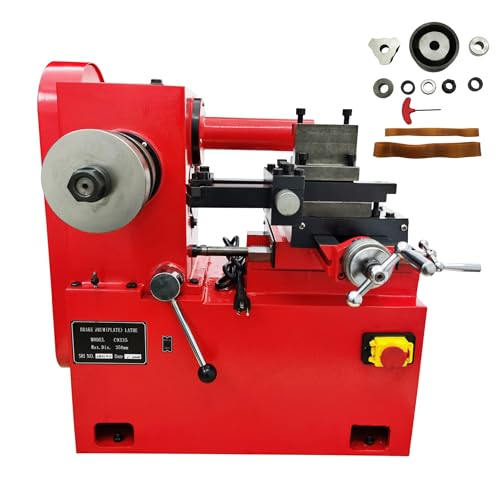
- Best for: A general shop that resurfaces drums and discs in one machine.
- 2-in-1 design resurfaces brake drums and rotors in one unit
- Processing diameter 180 to 350 millimetres
- 1100-watt motor, 110-volt operation
- Spindle speeds of 60 and 90 RPM

- Best for: A shop that wants variable speed and auto-feed for tricky rotors.
- Variable speed control from 0 to 140 RPM
- 0.55-kilowatt motor, 110-volt operation
- Brake drums 180 to 350 millimetres, rotors up to 400 millimetres
- 100-millimetre tool stroke with linear guide rails
All 4 Picks at a Glance
| Product | Specs | Action |
|---|---|---|
| EQCOTWEA Brake Disc Lathe |
| Check price on Amazon |
| INTSUPERMAI 2-in-1 Heavy Duty Brake Drum and Disc Lathe |
| Check price on Amazon |
| INTSUPERMAI Brake Drum and Disc Lathe C9335F |
| Check price on Amazon |
 WYDDDARY Brake Lathe Combination C9372 |
| Check price on Amazon |
The decision is which brake lathe matches the rotors a shop actually resurfaces, because these machines are heavy, expensive, and built for different work. A bench lathe that handles drums and discs suits a general repair shop, while a precision disc lathe suits a shop chasing vibration complaints, and the wrong choice wastes floor space and money. The four machines below cover disc-only precision work, two-in-one drum and disc lathes, and a wide-capacity combination unit, and each one suits a different kind of brake work.
This guide is for independent repair shops, fleet maintenance bays, and serious home garages that resurface rotors instead of replacing them. Every machine here was chosen from the names and specifications shown on its Amazon page, so the details reflect what the listing itself states about capacity, power, precision, and size.
Quick Picks
As an Amazon Associate we earn from qualifying purchases.
| Product | Best for | Key spec from title |
|---|---|---|
| EQCOTWEA Brake Disc Lathe | Precision disc resurfacing | 38-millimetre spindle, 0.002 to 0.005-millimetre accuracy |
| INTSUPERMAI 2-in-1 Heavy Duty | Drums and discs in one machine | 1100-watt motor, 180 to 350-millimetre range |
| INTSUPERMAI C9335F | Variable speed and auto-feed | 0.55-kilowatt motor, 0 to 140 RPM |
| WYDDDARY C9372 Combination | The widest rotor capacity here | Stepless 70 to 320 RPM, discs to 20 inches |
How to Choose
Match Capacity to the Rotors You See
Capacity decides which vehicles a lathe can serve, so start with the largest rotor and drum diameters that come through the shop. The machines in this guide cover discs from 180 millimetres up to 508 millimetres, and drums from 152 millimetres up to 500 millimetres, but no single machine covers the whole range. A shop that only services passenger cars can use a 180 to 350-millimetre machine, while a shop that sees trucks and large SUVs needs the wider combination unit. Measure the biggest rotor on the vehicles you service before ordering.
Compare Motor Power and Feed Control
Motor power decides how deep a cut the lathe can take without stalling, and feed control decides how smooth the finish will be. A 1100-watt motor handles heavier cuts on large rotors, while a 550-watt motor suits lighter passenger-car work with more passes. Variable speed matters too: a lathe that runs from 0 to 140 RPM lets the operator slow down for a rough rotor and speed up for a finish pass, while a fixed two-speed machine is simpler but less flexible. Look for auto-feed as well, because a steady automatic feed gives a more even finish than hand feeding.
Check Precision Figures Before You Buy
Precision is the point of resurfacing, so read the accuracy figures on the listing rather than trusting the word precision alone. The machines in this guide state turning accuracy from 0.002 to 0.005 millimetres, surface roughness down to Ra 1.5 to 2.0 micrometres, and thickness deviation as tight as 0.005 to 0.01 millimetres. A lathe with a thick spindle and rigid construction holds those figures in real use, while a light machine may flex under load. Compare the spindle diameter and the stated accuracy together, because the two figures tell the real story.
Plan for Weight, Power, and Safe Setup
These machines are heavy, and the listings state weights from 381 pounds to 688 pounds, so plan the floor, the delivery, and the lifting before the lathe arrives. A concrete floor and a hoist or engine crane are needed for the heavier units, and the machine must sit level on a solid bench or its own stand. Check the power supply too: most machines here run on 110 volts, while one uses 220 volts stepped down to 12 volts for safe operation. Wear eye protection and keep hands clear of the spinning rotor, and never run the lathe without the guards and adapters the listing includes.
The 4 Best Options
EQCOTWEA Brake Disc Lathe
- Best for: A shop chasing brake vibration with a precision disc-only lathe.
- 38-millimetre thick spindle for vibration-free cutting
- Turning accuracy of 0.002 to 0.005 millimetres
- Surface roughness Ra 1.5 to 2.0 micrometres
- Maximum disc thickness 42 millimetres
A shop chasing brake vibration with a precision disc-only lathe.
It resurfaces discs only, so drums need a different machine.
The EQCOTWEA disc lathe is the pick for precision disc resurfacing, because it is built around a 38-millimetre spindle and a turning accuracy of 0.002 to 0.005 millimetres. It corrects warped discs and vibration with a surface roughness of Ra 1.5 to 2.0 micrometres, handles discs up to 42 millimetres thick, and feeds at up to 8.5 millimetres per minute. The unit pairs a DL-718L resurfacing head with a DL-985L drive unit running at 50 to 250 RPM on 220 volts stepped down to 12 volts for safe operation. It suits a shop that chases brake vibration and needs a mirror-smooth disc finish.
INTSUPERMAI 2-in-1 Heavy Duty Brake Drum and Disc Lathe
- Best for: A general shop that resurfaces drums and discs in one machine.
- 2-in-1 design resurfaces brake drums and rotors in one unit
- Processing diameter 180 to 350 millimetres
- 1100-watt motor, 110-volt operation
- Spindle speeds of 60 and 90 RPM
A general shop that resurfaces drums and discs in one machine.
At 478 pounds, it needs a solid floor and help to install.
The INTSUPERMAI 2-in-1 is the pick for a shop that needs drums and discs handled in one machine. It resurfaces brake drums and rotors from 180 to 350 millimetres with an 1100-watt motor on 110 volts, running at 60 or 90 RPM, and the quick-change tool system switches between drum and disc adapters in under 60 seconds. The cast-iron construction and heavy workbench keep the machine stable during cuts, and the listed weight is 478 pounds. It suits a busy general repair shop that sees a mix of drums and discs every day.
INTSUPERMAI Brake Drum and Disc Lathe C9335F
- Best for: A shop that wants variable speed and auto-feed for tricky rotors.
- Variable speed control from 0 to 140 RPM
- 0.55-kilowatt motor, 110-volt operation
- Brake drums 180 to 350 millimetres, rotors up to 400 millimetres
- 100-millimetre tool stroke with linear guide rails
A shop that wants variable speed and auto-feed for tricky rotors.
The 0.55-kilowatt motor suits passenger cars, not heavy truck rotors.
The INTSUPERMAI C9335F is the pick for variable-speed control with auto-feed, because it runs from 0 to 140 RPM on a 0.55-kilowatt motor with a one-touch switch between manual handwheel tuning and auto-feed mode. It machines drums from 180 to 350 millimetres and rotors up to 400 millimetres, with a 100-millimetre tool stroke, linear guide rails, and a stated precision of plus or minus 0.002 inches. The integrated control panel adds LED guidance, and the listed weight is 381 pounds. It suits a shop that wants fine control over cutting speed for warped or uneven rotors.
WYDDDARY Brake Lathe Combination C9372
- Best for: A shop that services large SUVs and light trucks as well as cars.
- Brake disc diameter 7 to 20 inches, 180 to 508 millimetres
- Brake drum diameter 6 to 19.5 inches, 152 to 500 millimetres
- 600-watt motor, 110-volt operation
- Stepless spindle speed from 70 to 320 RPM
A shop that services large SUVs and light trucks as well as cars.
At 688 pounds, delivery and installation need a hoist and a level concrete floor.
The WYDDDARY C9372 is the pick for the widest capacity in this guide, handling brake discs from 7 to 20 inches and drums from 6 to 19.5 inches. It runs on a 600-watt motor with stepless spindle speed from 70 to 320 RPM and stepless cutting feed, so the operator can dial in the exact speed for each rotor. The bench and standard tooling package come with the machine, and the listed weight is 688 pounds. It suits a shop that services large SUVs and light trucks alongside passenger cars and needs one lathe for the whole range.
Which One Fits Your Situation
You Chase Brake Vibration and Pulsation
Choose the EQCOTWEA disc lathe if vibration complaints are the main work. The 38-millimetre spindle and 0.002 to 0.005-millimetre accuracy give the smoothest disc finish in this guide, and the low-voltage drive unit suits a precision workshop. The 42-millimetre maximum disc thickness covers most passenger car rotors, and the feed of up to 8.5 millimetres per minute keeps the cut moving without rushing the finish.
You Run a General Repair Shop
Choose the INTSUPERMAI 2-in-1 if the shop sees drums and discs in equal measure. One machine covers both jobs with quick-change adapters, and the 1100-watt motor handles the daily workload without slowing down for heavy cuts. The quick-change system swaps drum and disc setups in under 60 seconds, so the lathe keeps pace with a busy day of mixed brake work.
You Want Fine Speed Control
Choose the INTSUPERMAI C9335F if cutting speed matters more than raw power. The 0 to 140 RPM variable speed and auto-feed mode let the operator match the cut to each rotor, which helps with warped discs and uneven drum surfaces. The 100-millimetre tool stroke and linear guide rails keep the cut steady, and the LED guidance on the control panel makes the settings easy to read.
You Service Trucks and Large SUVs
Choose the WYDDDARY C9372 if the biggest rotors in the shop exceed 400 millimetres. The 20-inch disc capacity and stepless speed control cover vehicles the other machines cannot, and the bench and tooling package arrives ready to set up. The stepless feed from 70 to 320 RPM lets the operator dial in the exact speed for each rotor, and the 688-pound build stays rigid through heavy cuts.
Common Mistakes
- Buying a lathe for passenger cars and discovering the first truck rotor is too large for it.
- Ignoring the machine weight and finding the shop floor or bench cannot support a 600-pound lathe.
- Ordering a 220-volt machine for a shop wired only for 110 volts, or the reverse.
- Skipping the adapter set and finding the lathe cannot hold the rotors that come through the door.
- Running the lathe without eye protection or with loose clothing near the spinning rotor.
Frequently Asked Questions
Should I resurface a rotor or replace it?
Resurfacing suits a rotor that is warped, scored, or noisy but still above its minimum thickness. Measure the rotor thickness against the minimum stamped on the rotor hat, and replace the rotor if it is at or below that figure. A rotor that is cracked, deeply grooved, or rusted through should be replaced rather than cut.
What is the difference between an on-car and a bench lathe?
An on-car lathe mounts to the hub and machines the rotor while it stays on the vehicle, which corrects runout relative to the hub. A bench lathe clamps the rotor on an arbor and cuts it off the car, which is faster for loose rotors but cannot correct hub runout. The machines in this guide are bench lathes.
How often should a brake lathe be calibrated?
Follow the maker guidance for the specific machine, and check the setup whenever the finish looks rough or the cut feels uneven. Worn cutting tips, a loose arbor, and a dirty mounting surface all show up as poor finishes before they show up as measurements. Keep the adapters clean and the cutting tips sharp.
Can a brake lathe fix a rotor that vibrates when braking?
Often yes, when the vibration comes from thickness variation or lateral runout that machining can correct. The lathe cuts both faces parallel and true, which removes the uneven surface that causes the pedal pulse. If the vibration comes from a worn hub, a loose bearing, or a sticking caliper, the lathe alone will not fix it.


Write Your Review
No reviews yet. Be the first to share your experience!