
A board game is an easy gift to buy and a hard one to buy well. The box has to match the child in front of you: a game pitched two years too old sits unopened, and one pitched too young gets played once on Christmas morning and forgotten by New Year. The real decision is matching age range, reading level and session length to the child, then picking a style of play their household will actually repeat on ordinary weeknights, not just during the holidays.
This guide serves grandparents buying for a preschooler, parents shopping for siblings who play together, and anyone choosing for a child between roughly four and twelve. Every pick below is drawn from the details printed on its Amazon product page: the stated age range, the player count, the playing time and what sort of game it is. Where listings disagree with each other, the manufacturer’s own figures are the ones used.
Quick Picks
As an Amazon Associate we earn from qualifying purchases.
| Product | Best for | Key spec from title |
|---|---|---|
| My First Castle Panic | A preschooler’s very first board game | Ages 4+, 1 to 4 players, cooperative |
| Outfoxed! | Siblings who play better on the same team | Ages 5+, 2 to 4 players, 20 minutes |
| Ticket to Ride: First Journey | A first real strategy game | Ages 6+, 2 to 4 players, 15 to 30 minutes |
| Spot It! Classic | A full holiday table of mixed ages | Ages 6+, 2 to 8 players, 15 minutes |
| Dragonwood | An older child who loves fantasy quests | Ages 8+, 2 to 4 players, 20 minutes |
How to Choose
Age Range and Reading Level
Start with the age printed on the box, then check what the game asks the child to do. A four-year-old can match shapes and colours long before they can read a card, which is why the youngest pick here works through picture matching rather than text. Games for six and seven-year-olds often add short words and simple numbers. By eight, most children can read card effects unaided and hold a small hand of options. If the recipient is between two age bands, choose based on reading confidence rather than birthday: a strong reader of seven will handle an ages 8+ card game with an adult nearby, while a reluctant reader of nine may still prefer a picture-based game.
Play Time and Attention Span
Session length decides whether a gift gets replayed. Twenty minutes is a reliable ceiling for children under seven; anything longer needs a natural pause point or a very patient adult. All five games here finish in half an hour or less, and most land near the twenty-minute mark, which fits a school-night slot and lets a family play twice in one sitting. Longer games are not automatically better gifts. A sprawling ninety-minute strategy title given to a six-year-old usually becomes shelf decoration, while a tight fifteen-minute game that ends while everyone is still laughing gets requested again the next evening.
Cooperative Versus Competitive Play
In a cooperative game the whole table wins or loses together, and that structure changes the mood of a family evening. Nobody is eliminated, nobody cries because an older sibling outplayed them, and adults can genuinely help without throwing the game. Two of the picks below are fully cooperative, which suits younger children and mixed-age groups. Competitive games teach different lessons: handling a loss, planning against an opponent, and winning graciously. Children from about seven upward usually relish that edge. Match the format to the child you know. A sensitive five-year-old and a fiercely competitive ten-year-old need opposite things from a Christmas box.
Player Count for Siblings and Family
Count the people who will realistically sit down, not the people you hope will. A game capped at four players strands a fifth sibling or a visiting cousin, while a game needing three or more leaves an only child unable to play on a quiet afternoon. Most picks here work with two players, so a parent and child can play without recruiting anyone. One pick stretches to eight players, which covers the Christmas Day crowd of cousins, aunts and grandparents. Also check the minimum: a game that plays well with two but shines with four is still a sound gift for a two-child household.
The 5 Best Options
My First Castle Panic

This is the gentlest starting point in the list, built for children who have never sat through a board game before. Everyone defends one castle together, matching cards to the monsters marching down the path by shape and colour, so a four-year-old who cannot read a word still makes real decisions every turn. There is no winner and no loser among the players, which keeps a first game night free of tears. It also works with a single child and one adult, and a round is short enough to finish before bath time. For a preschooler opening their first game at Christmas, nothing else here is as forgiving.
Specs
- Brand: Fireside Games
- Manufacturer recommended age: 4 years and up
- Number of players: 1 to 4
- Playing time: about 20 minutes
- Game type: cooperative castle defence with shape and colour matching
- Item model number: FSG01013
- Contents include a game board, castle and wall pieces, castle cards and monster tokens
Best for: A child aged four or five receiving their first board game.
Watch out for: Fireside Games also sells the original Castle Panic, which is rated for much older players; confirm the listing says My First, and note the small-parts warning if a child under three lives in the house.
ASIN: B07KMLHPMK
Outfoxed!

A fox has stolen Mrs. Plumpert’s pot pie, and the whole table turns detective to work out which of the sixteen suspects did it before the fox escapes. Players roll dice to move around the board, reveal suspects, and slide clue cards into a decoder that shows whether the thief was wearing a hat, a scarf or glasses. Because everyone deduces together, a confident seven-year-old and a shaky five-year-old contribute equally, and nobody is knocked out early. The mystery resets every game because the thief card is drawn fresh, so the puzzle stays interesting across many repeat plays at home.
Specs
- Brand: Gamewright
- Manufacturer recommended age: 5 years and up
- Number of players: 2 to 4
- Estimated playing time: 20 minutes
- Game type: cooperative deduction and memory
- Item model number: CSG-OUTF
- Play uses suspect cards, clue cards and a slide-in clue decoder
Best for: Siblings aged five to eight who enjoy puzzles and play better as a team.
Watch out for: Children past about nine often solve the suspect grid quickly and may find the mystery thin; it is at its best in the five-to-eight window the box aims at.
ASIN: B00UB7P0XY
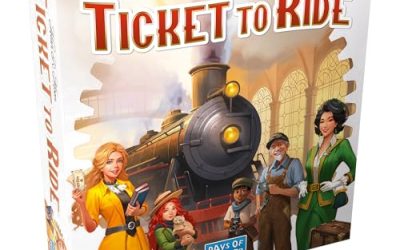
Ticket to Ride: First Journey

This is the children’s edition of one of the best-known modern board games, redrawn so a six-year-old can run a railway across the map. Players collect coloured train cards, claim routes between cities, and race to complete six ticket cards, with a golden ticket bonus for the first to finish. The rules fit on a single sheet, there is no reading beyond city names and colours, and the chunky plastic trains are satisfying for small hands to place. It teaches genuine planning — which route to grab before a sibling does — while staying light enough that a parent is a guide rather than a referee.
Specs
- Brand: Asmodee
- Manufacturer recommended age: 6 years and up
- Number of players: 2 to 4
- Playing time: 15 to 30 minutes
- Game type: route building and set collection
- Item model number: DO7225
- Contents include 1 game board, 80 plastic trains, 72 train cards, 32 ticket cards and a golden ticket card
Best for: A child of six to nine who is ready to graduate from matching games to real strategy.
Watch out for: If the child already plays the full adult Ticket to Ride, this simplified edition will feel too easy; also allow table space for the full-size board and its eighty train pieces.
ASIN: B01MQ4IKQJ
Spot It! Classic

Spot It! is a tin of round cards covered in symbols, and between any two cards there is exactly one matching picture. Every version of the game is a race to spot that match first and shout it out, which means a quick-eyed six-year-old regularly beats the adults, and grandparents need no rules lecture before joining in. It seats up to eight players, more than anything else in this guide, and a round takes minutes, so it fills the gaps between Christmas dinner courses as happily as it anchors a game night. The small tin also travels well to relatives’ houses over the holiday period.
Specs
- Brand: Zygomatic
- Manufacturer recommended age: 6 years and up
- Number of players: 2 to 8
- Average playing time: 15 minutes
- Game type: speed matching and observation card game
- Several mini-game variants are included in the one tin
Best for: A big mixed-age group, or a family that wants one game everyone can join.
Watch out for: Many themed and pocket editions of Spot It! sit alongside this one in search results; check that the listing is the Classic edition, and expect cards to scatter during fast rounds with excited younger players.
ASIN: B08CMRPCKL
Dragonwood

Dragonwood sends players into an enchanted forest to capture goblins, trolls and dragons. Adventurer cards are collected into runs and sets, and the size of the set decides how many dice you roll against a creature, so children weigh a safe small attempt against a risky big one on every turn. It is the most grown-up game in this guide: card text matters, simple probability is everywhere, and the fantasy artwork gives eight-to-twelve-year-olds a world they want to return to. Games stay near twenty minutes, victories feel earned, and the small box stores and travels easily after the holidays end.
Specs
- Brand: Gamewright
- Manufacturer recommended age: 8 years and up
- Number of players: 2 to 4
- Playing time: about 20 minutes
- Game type: card and dice adventure with set collection
- Contents: 108 cards and 6 custom dice
- Item model number: CSG-DRAGONW
Best for: A fantasy-loving child aged eight to twelve who is ready for dice, risk and light strategy.
Watch out for: The cards carry written effects, so a child who is not yet reading confidently will need help; dice luck also means the best planner does not always win, which frustrates some competitive children.
ASIN: B00UB7OV7K
Which One Fits Your Situation
A Preschooler Opening a First Game
Choose My First Castle Panic. A four or five-year-old cannot yet read cards or sit through long rules, and this game asks only for shape and colour matching while the whole family defends one castle together. There is no individual loser, the round lasts about twenty minutes, and one adult can run it with a single child, which suits how preschoolers actually play.
Siblings Who Fall Out Over Losing
Choose Outfoxed! Brothers and sisters aged five to eight investigate the same mystery as one team, sliding clues into the decoder and narrowing down sixteen suspects together. Because the fox is the opponent rather than each other, the usual game-night argument never starts, and a younger sibling’s contribution counts exactly as much as an older one’s deduction.
A House Full of Cousins and Grandparents
Choose Spot It! Classic. It is the only pick here seating up to eight players, the matching-symbol rules take under a minute to explain to a grandparent, and rounds are so quick that people can drift in and out between other festivities. Sharp-eyed children win often enough against adults to keep the whole table honest.
A Child Ready for Real Strategy
For ages six to eight, choose Ticket to Ride: First Journey, where claiming routes and finishing tickets introduces planning without heavy rules. For ages eight to twelve, choose Dragonwood instead: its dice rolls against forest creatures reward calculated risk, and the fantasy theme holds older children who have outgrown simpler family games but still finish in twenty minutes.
Common Mistakes
- Buying for the age you wish the child was: a game rated two years above the recipient usually stays in its shrink wrap until it is quietly outgrown in a different way.
- Ignoring the player count, then discovering the game needs three players in a house where only one adult plays, or seats four when five cousins arrive at Christmas.
- Choosing a long strategy game for a young child because the box art looks impressive, when a twenty-minute game would be played ten times as often.
- Forgetting reading level: several appealing games hide paragraphs of card text that a new reader cannot manage alone, turning a gift into homework.
- Giving a fiercely competitive game to a child who melts down when they lose, instead of picking one of the cooperative options where the table wins together.
Frequently Asked Questions
Should I buy the game for the child’s exact age or size up?
Buy for the age the child is now, or at most one band up if they are a confident reader. Box ages reflect the reading, counting and patience a game demands, not just its theme. A game that fits today gets played all winter; one bought for next year often misses its moment entirely.
Are cooperative games a good choice for Christmas?
Yes, especially for children under eight and for mixed-age family groups. Everyone works toward one result, so a younger child is helped rather than beaten, and adults can join without pretending to play badly. My First Castle Panic and Outfoxed! in this guide both use that structure, and it suits the forgiving mood of a holiday gathering.
How many players should a gift game support?
Two to four covers most households, because it lets a parent and child play alone and still fits a family of four. If the game is meant for Christmas Day itself, with cousins and grandparents around the table, a game seating up to eight, like Spot It! Classic, avoids leaving anyone watching from the sofa.
Will adults actually enjoy playing these games?
The stronger picks here give adults something real to do. Outfoxed! is a genuine deduction puzzle, Ticket to Ride: First Journey keeps the route-grabbing tension of its parent game, and Spot It! regularly humbles grown-ups. The preschool pick is simpler by design, but its twenty-minute cooperative rounds are painless for the adult running them.





Write Your Review
No reviews yet. Be the first to share your experience!