
The hard part of buying a board game for a woman is not finding something pretty. It is matching the game to the way she actually enjoys an evening: quick and chatty with friends, quietly strategic over a cup of tea, or all-in on beating you head to head. A gorgeous box she never opens is a failed gift, so play style comes first and artwork second.
This guide serves anyone shopping for a partner, sister, friend, mother or colleague who already likes games or keeps saying she wants to play more. Every pick below was chosen from the names and specifications on its Amazon product page, and each one earns its place through how it plays rather than how it photographs.
Quick Picks
As an Amazon Associate we earn from qualifying purchases.
| Product | Best for | Key spec from title |
|---|---|---|
| Carcassonne | The map-builder who loves a growing shared puzzle | Ages 7+, 2-5 players, 35 minute playtime |
| Cascadia | The nature lover who prefers gentle competition | Ages 10+, 1-4 players |
| Codenames (2nd Edition) | The social host whose game nights run large | 4+ players, word association party game |
| Jaipur | The partner who wants a fast, clever two-player duel | Ages 10+, 2 players, 30 minute playtime |
| Pandemic | The team player who would rather win together | Ages 8+, 2-4 players, 45 minute playtime |
How to Choose
Start With How She Likes to Play
Watch what she reaches for now. Does she enjoy outthinking one opponent, solving something alongside friends, or laughing through a loud group game? Competitive players tend to replay tense titles like Jaipur, while cooperative personalities get more from Pandemic, where the table wins or loses as one team. Word lovers light up at Codenames. If she mostly plays to unwind after work, a low-conflict tile game such as Carcassonne or Cascadia fits better than anything built on direct attack. The genre she already binges in books, shows and hobbies is usually the safest clue.
Match the Player Count to Her Real Life
A game that needs four people is a poor gift for someone whose gaming happens mostly with a partner. Check the player range on the box against her household and habits. Jaipur is built for exactly two. Cascadia even includes a solo mode for quiet evenings alone. Carcassonne stretches from two to five players, and Pandemic flexes comfortably between two and four, so they suit couples who occasionally host another pair. Codenames sits at the other end: it wants at least four and gets better with six or eight, which makes it a gift for women whose Christmas and weekends revolve around a full table.
Keep Play Time Honest
Session length decides whether a gift gets used weekly or gathers dust. A fifteen-minute round of Codenames can run five times in an evening and still leave room for dessert. Carcassonne and Jaipur land near half an hour, long enough to feel substantial on a weeknight. Cascadia and Pandemic stretch toward forty-five minutes, better suited to a planned Sunday session. If she is new to modern board games, shorter is kinder: teach time counts too, and every title here can be explained in a few minutes except Pandemic, which rewards one patient first read of the rules.
Let Art and Theme Break the Tie
Once play style, headcount and length line up, presentation matters. Carcassonne’s illustrated tiles build a medieval landscape that sprawls across the table as you play, and Cascadia’s Pacific Northwest artwork gives it a calm, giftable presence on the shelf. Codenames is a plain box of word cards, so wrap it for the friend who values the game over the object. Pandemic’s world-map board suits someone who likes a mission-driven theme. A game she is proud to leave on the coffee table gets suggested to guests more often, and that is how a Christmas gift turns into a year of game nights.
The 5 Best Options
Carcassonne

Carcassonne has players take turns drawing a landscape tile and adding it to a shared medieval map, then deciding whether to claim the city, road, monastery or field it touches with one of their few wooden meeples. The rules take minutes to learn, yet every placement is a small wager: finish your own feature now, or block the one she is building beside it. It suits a woman who enjoys puzzles with a gentle competitive edge, because the landscape grows cooperatively while the scoring stays personal. No two maps ever come out the same, so the box keeps offering fresh decisions years after it is given.
Specs
- Number of players: 2-5
- Recommended age: 7+
- Play time: 35 minutes
- Included components: 72 land tiles, 12 river tiles, 40 meeples in 5 colours, 5 abbots, 1 scoreboard, rulebook
- Item model number: ZM7810
Best for: A puzzle-minded player who likes building something together while quietly outscoring everyone.
Watch out for: A game in progress sprawls across a lot of table, so a small coffee table can run out of room.
Cascadia

In Cascadia each player builds a Pacific Northwest landscape from habitat tiles and places wildlife tokens to satisfy scoring patterns, from salmon runs to hawk territories. Turns are a single relaxed choice, yet the puzzle deepens as your terrain grows and options narrow. It fits a woman who likes nature, gentle pacing and games that feel restorative rather than combative. Nobody’s work gets destroyed, scores stay close, and the solo mode means the gift still gets used on evenings when nobody else is free to join her at the table.
Specs
- Number of players: 1-4
- Recommended age: 10+
- Play time: 30-45 minutes
- Theme: Pacific Northwest habitats and wildlife
- Item model number: AEG7098
Best for: A nature lover who wants a peaceful game that still rewards planning.
Watch out for: Competition is indirect, so a player who craves head-to-head confrontation may find it too gentle.
Codenames (2nd Edition)

Codenames splits a group into two teams, each led by a spymaster who must link several words on the grid with a single one-word clue while steering teammates away from the assassin card. The fun lives in how differently people connect ideas, which makes every round a small revelation about how your friends think. Give it to the woman who hosts, organises the group chat and loves wordplay. It scales to a full Christmas gathering, teaches in two minutes, and this second edition refreshes the word set for households that wore out the original.
Specs
- Number of players: 4-8+
- Recommended age: 10+
- Play time: 15 minutes
- Included components: 200 cards with 400 codenames, 40 key cards, agent and bystander tiles, card stand, rulebook
- Item model number: CGE00125
Best for: A social word lover whose game nights draw a crowd.
Watch out for: It needs at least four players, so it is a weak pick for a mostly two-player household.
Jaipur

Jaipur turns two players into rival merchants in an Indian market, trading in goods like silk, spices and gold while trying to sell at the moment prices peak. Each turn is a single sharp choice — take cards, swap with the market, or sell a set — yet the camel herd you quietly accumulate can flip a round. It is the right gift for a partner or close friend who enjoys direct, thoughtful rivalry in short sessions. Rounds are best of three, the artwork is rich, and the small box travels easily over the holidays.
Specs
- Number of players: 2
- Recommended age: 10+
- Play time: 30 minutes
- Included components: 55 goods cards, 38 goods tokens, 18 bonus tokens, 1 camel token, 3 seals of excellence
- Item model number: JAIP01
Best for: A couple or close pair who want a genuinely strategic two-player staple.
Watch out for: It plays two only, with no way to add family members who want to join in.
Pandemic
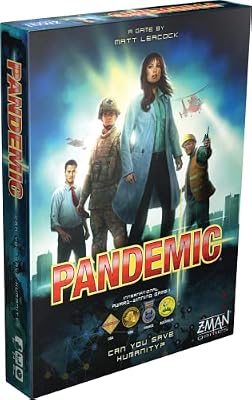
Pandemic sends two to four players around a world map as disease specialists racing to cure four infections before outbreaks overwhelm the board. Nobody competes; the group plans together, argues about priorities and either celebrates a shared save or loses side by side. That makes it ideal for a woman who dislikes cut-throat games but loves a hard problem, or for introducing a family that prefers teamwork. Each role has a distinct power, sessions stay tense to the final card, and the cooperative format often lands well with people who think board games are not for them.
Specs
- Number of players: 2-4
- Recommended age: 8+
- Play time: 45 minutes
- Game mechanics: cooperative
- Item model number: ZM7101
Best for: A team-minded player who enjoys solving a shared crisis.
Watch out for: One confident player can dominate the planning, so groups should agree everyone voices their own moves.
Which One Fits Your Situation
She Is New to Modern Board Games
Start with Carcassonne or Cascadia. Both teach in minutes, finish within the hour and never punish a beginner for someone else’s move. Carcassonne adds a touch more interaction between players, while Cascadia is the calmer of the two and includes a solo option. Either one looks beautiful wrapped, plays well with two, and leaves a new player wanting a second game rather than a rest.
She Mostly Plays With Her Partner
Choose Jaipur. It was designed from the ground up for exactly two players, so nothing feels scaled down or patched together. Thirty-minute sessions fit weeknights, the best-of-three rounds keep rematches fresh, and the rivalry stays friendly because a lost round is always one good sale away from being reversed next game. For a softer two-player mood, Carcassonne is the backup pick.
Her Game Nights Mean a Full House
Codenames is the crowd gift. It handles four to eight or more players, splits naturally into teams, and a single round takes about fifteen minutes, so latecomers can rotate in without wrecking the evening. Spectators enjoy shouting from the sofa almost as much as players do. If your recipient is the one who organises every gathering, this is the box that will actually come out at Christmas.
She Prefers Teamwork Over Rivalry
Give Pandemic. Everyone at the table shares one goal, which suits recipients who shy away from direct competition but love problem-solving with friends or family. The difficulty can be tuned by the number of epidemic cards, so the same box works for a first session with relatives and a harder rematch with her regular group later in the holidays.
Common Mistakes
- Buying by box art alone and ignoring whether the player count matches her household and habits.
- Giving a two-player-only game to a woman whose gaming happens at big family gatherings, or the reverse.
- Choosing a long, rules-heavy title for a recipient who is brand new to modern board games.
- Assuming a theme she likes in films automatically works for her in a game, without checking how it plays.
- Forgetting to check whether she already owns the classic you are about to wrap for her.
Frequently Asked Questions
Which of these games works best as a very first modern board game?
Carcassonne is the safest first step. Its rules fit on one explanation — draw a tile, place it, decide whether to claim it — and a full game ends in about thirty-five minutes. Cascadia runs a close second for someone who prefers nature themes and an even gentler pace at the table.
Can any of these be played by two people on Christmas night itself?
Yes. Carcassonne, Cascadia, Pandemic and Jaipur all play well with two people straight out of the box, so the gift can be opened and used the same evening. Only Codenames needs a bigger group, since it requires at least four players to form its two teams.
How do I choose between Carcassonne and Cascadia for the same person?
Pick Carcassonne if she enjoys light interaction and watching what an opponent is building, because the shared map puts everyone’s plans in view. Pick Cascadia if she would rather develop her own landscape undisturbed and likes wildlife and nature themes. Cascadia also adds a solo mode, which breaks the tie for independent players.
What if she does not like competitive games at all?
Give Pandemic. It is fully cooperative, so the table wins or loses together and nobody spends the evening being beaten by a partner or sibling. The shared planning suits players who enjoy discussion and problem-solving, and the challenge can be softened for a first game by using fewer epidemic cards.





Write Your Review
No reviews yet. Be the first to share your experience!