
Quick answer: For most people in 2026, the best shallow depth refrigerators for small kitchens is the Compact top-freezer — our #1 rated choice. See the full ranked comparison, alternatives and buying advice below.
- Best Shallow Depth Refrigerators for Small Kitchens
- Shortlist by kitchen and household
- What “shallow depth” actually means
- Typical dimensions and fit trade-offs
- Measure the opening, not just the refrigerator
- Choose the freezer layout for how you shop
- Ownership details that affect a small-kitchen choice
- Bottom line
Best Shallow Depth Refrigerators for Small Kitchens
The best shallow depth refrigerator for a small kitchen is usually a 24- to 30-inch-wide counter-depth model, but the right pick depends on the full installation depth, door swing and freezer layout—not the “counter-depth” label alone. For a narrow galley kitchen, prioritize a bottom-freezer or French-door design only if its doors can open without hitting a wall or cabinet; for the simplest fit, a top-freezer model often needs less clearance and offers more usable capacity for the price.
Shortlist by kitchen and household
- Best for a tight, budget-conscious fit: A 24-inch-wide top-freezer refrigerator. It is commonly shallower and narrower than full-size models, and its simple layout avoids the wide door sweep of many French-door refrigerators. Expect less total capacity, so it suits one or two people who shop frequently.
- Best for easier access in a narrow aisle: A French-door counter-depth refrigerator, if the kitchen has enough width for both doors to open. Each door swings through a smaller arc than a single wide door, though the handles and open doors still need clearance.
- Best for frozen-food storage: A bottom-freezer model with pull-out drawers and a divider. Drawers keep frozen items visible from above, but the fully extended freezer needs room into the aisle.
- Best for a compact kitchen with limited shopping frequency: A 30-inch counter-depth refrigerator with the largest practical fresh-food compartment. Compare usable capacity, not just the headline cubic-foot figure; ice makers and bulky drawers can reduce the space available for groceries.
What “shallow depth” actually means
Manufacturers often use “counter-depth” to describe a refrigerator designed to sit closer to standard kitchen counters than a conventional full-depth model. It does not guarantee a flush fit. A listed depth may exclude the handles, doors, hinges or required rear ventilation gap. Measure to the front of the countertop and cabinet face, then compare that measurement with the appliance’s depth at each point.

Frigidaire, 2 Door Apartment Size Refrigerator/Freezer Combo, 7.5 cu ft, Platinum Series, Stainless, 23" D x 21.5" W x 55.5" H
Included for 'Best Shallow Depth Refrigerators for Small Kitchens' because the listing specifies 2 Door Apartment Size Refrigerator/Freezer Combo and 7.5 cu ft, details this guide uses to compare options.
View on Amazon
Kenmore 18.1 cu. ft. 30" Wide Top Mount Refrigerator - White
Included for 'Best Shallow Depth Refrigerators for Small Kitchens' because the listing specifies White, details this guide uses to compare options.
View on Amazon
EUHOMY 130 Can Mini Fridge, Beverage Refrigerator with Glass Door, Black
Included for 'Best Shallow Depth Refrigerators for Small Kitchens' because the listing specifies Beverage Refrigerator with Glass Door and Black, details this guide uses to compare options.
View on Amazon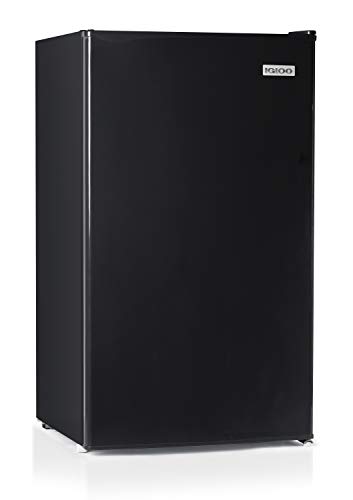
Igloo 3.2 Cu.Ft. Mini Fridge with Freezer - Single Door Compact Refrigerator with Glass Shelves for Homes, Dorms & Offices- Keep Snacks, Drinks & Frozen Foods Cool with Temperature Control Mini Fridge
Included for 'Best Shallow Depth Refrigerators for Small Kitchens' because the listing specifies Dorms & Offices- Keep Snacks, details this guide uses to compare options.
View on AmazonCabinet depth is also not the same as usable interior depth. A shallow refrigerator may leave the kitchen aisle clearer but have shorter shelves and less room for wide platters. If your household stores tall bottles, large pans or bulk groceries, check shelf dimensions and drawer configuration before choosing based on exterior measurements alone.
Typical dimensions and fit trade-offs
These ranges are practical screening estimates, not specifications for any one model. Always use the manufacturer’s installation guide for the exact unit.
| Refrigerator type | Typical width | Typical cabinet-depth body | Typical capacity range | Main fit trade-off |
|---|---|---|---|---|
| Compact top-freezer | 24–28 in | 24–28 in | 10–18 cu ft | Smaller footprint, but limited shelf width and freezer volume |
| Counter-depth top-freezer | 28–33 in | 25–30 in | 18–22 cu ft | Relatively simple door swing; capacity varies considerably by model |
| Counter-depth bottom-freezer | 30–36 in | 25–30 in | 18–22 cu ft | Convenient fresh-food access; drawer needs clearance when extended |
| Counter-depth French-door | 30–36 in | 25–30 in | 20–25 cu ft | Narrower individual doors, but greater width and often more complex installation |
Depth ranges can vary depending on whether the measurement includes the door and handles. Capacity is also model-dependent, and two refrigerators with the same stated capacity may organize that space very differently.
Measure the opening, not just the refrigerator
- Measure the available width at the floor, middle and top. Walls, trim and cabinets can make an opening narrower at one point. Use the smallest measurement and allow the manufacturer’s required side clearance.
- Measure depth in stages. Record the distance from the back wall to the countertop edge, then check whether the refrigerator’s case, door and handle will project past those points. Include any required gap behind the appliance for ventilation and connections.
- Check door swing against nearby obstacles. Open the refrigerator door to the angle needed to pull out crisper bins. A door that technically opens may still prevent drawers from coming out. For a model with reversible hinges, confirm the hinge can be changed before delivery.
- Account for the aisle and freezer drawer. Measure the remaining passage with the refrigerator doors open and the freezer drawer fully extended. This matters in galley kitchens, where an open drawer can block the only route through the room.
- Trace the delivery route. Measure entry doors, hallways, turns and stair openings—not just the kitchen opening. Check the appliance’s delivery dimensions and whether doors or handles can be removed for transport.
Worked fit check: Suppose the opening is 34 inches wide and 27 inches from the back wall to the counter edge. If a candidate is 33 inches wide, that leaves just 1 inch total for side gaps—less than the specified clearance on some models. If its body is 28 inches deep before the handles, it may project beyond the counter, even though it is marketed as counter-depth. The fit decision should be based on the installation drawing, not the category name.
Choose the freezer layout for how you shop
Top-freezer: Usually the most straightforward layout and often a sensible choice when price and compact width matter. Frozen food is higher up, while fresh food sits below. The freezer shelf can be awkward for large packages, and smaller models may lack organized bins.
Bottom-freezer drawer: Keeps everyday fresh food near eye level. Look for a drawer that separates small items from larger packages and extends far enough to see the back. In a narrow kitchen, check how far it projects and whether it blocks a walkway.
French door: Split fresh-food doors can help in a constrained aisle, especially when you only need to open one side. However, many models are wider, and a full-width freezer drawer still requires forward clearance. Door bins and interior layout can also make the advertised capacity less useful for large containers.
For households that buy frozen food in bulk, prioritize freezer capacity and drawer organization over a large fresh-food number. For frequent produce shopping, adjustable shelves and accessible crisper drawers may be more valuable than a bigger freezer.
Ownership details that affect a small-kitchen choice
- Ice and water features: An ice maker takes up space and adds plumbing requirements. Check whether a water line can reach the connection without being pinched behind the refrigerator. A dispenser can also add depth or width around the door.
- Cleaning access: A tight side gap makes dust and spills harder to reach. Confirm the appliance can be pulled forward safely for maintenance, and follow the manufacturer’s cleaning instructions for condenser areas and door seals.
- Door seals and drawers: Door gaskets and drawer slides are common wear points on any refrigerator. Keep seals clean, avoid overloading bins, and do not slam drawers; a damaged seal can let warm air in and affect cooling efficiency.
- Leveling and ventilation: An uneven refrigerator may have doors that do not close properly, while blocked ventilation can interfere with operation. Use the specified leveling procedure and clearances rather than pushing the unit tightly against surrounding surfaces.
Bottom line
For a narrow kitchen, start with the opening width, true installed depth and door or drawer clearance; then choose the layout that matches your shopping habits. A compact top-freezer is often the practical choice when footprint and cost lead. A bottom-freezer or French-door model can be easier for daily access, but only if the open doors and drawers leave a usable aisle. Before ordering, verify the exact model’s installation dimensions, hinge direction, ventilation gaps and delivery path.
Ready to decide? Our #1 pick for 2026 is the Compact top-freezer.
Live price & availability on Amazon.





Write Your Review
No reviews yet. Be the first to share your experience!