
- Top Pick: Benriner Mandoline Jumbo Slicer, Japanese Stainless Steel Blade, Beige
- Best Value: OXO Good Grips V-Blade Mandoline Slicer
- Premium Choice: Mueller Mandoline Slicer for Kitchen, 5-Blade,
The Short Answer
For most home cooks, a mandoline slicer with a blade width of about 3.5 to 4 inches (9 to 10 cm) is the best all-purpose choice. That size is wide enough for potatoes, onions, cucumbers, zucchini, apples, and most other everyday produce, while still fitting comfortably in a kitchen drawer or cabinet.
Choose a 2.5- to 3-inch (6.4- to 7.6-cm) blade if you mainly slice small vegetables, cook for one or two people, or have limited storage. Choose a 4.5- to 5-inch (11.4 to 12.7 cm) blade if you regularly prepare large potatoes, eggplant, cabbage wedges, or food for a family. Wider models save time, but they also take up more storage space and can be harder to control.
As an Amazon Associate we earn from qualifying purchases at no extra cost to you. Product prices and availability are accurate as of the date shown and are subject to change.


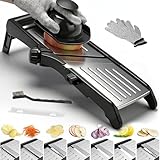
Blade width is not the same as slice thickness. Width describes how much produce can contact the blade in one pass. Thickness describes whether the slicer makes paper-thin shavings, medium slices, or cuts several millimeters thick. For everyday versatility, look for a cutting width near 4 inches plus an adjustable thickness range of approximately 0.5 to 3 mm.
Standard Sizes
Mandoline dimensions vary by brand, but the following categories provide a useful buying guide. The blade measurements refer to the approximate usable cutting area, not the slicer’s total outside width. Handles, side rails, safety guards, and adjustment knobs can make the complete tool 1 to 3 inches wider or longer.
| Mandoline size | Approximate blade width | Approximate overall size | Best for |
|---|---|---|---|
| Compact | 2.5–3 in (6.4–7.6 cm) | 10–12 in L × 3.5–5 in W (25–30.5 × 8.9–12.7 cm) | Small vegetables, quick garnishes, small kitchens |
| Standard | 3.5–4 in (8.9–10.2 cm) | 12–15 in L × 5–6 in W (30.5–38.1 × 12.7–15.2 cm) | Most home cooking and family meals |
| Wide | 4.5–5 in (11.4–12.7 cm) | 14–17 in L × 6–7 in W (35.6–43.2 × 15.2–17.8 cm) | Large potatoes, cabbage, eggplant, batch prep |
| Extra-wide or professional-style | 5–6 in (12.7–15.2 cm) | 16–20 in L × 7–9 in W (40.6–50.8 × 17.8–22.9 cm) | High-volume prep and commercial-style kitchens |
A standard 3.5- to 4-inch model is the safest starting point for most buyers. The Benriner Mandoline Jumbo Slicer, for example, is designed around a broad cutting surface and is useful when you want to prepare larger produce without making repeated narrow passes. Its price is typically around $35 to $50. A standard V-blade design such as the OXO Good Grips V-Blade Mandoline Slicer commonly falls in the $40 to $55 range and offers a practical balance between width, adjustability, and countertop stability.
Budget multi-blade models, including five-blade and seven-in-one designs, often cost approximately $20 to $40. The Mueller five-blade slicer and similar adjustable models are generally aimed at cooks who want several cutting styles in one tool. Check the stated cutting width carefully, because a large accessory count does not necessarily mean a wide blade. Some inexpensive models have a cutting surface closer to 3 inches (7.6 cm) even when the body looks substantial.
How to Measure Your Space
- Measure the storage opening. Use a tape measure to record the opening’s height, width, and depth. Measure the narrowest point, not just the front of the cabinet or drawer.
- Account for the folded or locked position. A mandoline may store flat but have a raised handle, thickness dial, or removable food holder. Use the manufacturer’s stored dimensions when available. Otherwise, measure the tool with its legs folded and accessories attached.
- Add clearance for your hand. For a drawer, leave at least 0.5 inch (1.3 cm) of spare space on each side so the slicer can be lifted out without catching on the drawer walls. For a cabinet, allow about 1 inch (2.5 cm) above the tool.
- Measure the working area. During use, most mandolines need a stable surface approximately 16 to 20 inches (40.6 to 50.8 cm) long. A wide model can need 7 to 9 inches (17.8 to 22.9 cm) of counter width once you include a bowl or cutting board.
- Check the receiving bowl. If the slicer rests over a bowl, measure the distance between its legs or supports. A model with a 4-inch blade may not fit securely over a narrow 5-inch bowl if its feet are widely spaced.
- Plan for accessories. Extra blades, julienne inserts, cleaning tools, and food holders may need a separate 2- to 4-inch (5.1- to 10.2-cm) storage space. Count them before choosing a compact drawer fit.
By Room or Use Case
Small apartment kitchen
Choose a compact or standard mandoline with a 2.5- to 3.5-inch (6.4- to 8.9-cm) blade. A lightweight model between 0.5 and 1.5 pounds (0.23 to 0.68 kg) is easier to store, but make sure it has nonslip feet or a handle. A folding design can fit a drawer that is only 3 inches (7.6 cm) high. Avoid choosing a wide model simply for its extra features if your counter is already crowded.
Everyday family cooking
A 3.5- to 4-inch blade is the most versatile option. It accommodates medium and large potatoes, onions, tomatoes, cucumbers, and apples without making the slicer excessively bulky. Look for a stable base, a food holder with a broad grip, and thickness settings from approximately 1 to 5 mm. Expect to pay about $30 to $60 for a dependable home model.
Large vegetables and batch preparation
If you often prepare gratins, potato chips, vegetable trays, or large quantities of slaw, select a 4.5- to 5-inch blade. The extra width reduces the number of passes needed for large potatoes and cabbage wedges. Allow at least 18 inches (45.7 cm) of usable counter length and plan for a storage location roughly 17 inches (43.2 cm) long. Wider mandolines may weigh 1.5 to 3 pounds (0.68 to 1.36 kg), which can improve stability but makes them less convenient to move.
Garnishes and small portions
A narrow 2.5- to 3-inch blade is sufficient for radishes, garlic, small carrots, shallots, and decorative fruit slices. It can also be easier to control when making a few slices rather than preparing an entire meal. However, never hold small produce directly against the blade. Use the supplied guard and discard pieces that are too small to hold safely.
Frequent meal prep
For several meals per week, prioritize construction and adjustment controls over the maximum number of blade inserts. A standard or wide model with a stainless-steel blade, secure feet, and clearly marked thickness settings is usually more practical than a very inexpensive seven-piece kit. A typical home-use mandoline requires no electrical power; wattage does not apply unless you are comparing it with an electric food slicer.
Common Sizing Mistakes
- Confusing total width with blade width. A slicer may measure 7 inches (17.8 cm) across its outer frame but provide only a 3.5-inch (8.9-cm) cutting surface.
- Buying the widest model automatically. Extra width is useful for large produce, but it can make storage, cleaning, and handling more difficult.
- Ignoring food-holder size. A wide blade does not help if the guard is too small to grip a large potato or cabbage wedge securely.
- Measuring only the counter. Check the drawer, cabinet, sink area, and bowl fit before purchasing.
- Assuming more blades means better sizing. Interchangeable inserts add functions, but they may require a dedicated container and can be easy to misplace.
- Using blade width as a safety measure. A wider slicer is not automatically safer. Stability, a sharp blade, a secure food holder, and careful technique matter more.
FAQ
Is a 3-inch mandoline wide enough?
Yes, for small to medium vegetables and most basic slicing tasks. A 3-inch blade is especially suitable for one- or two-person households and kitchens with limited storage. Large potatoes, cabbage, or eggplant may require more passes or partial cuts.
Is a 4-inch mandoline better than a 5-inch model?
Neither is universally better. A 4-inch model is easier to store and handles most produce, while a 5-inch model is faster for large vegetables and batch cooking. Choose the 5-inch size only if you have enough storage and regularly prepare large quantities.
What blade width is best for potato chips?
A 3.5- to 4.5-inch blade works well for potatoes. More important than width is a consistent thickness setting, commonly around 1 to 2 mm for thin chips. Use the food holder and keep your fingers away from the cutting surface.
How wide should a mandoline be for cabbage?
Choose at least a 4-inch blade for cabbage wedges, and consider a 5-inch model for frequent slaw or batch preparation. Even with a wide slicer, cut the cabbage into stable wedges that fit securely under the food holder. For 2026 purchases, verify both the usable blade width and the folded storage dimensions before ordering.
Ready to decide? Our #1 pick for 2026 is the Compact.
Live price & availability on Amazon.






Write Your Review
No reviews yet. Be the first to share your experience!