
The Short Answer
For most kitchens, a 2-cup liquid measuring cup is the most practical size. It is large enough for pancake batter, soup stock, sauces, and everyday cooking, while still fitting comfortably in a cabinet or drawer. A 1-cup cup is useful for smaller portions and tight storage, but it may require multiple fills for larger recipes.
If you bake often or prepare family-size meals, the most versatile setup is a 1-cup and 2-cup pair. Add a 4-cup model only if you regularly mix large batches, measure several cups of liquid at once, or want a container that doubles as a small batter pitcher. In 2026, typical prices range from about $7 to $18 for a basic two-piece set and $12 to $25 for a well-designed single 2-cup cup. Glass models commonly cost more than lightweight plastic.
As an Amazon Associate we earn from qualifying purchases at no extra cost to you. Product prices and availability are accurate as of the date shown and are subject to change.


Standard Sizes
Liquid measuring cups are usually marked in U.S. cups, fluid ounces, milliliters, and sometimes pints or quarts. One U.S. cup equals 8 fluid ounces, or approximately 237 milliliters. The outside dimensions below are typical ranges, not universal specifications; handles, pouring lips, measurement markings, and nesting designs can change the footprint.
| Capacity | Typical outside dimensions | Approximate weight | Best for |
|---|---|---|---|
| 1/4 cup | 3.5–4.5 in L × 2.5–3.5 in W × 2–2.75 in H (8.9–11.4 × 6.4–8.9 × 5.1–7 cm) |
1–3 oz (28–85 g) |
Small amounts of milk, oil, dressings, and sauces |
| 1/3 cup | 4–5 in L × 2.75–3.5 in W × 2.25–3 in H (10.2–12.7 × 7–8.9 × 5.7–7.6 cm) |
1–3 oz (28–85 g) |
Small recipes and portioned ingredients |
| 1/2 cup | 4.5–5.5 in L × 3–4 in W × 2.5–3.5 in H (11.4–14 × 7.6–10.2 × 6.4–8.9 cm) |
1.5–4 oz (43–113 g) |
Single servings, sauces, and smaller baking recipes |
| 1 cup | 5.5–7 in L × 3.5–4.5 in W × 3.25–4.5 in H (14–17.8 × 8.9–11.4 × 8.3–11.4 cm) |
3–10 oz (85–283 g) |
Everyday cooking, small batches, and compact storage |
| 2 cups | 7–9 in L × 4–5.5 in W × 4–5.5 in H (17.8–22.9 × 10.2–14 × 10.2–14 cm) |
5–18 oz (142–510 g) |
Most cooking, baking, soups, sauces, and meal prep |
| 4 cups | 9–11.5 in L × 5–6.5 in W × 5–6.5 in H (22.9–29.2 × 12.7–16.5 × 12.7–16.5 cm) |
8–32 oz (227–907 g) |
Large batches, mixing, gravy, and family-size recipes |
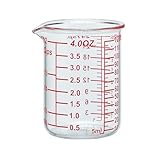
A 2-cup cup offers the best balance of capacity and storage for most households. Look for clear markings at eye level, a broad base, a comfortable handle, and a spout that pours without dribbling. Glass is heavier and can handle hot liquids well when labeled for that use. Plastic is lighter, less likely to break, and usually easier to handle with wet hands. A set such as the Pyrex Essentials 1- and 2-cup pair covers the two sizes most people use, while an angled 2-cup design can make reading measurements easier from above.
How to Measure Your Space
- Measure the storage opening. Use a tape measure to record the opening’s width, depth, and height in inches. Measure the narrowest points, not just the widest part of the cabinet.
- Account for the handle. The handle often creates the widest part of a measuring cup. Add at least 1/2 inch of clearance to the product’s listed width whenever the cup will slide into a tight drawer.
- Check shelf clearance. A 4-cup cup can be 5 to 6.5 inches tall, and its handle may prevent it from standing upright on a short shelf. Confirm the usable height below the shelf above it.
- Measure the drawer depth. For drawer storage, compare the cup’s longest measurement, including the spout and handle, with the drawer’s interior depth. A 2-cup model may need 8 to 9 inches of front-to-back space.
- Plan for nesting. If buying multiple cups, check whether the handles and spouts nest or sit beside one another. Two separate cups may occupy more room than their capacities suggest.
- Leave working space. Do not choose a cup that barely fits. Leave about 1 inch around it so you can remove it without catching the handle or scraping the spout.
By Room or Use Case
Everyday kitchen cooking
Choose a 2-cup cup. It handles common quantities without becoming cumbersome, and its markings typically include 1/4, 1/2, 1, 1 1/2, and 2 cups. This is the best single-size choice for a household that makes soups, marinades, sauces, boxed mixes, and beverages.
Small kitchen or apartment storage
Choose a 1-cup cup, or buy a nesting 1- and 2-cup set. A 1-cup model is easier to fit in a narrow drawer and weighs less when full. It is less convenient when a recipe calls for 3 or 4 cups, so a compact set is usually more practical than a 1-cup cup alone.
Frequent baking
Choose both 1- and 2-cup sizes, with clear milliliter and fluid-ounce markings. Baking often involves several liquid ingredients, and two cups let you measure one ingredient while another is being used. For yeast doughs, custards, and large cake batches, a 4-cup cup can reduce spills during mixing.
Large households and meal prep
Choose a 4-cup cup if you frequently make stock, gravy, punch, soup, or sauces in larger quantities. Its larger handle and base can improve stability, but its bulk makes it less convenient for small tasks. Keep a 1- or 2-cup model nearby for routine measurements.
Hot liquids and stovetop work
Choose heat-resistant glass or a plastic cup specifically rated for hot liquids. A broad base, sturdy handle, and generous headspace are more important than the largest capacity. Do not fill a cup to the rim with boiling liquid; leave room below the spout to reduce splashing and overflow.
Occasional or budget use
A basic two-piece set is usually the best value. Sets priced around $7 to $15 commonly include 1- and 2-cup capacities, while sturdier glass or angled-read designs often cost about $13 to $25. Verify that the markings are molded, printed, or etched clearly enough to remain readable after washing.
Common Sizing Mistakes
- Buying only a 4-cup cup. Large cups are useful, but they are awkward for measuring a few tablespoons of liquid and often take up too much storage space.
- Ignoring the handle and spout. Product dimensions may list the body only. The handle can add several inches to the total length or width.
- Confusing dry and liquid measurements. A liquid cup measures volume with space for leveling at the meniscus. Dry measuring cups are designed to be filled and leveled, so they are not interchangeable for every recipe.
- Using a small cup for large quantities. Repeated fills increase the chance of reading the wrong line or spilling. Move up to a 2- or 4-cup model when a recipe requires more than 2 cups.
- Choosing capacity over readability. A cup is not practical if dark, crowded, or low-contrast markings are difficult to see. Angled markings can help when measuring directly from above.
- Forgetting weight. A glass 2-cup cup may weigh several times more than a plastic version before filling. If hand strength or frequent lifting is a concern, choose lightweight plastic.
FAQ
Is a 1-cup or 2-cup liquid measuring cup better?
A 2-cup cup is better as a single all-purpose choice because it handles more recipes without being excessively large. A 1-cup cup is better for small kitchens, quick tasks, and people who mostly cook for one or two.
What size measuring cup do most recipes use?
Most everyday recipes use between 1/4 cup and 2 cups of liquid, which is why a 1- and 2-cup combination is so useful. Recipes for soups, drinks, and large batches may call for a 4-cup cup.
Are glass liquid measuring cups better than plastic?
Neither material is universally better. Glass is heavier, transparent, and often suited to hot ingredients when heat-rated. Plastic is lighter, quieter, and more resistant to breaking. Choose based on temperature needs, storage, and how often the cup will be moved while full.
How many liquid measuring cups should a kitchen have?
One 2-cup cup is enough for basic cooking. Two cups—a 1-cup and a 2-cup—are more practical for regular baking and meal preparation. Add a 4-cup model only when large-volume cooking makes repeated measuring inconvenient.
Ready to decide? Our #1 pick for 2026 is the 1/4 cup.
Live price & availability on Amazon.





Write Your Review
No reviews yet. Be the first to share your experience!