
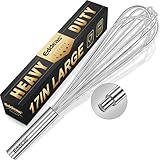
- Top Pick: Eddeas 17in/43cm Extra Large Whisk,5Ib Heavy Duty Whisk, 2.4mm Wire Whisk Suitable for Mixing Thick batter and Large batch soup.Not suitable for individual small batch production(Silver)
- Best Value: OYV 18/10 Stainless Steel Large Whisk, 17-Inch Heavy-Duty Kitchen Whisk
- Premium Choice: Walfos Whisk,17in Large Whisks, Heavy Duty Stainless Steel Wire Whisk Ideal For Beating Eggs, Blending Sauces, Mixing Batter.
Buying a heavy-duty whisk is less straightforward than choosing a standard balloon whisk. The largest model is not automatically the strongest, and a thick wire does not guarantee comfortable mixing. Many shoppers make three common mistakes: they choose a whisk that is too large for their bowl, confuse a high product weight with durable construction, or pay a commercial price for capacity they will never use. Others overlook handle length, wire attachment points, storage, and whether the whisk is intended for batter, sauces, eggs, or large pots.
The right choice depends on the volume and thickness of your mixtures, the size of your cookware, and how often you expect to use the tool. The following guide explains what to look for in a heavy duty whisk in 2026, using practical dimensions and price ranges rather than vague claims.
As an Amazon Associate we earn from qualifying purchases at no extra cost to you. Product prices and availability are accurate as of the date shown and are subject to change.


Decide These 3 Things First
- What will you mix? Thick pancake batter, bread-adjacent doughs, mashed potatoes, and large batches need sturdier wires than whipped cream, eggs, or thin gravies.
- What is your batch size? A 12-inch whisk is easier to control in a 2- to 4-quart bowl. A 17- to 18-inch model makes more sense for 6- to 12-quart bowls, stockpots, or restaurant-size batches.
- How much force and reach do you need? Long handles keep hands away from hot pots, but they add leverage, weight, and storage difficulty. Decide whether you need a countertop baking tool or a pot-stirring tool before comparing prices.
Size and Working Capacity
Length is one of the most important specifications because it determines both reach and control. For ordinary home baking, look for a whisk between 10 and 14 inches long. This range works well in mixing bowls and gives enough handle clearance without feeling unwieldy.
Large home and light-commercial whisks typically measure 17 to 18 inches. These are useful for large batches of batter, soup, custard, sauces, or scrambled eggs. Examples such as the Eddeas 17-inch model, the OYV 17-inch model, and the Walfos 17-inch model fit this category. They are better suited to large bowls and pots than to individual portions. A 17-inch whisk can be awkward in a small 1- to 2-quart bowl, where the wires may not contact the ingredients efficiently.
For commercial stockpots or deep containers, a 24- to 40-inch whisk may be appropriate. The Browne Foodservice model, at 40 inches, is intended for unusually deep or large vessels rather than everyday home use. Before buying one, measure the depth of your pot and allow at least 4 to 6 inches of handle to remain above the rim. A whisk that is too short forces you to work close to heat; one that is too long can be tiring and difficult to maneuver.
Material: Stainless Steel Is the Default
Look for food-contact stainless steel throughout the working end and, ideally, the handle. Stainless steel resists rust, tolerates hot mixtures, and is less likely to retain food odors than porous materials. An 18/10 stainless-steel description indicates approximately 18% chromium and 10% nickel, a common grade associated with corrosion resistance and a polished appearance. The OYV 18/10 model is an example of this specification.
Do not assume that every “stainless steel” whisk has identical durability. The grade may apply only to the wires, while the handle contains a separate material or a hollow metal tube. Check whether the product description specifies stainless steel for both the wires and handle, and look for care instructions. Dishwasher safety is convenient, but repeated exposure to aggressive detergent and heat can affect finishes or loosen poorly assembled handles over time.
Silicone-coated wires can protect nonstick cookware, but they are usually less suitable for very thick mixtures than exposed stainless-steel wires. If you use nonstick pots, confirm the temperature rating and inspect the coating for gaps. For a general heavy-duty whisk, uncoated stainless steel is usually the simplest and most durable option.
Wire Thickness and Construction
Wire diameter is a useful durability indicator, although it should never be considered alone. A 2.4-millimeter wire is substantially more substantial than the fine wires found on many lightweight balloon whisks. The Eddeas 17-inch model, for example, lists 2.4-millimeter wires and a 5-pound product description; verify the actual shipping and item weight before treating that number as a performance measure.
For thick batter and frequent use, a wire diameter of about 2.0 to 2.5 millimeters is a sensible target. Wires below roughly 1.5 millimeters can still be effective for eggs and cream, but they may flex more under heavy resistance. Very thick wires can increase weight and reduce the whisk’s ability to incorporate air, so thicker is not always better for meringue or whipped cream.
Examine how the wires meet the handle. The strongest designs have a secure, smooth connection with no visible gaps, sharp edges, or loose movement. A welded or mechanically secured connection is generally preferable to a handle that merely traps wire ends under a cap. The wire loops should be evenly spaced and symmetrical. Uneven loops can create dead spots where ingredients collect and may indicate inconsistent assembly.
Also check whether the whisk has a teardrop, balloon, or straight profile. Balloon and teardrop shapes cover more surface area and are useful in bowls. Straight or narrow whips reach into deep pots and containers more easily.
Comfort and Mixing Performance
A heavy-duty whisk should be strong enough for resistance without becoming exhausting. For most home users, an assembled weight between 8 and 16 ounces is manageable for extended hand mixing. Commercial models or oversized whips can weigh 1 to 3 pounds, particularly when they use long handles and thick wire. A heavier tool may feel reassuring, but it also increases wrist and shoulder fatigue.
Look for a handle diameter of approximately 1 to 1.25 inches, with a smooth surface that is easy to grip when hands are damp. A completely round metal handle can become slippery. A textured, contoured, or slightly flattened grip offers better control. Avoid pronounced seams, exposed welds, and end caps that dig into the palm.
Consider the mixture as well as the whisk. Balloon whisks with several well-spaced loops are good for adding air to eggs and cream. Dense, sturdy loops are better for sauces and thick batters. A large whisk is not a substitute for a stand mixer: it still requires hand force, and most heavy-duty whisks are not designed for dough or extremely stiff mixtures.
Price Tiers: What You Get
Budget heavy-duty whisks generally cost about $12 to $25. This is where many 17- to 18-inch stainless-steel models sit, including the example products priced around $17.99 to $18.99. At this level, prioritize wire diameter, secure construction, and a clearly stated length over decorative handles or oversized marketing claims.
Midrange whisks usually cost $25 to $60. They may offer better finishing, more consistent wire spacing, a more comfortable handle, or a specialized shape. This tier is worthwhile for frequent home cooks who use the whisk several times a week but do not need restaurant-scale equipment.
Premium and commercial models commonly run from $60 to $120 or more. A 40-inch stainless-steel foodservice whisk priced around $67.67 illustrates why commercial tools cost more: the design targets deep vessels, high-volume work, and professional handling rather than compact storage. Pay the premium only if the capacity and reach solve a real problem.
Warranty and Replacement Support
Check the warranty before assuming a heavy-duty whisk will last indefinitely. A basic product may offer no stated warranty, while a better-supported model may include 30 days to one year against manufacturing defects. Some commercial suppliers provide longer coverage, but exclusions can apply to bent wires, misuse, corrosion, or normal wear.
Look for a clearly identified seller, customer-service contact, and return period of at least 30 days. Replacement availability matters when buying a commercial tool: a handle or wire assembly may be unavailable for an inexpensive consumer whisk, while foodservice brands sometimes maintain parts catalogs. Keep the original packaging until you have checked the handle connection and wire alignment.
Delivery, Storage, and Assembly
Most one-piece whisks require no assembly, but oversized models may arrive in long packaging that can be damaged in transit. Inspect the whisk immediately for bent loops, dents, rough welds, and a loose handle. A 17-inch tool needs a drawer or utensil crock that can accommodate its full length; a 40-inch whisk may require wall storage or a dedicated commercial utensil rack.
Confirm the delivered dimensions rather than relying only on the product title. “17-inch” can refer to the overall length, not the handle or working head. If the whisk will be used in a stockpot, measure the distance from the rim to the bottom and compare it with the working-head length. Avoid models that require attaching a handle unless the connection is designed for repeated torque and is easy to clean.
Spec Checklist
| Spec | Budget | Mid | Premium |
|---|---|---|---|
| Typical price | $12–$25 | $25–$60 | $60–$120+ |
| Overall length | 10–18 inches | 12–24 inches | 18–40 inches |
| Wire diameter | 1.5–2.0 mm | 2.0–2.5 mm | 2.0–3.0 mm |
| Best batch size | 2–6 quarts | 4–10 quarts | 8+ quarts or deep pots |
| Comfortable target weight | 6–12 ounces | 8–20 ounces | 1–3 pounds |
| Warranty target | 30 days or stated defect coverage | 90 days–1 year | 1 year or commercial support |
Red Flags
- Unclear measurements: Avoid listings that provide only “extra large” without overall length, head dimensions, or wire thickness.
- Unusually high weight claims: A claimed 5-pound weight may refer to packaging or shipping weight. Confirm the actual item weight.
- Loose or covered connections: A cap that hides the wire attachment makes it harder to assess cleanability and structural security.
- Sharp edges and rough welds: These can cut hands, trap food, or scratch cookware.
- Overpromising: A whisk marketed for thick batter is not necessarily suitable for bread dough, commercial production, or continuous professional use.
- No care instructions: Missing dishwasher, temperature, or storage guidance is a sign to investigate further.
- Too much whisk for the job: A 24- to 40-inch model is inconvenient for everyday bowl mixing and may create more fatigue than efficiency.
FAQ
What size heavy-duty whisk is best for home use?
A 12- to 14-inch whisk is the most versatile choice for typical home bowls. Choose a 17- to 18-inch model when you regularly mix large batches or work in deep pots. Models longer than 24 inches are usually specialized tools.
Is a thicker wire always better?
No. Wires around 2.0 to 2.5 millimeters are useful for thick mixtures, but thin wires incorporate air more efficiently into eggs and cream. Match the wire thickness to the task instead of choosing the largest number.
Can a heavy-duty whisk replace a mixer?
No. It can handle sauces, eggs, soup, and many batters, but it still depends on human effort. Very stiff dough and large repeated batches are better suited to a stand mixer or commercial mixer.
How should I clean and store one?
Rinse it promptly so batter and sauce do not dry around the wire junctions. Use a dishwasher only if the manufacturer permits it. Dry the connection thoroughly, then store the whisk where the loops will not be bent by other utensils.
Ready to decide? Our #1 pick for 2026 is the Typical price.
Live price & availability on Amazon.





Write Your Review
No reviews yet. Be the first to share your experience!