
A wood cutting board can be a daily pleasure—or a warped, stained, knife-dulling nuisance. The most common mistake is choosing by appearance alone, especially when a board is styled as kitchen décor. A handsome stand or book-shaped cover does not tell you whether the actual cutting surface is large enough, made from suitable wood, or easy to clean.
Shoppers also underestimate thickness, buy a board that is too small for their prep habits, and assume “hardwood” automatically means high quality. Some listings use broad terms without clearly stating the species, dimensions, finish, or whether the pictured stand is included. Before comparing colors and prices, use the criteria below to decide what will work in your kitchen.
As an Amazon Associate we earn from qualifying purchases at no extra cost to you.



Decide These 3 Things First
- How much prep space do you need? For occasional garnish and small meals, a board around 12 by 16 inches may be adequate. Regular cooks should look closer to 16 by 20 inches or larger.
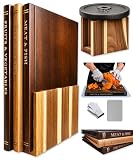
- Will it be a work surface or display piece? A book-style set with three smaller boards and a stand can look attractive on a counter, but it may not replace one substantial everyday board.
- What is your care tolerance? Every real wood board needs hand-washing, prompt drying, and occasional food-safe oil. If you want a board that can go in the dishwasher, choose plastic or composite instead.
Size and Working Area
Size affects safety as much as convenience. Your knife should have room to move without ingredients sliding off the edge. A practical minimum for a primary board is about 14 by 18 inches, while 16 by 20 inches is a comfortable target for vegetables, herbs, and boneless meat. A board measuring 10 by 14 inches is useful as a secondary surface but can feel cramped for dinner prep.
Check the usable cutting area rather than the outside dimensions. A juice groove, border, decorative edge, or recessed handle can reduce the flat work zone by 1 to 2 inches on each side. For carving, a groove roughly ¼ inch deep and ⅛ to ¼ inch wide can catch juices, but it also takes away some usable space and is harder to scrub.
Thickness matters too. Boards around ¾ inch thick are easier to lift and store. A 1 to 1½-inch board feels more stable and is less likely to flex, particularly at larger sizes. It will also be heavier: a 16-by-20-inch hardwood board can weigh approximately 8 to 15 pounds, depending on the wood and construction. Make sure you have enough counter and cabinet space before buying.
Material and Wood Species
Look for a clearly identified, close-grained hardwood such as maple, walnut, cherry, or beech. Maple is generally light in color and durable; walnut is darker and often slightly softer; cherry develops a richer tone over time; and beech offers a practical balance of hardness and cost. The species alone does not guarantee quality, but vague wording such as “premium wood” gives you less useful information.
End-grain boards arrange the cut ends of wood fibers on the surface. They are often thicker, heavier, and more expensive, with typical prices from about $80 to more than $200 depending on size and craftsmanship. Edge-grain boards expose the long edges of the wood and can offer excellent performance at roughly $35 to $120. Face-grain boards are usually thinner and less expensive, commonly $20 to $70, but they can show knife marks sooner.
Avoid boards made from unknown reclaimed wood, painted surfaces, or wood treated with non-food-safe finishes. A food-safe finish should be identified as mineral oil, beeswax, or another coating specifically intended for food contact. “Natural” is not a sufficient safety specification.
Construction and Stability
Inspect how the board is assembled. Laminated boards should have tight, even seams without visible gaps, glue squeeze-out, or sections that appear to be separating. On an edge-grain board, the grain should run consistently along the length of each strip. End-grain blocks should fit together neatly, without large voids that can trap food and moisture.
Stability comes from thickness, weight, and the underside design. Non-slip feet can help, but they add parts that may loosen or make the board harder to flip. A board without feet should sit flat and have enough weight to resist movement. If the product includes a stand, verify that the stand supports the board securely and does not allow the cutting surface to touch a damp counter while stored.
Book-style sets deserve special scrutiny. Confirm whether the “book” is a wooden case, a decorative sleeve, or simply a stand. Check the dimensions of all three boards, not just the overall package. A set may include boards measuring approximately 8 by 12, 9 by 13, and 10 by 14 inches—useful as supplemental boards but smaller than many buyers expect.
Comfort and Cutting Performance
A good board should stay put, feel comfortable under your knife, and provide enough room to organize ingredients. Rounded edges are easier on the hands than sharp corners, while a chamfered or beveled underside can make a thick board easier to lift. Integrated handholds are convenient, but they can reduce the cutting area and collect crumbs if poorly shaped.
Wood is generally kinder to knife edges than glass, stone, or ceramic. That does not mean every wood board feels the same. Very hard surfaces can feel less forgiving, while softer woods may develop knife marks quickly. Moderate knife marks are normal and do not mean the board has failed; deep cuts, splinters, or raised fibers are signs that it needs sanding or replacement.
For meat preparation, consider whether you want a separate board. Using one board for raw poultry, produce, and ready-to-eat foods increases cross-contamination risk unless it is thoroughly washed between tasks. A three-board set can be useful when the boards are genuinely separate and easy to identify, but labels alone do not replace proper cleaning.
Price Tiers: What You Actually Get
Budget, $20–$50: Expect a thinner face- or edge-grain board, often around ¾ inch thick and 12 by 16 inches. These can be good for light prep, but inspect the species, finish, and flatness carefully. Basic book-style sets commonly fall near this range; example listings priced from about $45.99 to $49.13 should be judged by board dimensions and construction rather than the decorative presentation.
Midrange, $50–$100: This is the most useful range for many home cooks. You may find thicker edge-grain boards, better-finished hardwood, or a three-piece set with a stand. The example sets priced around $59.47 and $59.99 fit this category, but the value depends on whether the boards are full-size working tools or mostly compact accessories.
Premium, $100–$250 or more: Expect substantial thickness, carefully matched hardwood, smoother finishing, and sometimes end-grain construction. Premium boards can weigh 10 to 20 pounds at larger sizes. They are worthwhile for cooks who want a long-term centerpiece, but they still require the same hand-washing and oiling as less expensive boards.
Warranty and Product Support
A warranty is not a substitute for good construction, but it can reveal how confidently a manufacturer stands behind the product. Look for coverage of splitting, delamination, or manufacturing defects for at least 12 months. Some premium makers offer longer coverage, but read the exclusions: warping caused by soaking, dishwasher use, or failure to oil the board may not qualify.
Check whether the seller provides care instructions and a clear process for reporting damage. Keep photos of the board when it arrives, particularly if the listing promises a flat surface or a complete stand-and-board set. A warranty that covers only the stand while excluding the cutting boards offers limited practical protection.
Delivery and Assembly
Most individual boards require no assembly, but stands and multi-piece sets may need light assembly or fitting. Confirm the package contents, packed weight, and finished dimensions. A 16-by-20-inch board may not fit through a narrow cabinet opening, and a stand can add 2 to 4 inches to the total width or height.
Inspect the board within 48 hours of delivery. Look for cracks, loose joints, chipped corners, missing feet, and severe rocking on a flat surface. Minor color variation is normal in natural wood, but a board that arrives visibly bowed, damp, or split should be photographed and reported before use.
Spec Checklist
| Spec | Budget | Mid | Premium |
|---|---|---|---|
| Typical price | $20–$50 | $50–$100 | $100–$250+ |
| Useful primary size | 12 × 16 in. | 14 × 18 to 16 × 20 in. | 16 × 20 to 20 × 24 in. |
| Typical thickness | ½–¾ in. | ¾–1¼ in. | 1–1½ in. |
| Construction | Face or basic edge grain | Finished edge grain | Premium edge or end grain |
| Approximate weight | 2–6 lb. | 5–12 lb. | 8–20 lb. |
| Care finish | Food-safe oil | Oil, often with wax | Oil and wax or maker-specific food-safe finish |
| Warranty target | 30 days–1 year | At least 1 year | 1–5 years |
Red Flags
- The listing does not name the wood species or provide exact board dimensions.
- Photos show a stand or decorative case, but the description does not clearly say it is included.
- The board is labeled “dishwasher safe.” Heat and prolonged water exposure can cause wood to crack, split, or warp.
- There are visible gaps, rough seams, splinters, or glue lines in product photos.
- The seller claims a board is “self-healing” or permanently stain-proof without explaining the material or finish.
- A large board is advertised as lightweight without giving its actual weight; it may be unusually thin or hollow.
- Reviews repeatedly mention bowing, odor, peeling finish, or a stand that does not fit.
FAQ
What is the best wood for a cutting board?
Maple, walnut, cherry, and beech are reliable choices when properly constructed and finished. The best option depends on your preferences for color, hardness, weight, and price. More important than a fashionable species is a flat, well-sealed board made with food-safe materials.
How thick should a wood cutting board be?
Choose at least ¾ inch for a general-purpose board. A thickness of 1 to 1½ inches offers greater stability and durability, especially for boards 16 inches wide or larger. Thinner boards can still work well as lightweight prep or serving boards.
Are book-style cutting board sets worth buying?
They can be worthwhile if you need several compact boards and appreciate the stand. Compare the individual cutting surfaces with your normal prep needs. If all three boards are under 12 by 16 inches, treat the set as a collection of secondary boards rather than a replacement for a large primary board.
How do you care for a wood cutting board?
Wash it by hand with warm water and mild dish soap, then dry both sides promptly and store it upright or with airflow. Apply food-grade mineral oil when the surface looks dry, usually every few weeks to several months depending on use. Never soak it, leave it wet on one side, or put it in the dishwasher.
Ready to decide? Our #1 pick for 2026 is the Typical price.
Live price & availability on Amazon.





Write Your Review
No reviews yet. Be the first to share your experience!