
Quick answer: Our top pick in 2026 is the Basic nylon slotted turner — our #1 rated choice. See the full ranked comparison, alternatives and buying advice below.
The Short Answer
Yes—fish spatulas are worth it for regular cooking if you often handle delicate, wide, or awkward foods. The one condition is that you choose the right version for your cookware: a thin stainless-steel turner is excellent for cast iron and stainless steel, while a silicone-edged model is safer for nonstick pans but usually less precise.
Despite the name, a fish spatula is not a specialty tool reserved for seafood. Its thin, flexible blade slides beneath fried eggs, pancakes, burgers, roasted vegetables, tofu, cookies, and flaky fish with less scraping and crushing than a standard square spatula. For many kitchens, it can replace a conventional turner rather than add another rarely used utensil to the drawer.
As an Amazon Associate we earn from qualifying purchases at no extra cost to you. Product prices and availability are accurate as of the date shown and are subject to change.

What You Actually Get
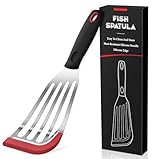
A fish spatula is a slotted turner with three defining features: a narrow leading edge, a broad blade, and some flexibility. Most blades measure roughly 3 to 4 inches wide and 8 to 10 inches long, with an overall handle-to-tip length of about 12 to 14 inches. That size gives you enough support for a salmon fillet or burger without making the utensil clumsy in a small skillet.
The slots allow oil, butter, and cooking juices to drain as you lift food. They also reduce suction between the blade and the pan, which is one reason a fish spatula slides more cleanly under food than a solid turner. A typical metal model weighs approximately 2 to 4 ounces. Silicone versions often weigh closer to 3 to 5 ounces because their coated heads and thicker handles add material.
There are two main styles:
- Stainless-steel fish spatulas: These have the thinnest edges and the most responsive flex. They are ideal for stainless-steel, carbon-steel, cast-iron, and other metal cookware. They may scratch coated pans if you press the edge against the cooking surface.
- Silicone-edged fish spatulas: These are designed for nonstick and ceramic-coated pans. They are gentler on finishes, though their edges are usually thicker and less sharp. Heat ratings commonly fall around 400°F to 600°F, but the exact limit depends on the product and whether the handle or blade is exposed to direct flame.
For a low-cost test, the HOTEC 2-Pack Silicone Slotted Fish Turner Spatula Set is listed at $7.47, which works out to about $3.74 per spatula. Another silicone fish spatula with a heat-resistant edge is listed at $6.99. Those prices are inexpensive enough to try the shape without committing to a premium kitchen tool. Just check the stated temperature rating, dishwasher guidance, and handle construction before buying.
Pros
- It gets under food easily. The tapered front edge can slip beneath delicate food before it tears or folds. This is especially helpful with fried eggs, crepes, fish skin, and thin pancakes.
- It supports more than it appears to. A blade about 3.5 inches wide can carry a burger, chicken cutlet, or several roasted vegetables when the food is firm enough to move as a unit.
- It drains excess fat. Slots let oil run back into the pan, so you are less likely to transfer a pool of grease to the plate.
- It is useful for browning. A flexible metal blade can scrape up browned bits and release food that has formed a crust, without requiring the blunt force often needed with a thick spatula.
- It takes up little space. Most fish spatulas are narrow and flat, making them easy to store in a utensil crock or drawer. One can perform the work of both a fish turner and a general-purpose slotted spatula.
- It is inexpensive to sample. Basic silicone models often cost about $6 to $12, while simple stainless-steel versions commonly range from $8 to $20. You do not need to spend $30 or more to discover whether the shape suits your cooking.
- It improves control. The combination of flex and a long handle helps you turn food in a hot skillet while keeping your hand several inches away from the cooking surface.
Cons
- The flexibility takes practice. A very thin blade can bend under a heavy roast, thick burger, or full stack of vegetables. You may need to slide farther underneath the food or use a second utensil for support.
- Metal can damage nonstick cookware. Even if a stainless-steel turner feels smooth, repeated contact with a coated pan can cause scratches. For nonstick cookware, use a silicone-edged model and avoid dragging it forcefully across the surface.
- Silicone edges can be too thick. A silicone spatula is safer for coated cookware, but it may not slide beneath a delicate crust as cleanly as a thin steel blade. Some also flex more than expected when lifting heavier food.
- Slots are not always convenient. Loose rice, small diced vegetables, scrambled eggs, and sauces can fall through the openings. A solid turner is often better for scooping or serving foods that need full support.
- The long handle may be awkward. A 12- to 14-inch utensil is useful around a hot pan but can feel oversized in a small saucepan or crowded utensil drawer.
- Construction varies at budget prices. Look for a blade that is firmly attached, a handle with no sharp seams, and a head that does not twist excessively. A low price is worthwhile only if the tool remains stable during use.
Who Should Buy It
Buy a fish spatula if you cook eggs, pancakes, burgers, fish, tofu, cutlets, or roasted vegetables several times a month. It is particularly useful for people who struggle to get beneath food without breaking it. Cooks using stainless steel, cast iron, or carbon steel should strongly consider a thin stainless-steel version. Its edge is also handy for loosening browned food and checking whether a crust has formed.
It is a good choice for small kitchens, too. If you want one compact turner that can manage breakfast, weeknight dinners, and occasional baking, a fish spatula has a wider range than its name suggests. A silicone model is the more practical pick when most of your cookware is nonstick or ceramic-coated.
Who Should Skip It
Skip it if you mainly use a deep Dutch oven, cook large quantities, or need to lift heavy foods such as thick steaks and casseroles. A rigid, solid turner or wide pancake spatula will provide more support. You may also prefer a standard silicone spatula if your cooking involves stirring, scraping bowls, sautéing small ingredients, and serving saucy foods more often than flipping.
Do not buy a metal fish spatula solely because it is thinner if all your pans are nonstick. The small improvement in maneuverability is not worth risking the coating. Likewise, if you already own a reliable slotted turner that slides easily under food, a second fish spatula may offer only a minor upgrade.
Cheaper Alternatives
| Option | Cost | Trade-off |
|---|---|---|
| Basic nylon slotted turner | $4–$10 | Gentle on nonstick cookware and inexpensive, but usually thicker and less flexible than a fish spatula. |
| Silicone pancake turner | $6–$14 | Good for coated pans and delicate foods, but the solid or wider head may not drain oil as well. |
| Stainless-steel grill or burger turner | $7–$18 | Strong and effective on metal cookware, but often too rigid or broad for fragile fish and eggs. |
| Offset metal icing spatula | $5–$12 | Very thin and maneuverable for eggs or crepes, but lacks slots and may bend under heavier food. |
| Two-piece silicone fish-turner set | $7–$15 | Provides a spare or matching second utensil; budget sets may have thicker edges and less durable handles. |
If you are uncertain, the least expensive sensible test is a silicone fish-turner set in the $7 to $10 range. If you enjoy the shape but want sharper control, upgrade later to a stainless-steel model for uncoated cookware. That progression makes more sense than paying for a premium utensil before knowing whether you will use it.
FAQ
Can a fish spatula replace a regular spatula?
Often, yes. It can handle most flipping jobs, including burgers, eggs, pancakes, fish, vegetables, and chicken cutlets. It is less suitable for scooping wet foods, lifting very heavy portions, or scraping the sides of a pan. Many cooks use it as their everyday turner and keep a solid spatula for jobs that require full support.
Are fish spatulas safe for nonstick pans?
Silicone-edged or nylon fish spatulas are generally the safer choice for nonstick cookware. Avoid stainless-steel edges unless the pan manufacturer specifically permits metal utensils. Even a silicone tool can damage a coating if you use excessive force, so lift food rather than scraping aggressively.
Is silicone or stainless steel better?
Neither is universally better. Stainless steel offers the thinnest edge, quicker response, and better performance for cast iron and stainless steel. Silicone protects nonstick surfaces and is more forgiving, but it can feel thicker and less precise. Match the material to your cookware first, then consider flexibility and handle comfort.
What should I look for when buying one?
Look for a blade roughly 3 to 4 inches wide, an overall length near 12 to 14 inches, a securely attached handle, and moderate flex rather than a floppy head. For silicone, verify a heat rating of at least 400°F and check whether the entire tool—not just the blade—is dishwasher safe. For metal, inspect the edge for a smooth finish and choose a width that fits your most-used skillet.
Ready to decide? Our #1 pick for 2026 is the Basic nylon slotted turner.
Live price & availability on Amazon.





Write Your Review
No reviews yet. Be the first to share your experience!