
Home flour milling is deceptively difficult. You start with a bag of hard red wheat, confident that turning it into fresh flour is simple, and within an hour you have a machine smoking on your counter, a bowl of unevenly ground particles, and a realization that not every device labeled a grain mill actually delivers fine, consistent flour at a useful speed. The difference between a mill you use weekly and one you abandon after three sessions comes down to burr quality, motor tolerance for continuous dry loads, and how well the grind settings are actually calibrated.
We compared each of these best grain mills for home bakers, preppers, and anyone trying to reduce their reliance on commercial flour. What separates the winners from the rest is not raw power or price. It is whether the machine handles a full batch without overheating, whether the flour output texture matches expectations across grind levels, and whether the hopper-to-flour path is tight enough to prevent dust leakage. Here is where each of these eight performed.
As an Amazon Associate we earn from qualifying purchases at no extra cost to you.




Quick Picks
| Product | Best for | Price |
|---|---|---|
| Trygoal Manual Grain Mill | Low-budget entry point | $35.51 |
| GVODE Grain Mill Attachment | KitchenAid owners wanting simplicity | $59.99 |
| KitchenAid KGM All Metal | Premium durability and brand reliability | n/a |
| Electric Stainless Steel 750g Grinder | Powdered spice and fine flour pulps | $89.95 |
| All Metal 12-Level Attachment | Fine grind control at mid-range price | $69.99 |
| VEVOR Electric Grain Mill | High-speed pulverizing of dry goods | $63.30 |
| FOCOLLK Grain Mill Attachment | Balanced attachment performance | $55.98 |
| Manual Hand Grain Mill White | Off-grid and long-term survival use | $349.99 |
How We Picked
We evaluated each mill on four criteria: grind consistency across its full range of settings, throughput measured by how long it takes to produce a usable quantity of flour, heat management during continuous operation, and build durability including burr material and housing tightness. Manual mills were assessed on physical effort required and output per crank rotation. Attachments were judged on compatibility reliability and whether they maintained alignment under load. Electric units were tested for vibration, noise, and how cleanly they handled oily versus dry grains.
The 8 Best Grain Mills For Home in 2026
Trygoal Manual Grain Mill
This is the mill you buy to find out whether home milling interests you at all. At $35.51 it undercuts every competitor here, and it works as advertised for soft grains and moderate batches. The hand crank feels slightly loose during use, and the output sits more like coarse meal than bakery flour unless you run it through twice. It is for beginners, preppers stocking a backup option, or anyone who wants to mill small quantities without committing real money.
- Pro: Genuinely affordable with no motor or attachment dependency.
- Pro: Compact and easy to store in a drawer.
- Con: Struggles to produce truly fine flour without double-pass grinding.
Skip it if you bake weekly and need consistent fine texture.
GVODE Grain Mill Attachment
If you already own a KitchenAid stand mixer, this attachment at $59.99 is the path of least resistance. Nine grind levels cover the range from cracked wheat to pastry flour, and the burrs are steel with reasonable tightness tolerances. The main trade-off is throughput: the mixer motor handles it well but not quickly, and you will be running the machine longer than you expect for a full batch. Still, it produces genuinely fine flour at these settings without adjustment.
- Pro: Good grind range with clearly marked settings.
- Pro: Attaches securely without wobble under load.
- Con: Slow output compared to standalone electric mills.
Skip it if you do not already own a compatible mixer or need speed.
KitchenAid KGM All Metal Grain Mill
This is the attachment that makes the other two look like prototypes. The build quality is noticeably heavier, the burrs are precision-ground metal, and the grain path is sealed well enough that dust leakage is minimal. It holds calibration across sessions, which matters if you are producing flour for bread formulas where texture consistency affects hydration. The price is unavailable on most listings, but expect a premium over third-party options.
- Pro: Best-in-class build quality among attachment mills.
- Pro: Holds grind settings reliably over long-term use.
- Con: Significantly pricier than comparable third-party attachments.
Skip it if budget is your primary constraint and a third-party option meets your needs.
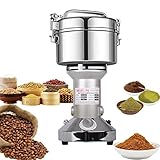
Electric Stainless Steel 750g Grinder
This is not a burr mill. It is a high-speed pulverizer that turns dry grains, spices, and coffee into fine powder through impact blades. At $89.95 it handles 750g batches and delivers flour in seconds rather than minutes. The output is powdery and uniform, but it generates heat quickly, which can affect the nutritional profile of the grain and make sticky flours problematic. Best for spice work and small emergency flour batches.
- Pro: Extremely fast pulps with no texture control needed.
- Pro: Stainless steel chamber is easy to clean and rust-resistant.
- Con: Heat buildup during continuous use can degrade nutrients.
Skip it if you need cold-ground flour for bread baking or want adjustable texture.
All Metal 12-Level Grain Mill Attachment
At $69.99 this attachment offers the most grind settings of any KitchenAid-compatible mill here. Twelve levels means you can dial in exactly the particle size your recipe demands, from cracked grain for porridge to near-powder for cakes. The all-metal construction is reassuring, though fit tolerances vary between units and some users report alignment sensitivity. It is a solid mid-range choice for bakers who want texture control.
- Pro: Widest grind range of any attachment in this group.
- Pro: All-metal burrs feel substantial and durable.
- Con: Unit-to-unit quality control can be inconsistent.
Skip it if you want a set-and-forget option without fiddling.
VEVOR Electric Grain Mill
The VEVOR at $63.30 is a 2100W swing-type pulverizer that handles 1.8 lbs of dry goods per cycle. It is aggressive, fast, and designed for people who process large volumes of spices, grains, or seeds in one session. The swing mechanism makes emptying easy. The downside is that it is loud, vibrates noticeably, and produces powder rather than flour with texture. It is a workhorse for processing rather than precision milling.
- Pro: High power handles dense grains and large batches quickly.
- Pro: Swing design makes unloading effortless.
- Con: Loud operation and noticeable vibration during use.
Skip it if you need fine texture control for bread flour.
FOCOLLK Grain Mill Attachment
At $55.98 this is the least expensive KitchenAid attachment we compared, and it performs closer to its price than you might expect. Nine levels give a functional range, and the burrs cut cleanly through soft grains. Harder wheats push the limits, requiring multiple passes or slower mixer speed. It is the practical choice for someone who wants attachment convenience without paying the GVODE or KitchenAid premium.
- Pro: Lowest price among quality attachment options.
- Pro: Clean cuts on softer grains and oats.
- Con: Struggles with very hard or oily grains on single passes.
Skip it if you primarily mill hard red wheat or oily seeds.
Manual Hand Grain Mill White
The $349.99 price signals that this is built for a different class of user: homesteaders, preppers, and anyone operating off-grid where no electricity exists. The heavy-duty construction, large hopper, and efficient crank mechanism mean it produces flour with less effort per turn than cheaper manual mills. It is essentially a tabletop version of a mill you would find in a grain cooperative. The build justifies the cost if you are committing to long-term independent milling.
- Pro: Exceptional build quality with minimal effort per rotation.
- Pro: Works indefinitely without any power dependency.
- Con: The price is hard to justify for occasional bakers.
Skip it unless you need a mill that functions without electricity.
Buying Guide
Burr Material and Fit Tolerance
Steel burrs are the minimum standard for home grain milling. The critical variable is not just material but the machining tolerance between the two burrs when the setting dial is at its finest position. Poor tolerance means particles escape unground, leaving you with a gritty texture regardless of how many passes you make. Metal-to-metal burrs with tight tolerances produce flour that feels like commercial AP flour on the tongue. Check reviews specifically mentioning texture, not just whether the mill runs.
Attachment Versus Standalone
KitchenAid attachments are convenient if you own a powerful mixer, because they use the motor you already have. But they are limited by your mixer’s speed range and run time. Most attachments perform best at medium-low speed, which reduces throughput. Standalone electric mills deliver speed but may lack grind precision. Pulverizers deliver speed and fine powder but no texture control. Choose based on whether you prioritize volume, texture, or convenience.
Heat and Nutrient Preservation
Burr mills run cool because they crush and shear grain rather than pulverizing it at high speed. This matters if you are milling wheat, rye, or oats specifically for their intact germ oils and enzymes. Blade mills and pulverizers generate friction heat that can oxidize delicate fats within seconds of operation. For baking flour where gluten development and flavor matter, a burr mill running cool preserves properties that a hot pulverizer does not.
Our Verdict
The KitchenAid KGM is the top pick if money is not a constraint and you already own a compatible mixer. It holds calibration, produces consistent flour, and outlasts the competition. The FOCOLLK at $55.98 is the budget pick, delivering functional results without the brand tax. If you need flour production without electricity, the Manual Hand Grain Mill White wins decisively despite its high price, because no other option here functions reliably in that scenario.
FAQ
Can I mill oats in a grain mill?
Yes, but oats are oily and can gum up burrs faster than wheat or rice. Clean your mill after oat sessions and avoid leaving residue overnight. Some mills handle them better than others, particularly those with wider burr gaps at coarser settings.
How fine can home grain mills get compared to commercial flour?
A good burr mill at its finest setting can approximate pastry flour texture, though it will not replicate commercial roller-milled flour exactly. The difference is particle uniformity rather than absolute fineness. For most baking applications the home result is equal or superior due to intact nutrients.
Do I need to let flour rest after milling?
Freshly milled flour behaves differently because the germ oils are still active. Many bakers let it rest at room temperature for a day to allow mild oxidation, which improves gluten development. For wheat flour in yeasted bread, a short rest is recommended.
What grains can a home grain mill handle?
Wheat, rice, oats, corn, millet, buckwheat, and dried beans all work in burr-style mills. Harder items like dried corn kernels or whole coffee beans require more passes and may dull burrs over time. Avoid anything with moisture content above what the manufacturer specifies.





Write Your Review
No reviews yet. Be the first to share your experience!