
The best clicker presses for leather die cutting production are a 20-ton benchtop press for most small workshops, a 25–40-ton hydraulic press for larger dies and thicker stacks, and a swing-arm or traveling-head production machine when speed and full-sheet coverage matter more than purchase price.
- Quick picks by production situation
- Best overall: a 20-ton hydraulic clicker press
- Best for compact workshops: a small manual or hydraulic press
- Best for large dies: swing-arm and traveling-head presses
- Force: match tonnage to die area, not just material thickness
- Stroke, platen size, and production pace
- Safety features worth paying for
- A simple capacity calculation
- Setup and maintenance that protect cut quality
- Final buying recommendation
Quick answer: For most people in 2026, the best clicker presses for leather die cutting production is the Occasional belts, wallets, and small goods — our #1 rated choice. See the full ranked comparison, alternatives and buying advice below.
Quick picks by production situation
| Situation | Best press type | Practical target specifications | Why it fits |
|---|---|---|---|
| Occasional belts, wallets, and small goods | Manual or compact hydraulic clicker | 10–20 tons; 300 × 400 mm platen; 50–80 mm stroke | Lower cost, modest footprint, sufficient for single-layer leather and small dies |
| Daily workshop production | 20-ton hydraulic benchtop press | 20 tons; 400 × 500 mm platen; 70–100 mm stroke | A strong balance of force, die coverage, repeatability, and manageable power requirements |
| Large bags, panels, or several small dies per layout | 25–40-ton swing-arm or traveling-head press | 25–40 tons; 600 × 800 mm or larger cutting area; 80–120 mm stroke | More coverage and faster repositioning reduce handling between cuts |
| Continuous factory production | Automatic traveling-head or beam press | 40–100+ tons; 1,000 × 1,600 mm or larger working area | Designed for high cycle counts, programmed movement, and consistent pressure |
Best overall: a 20-ton hydraulic clicker press
A 20-ton hydraulic press is the most useful starting point for leatherworkers who cut every week rather than occasionally. The Weaver Mighty Wonder 20 Ton Clicker Press is a well-known example of this class. It is intended for cutting leather and other sheet materials with steel-rule dies, while its relatively compact format suits a dedicated workshop better than a factory-size beam press.

VEVOR Leather Cutting Machine, 14.2 x 10.2 in Embossing Plate Manual Die Cutter, 0.47 in Pressure Stroke Leather Embossing Machine, Dual Guide Shafts Die Cut Machine for Various of Materials
Included for 'Best Clicker Presses for Leather Die Cutting Production' because the listing specifies 14.2 x 10.2 in Embossing Plate Manual Die Cutter and 0.47 in Pressure Stroke Leather Embossing Machine, details this guide uses to compare options.
View on Amazon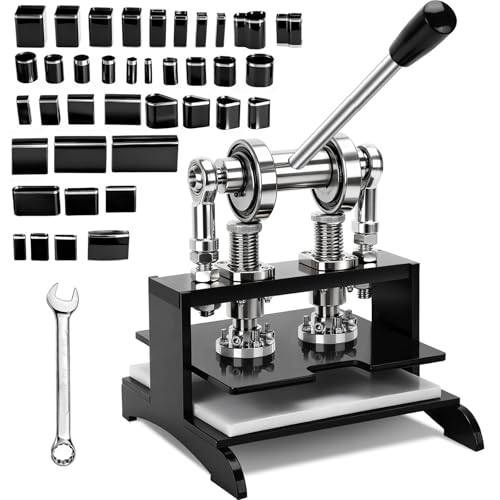
1.5Ton Leather Cutting Machine,20 * 20cm Leather Hand Press Dual Guide Shafts Die Cut Machine with 39 pcs Hole Punch Tool Set for Leathercraft,DIY & Various Materials Die Cutting
Included for 'Best Clicker Presses for Leather Die Cutting Production' because the listing specifies DIY & Various Materials Die Cutting, details this guide uses to compare options.
View on Amazon
Leather Cutting Machine 1.8 Ton, Portable Manual Press Die Cutter Dual Guide Shafts Die Cut Machine with 39-Piece Professional Hole Punch Kit for Leather, Fabric, Plastic & More — DIY Craft Essential
Included for 'Best Clicker Presses for Leather Die Cutting Production' because the listing specifies Fabric and Plastic & More — DIY Craft Essential, details this guide uses to compare options.
View on Amazon
Flyrivergo 5x3.5inch Small Leather Die Cutting Machine - 1 Ton Pressure
Included for 'Best Clicker Presses for Leather Die Cutting Production' because the listing specifies 1 Ton Pressure, details this guide uses to compare options.
View on AmazonThe important advantage is not simply the headline tonnage. A 20-ton machine can usually cut common vegetable-tanned, chrome-tanned, and oil-tanned leather in one or more layers, provided the die is appropriately sized and the material is supported by a suitable cutting board. It also offers enough reserve force that the operator does not need to run the machine continuously at its limit.
For wallets, watch straps, belts, footwear components, and small bags, choose a platen of at least 400 × 500 mm if your space allows. A smaller 300 × 400 mm platen may cost less, but large dies will require more repositioning and may not fit safely under the cutting head.
Best for compact workshops: a small manual or hydraulic press
A compact 10–15-ton press makes sense when the work is occasional, the dies are small, and floor space is limited. It can handle many single-layer leather jobs, but its limitations appear quickly with thick skirting leather, stacked layers, large dies, or dense synthetic materials.
Before choosing this class, measure the largest die you actually use. The cutting area must be larger than the die in both directions, with enough room for the die to sit flat without contacting the frame. A 250 × 300 mm opening may be adequate for card wallets and small straps but frustrating for bag gussets or long belt components.
Compact presses are also more sensitive to uneven loading. If only one corner of a large die sits beneath the ram, the press may flex, the die may cut unevenly, and the cutting board may wear in one concentrated area. For that reason, a slightly larger 20-ton machine can be better value for regular production even when maximum force is rarely needed.
Best for large dies: swing-arm and traveling-head presses
Swing-arm presses, sometimes called clicker presses, let the cutting head move across a larger work surface. Traveling-head models move the head along rails or a bridge. Both designs improve production pace because the operator can place several dies on a hide or sheet and move the head to each one instead of repeatedly shifting the entire material.
These machines are especially useful for handbags, footwear uppers, upholstery panels, and coordinated sets of components. A 25–40-ton machine with a 600 × 800 mm platen can accommodate much larger layouts than a compact benchtop press.
The trade-off is ownership cost and space. Industrial presses may require three-phase electrical service, a reinforced floor, lifting equipment, or professional installation. Their greater stroke and mass can also make setup less forgiving. They are justified when reduced handling time produces more finished pieces per hour, not merely because a larger tonnage number looks attractive.
Force: match tonnage to die area, not just material thickness
Cutting force depends on the total length of the die’s cutting edge, the material’s density and hardness, the number of layers, and the sharpness of the rule. A small die cutting thick leather may need less force than a large die cutting a thin but wide piece.
A useful planning method is to treat the press’s rated tonnage as a working ceiling rather than a target. If a job appears to require 15 tons, a 20-ton press provides useful reserve for variation in leather density and die sharpness. Running at the limit on every cycle increases mechanical stress and makes incomplete cuts more likely when the cutting board compresses.
Do not assume that stacking more layers always improves productivity. If the stack is too high for the available stroke, the top layers may cut while the bottom layers remain attached. Test the actual material and die combination, then record the maximum reliable stack height.
Stroke, platen size, and production pace
| Specification | Small workshop | Production workshop | Why it matters |
|---|---|---|---|
| Rated force | 10–20 tons | 25–60 tons | Determines the size, density, and layer count the press can cut reliably |
| Platen or cutting area | 300 × 400 mm to 400 × 500 mm | 600 × 800 mm to 1,000 × 1,600 mm | Controls die size and how many components fit in one layout |
| Usable stroke | 50–80 mm | 80–120 mm | Must accommodate the die, leather stack, cutting board, and safe clearance |
| Cycle time | 8–20 seconds | 3–10 seconds | Includes approach, cutting dwell, return, and repositioning—not just hydraulic movement |
| Typical footprint | 600 × 800 mm to 900 × 1,100 mm | 1,200 × 1,800 mm or more | Allow additional space for material loading and operator movement |
Stroke is often overlooked. A die that is 20 mm tall may need another 20–40 mm for the cutting board and compressed material. If the machine has insufficient clearance, the ram cannot complete the cut. Excessive stroke is not automatically better, because it can add travel time and make the operator reach farther into the work area.
Safety features worth paying for
- Two-hand controls: Require both hands away from the cutting zone during activation. This is preferable to a single exposed foot or hand control.
- Guarding and restricted access: A fixed or interlocked guard should prevent accidental access beneath the head while it is moving.
- Emergency stop: The stop should be easy to reach without reaching across the die or material.
- Adjustable pressure and stroke: These features prevent unnecessary force and shorten the cycle for thin materials.
- Pressure hold and controlled return: A stable dwell and predictable return reduce partial cuts and unexpected movement.
- Overload protection: Hydraulic relief protection helps prevent damage when a die is misaligned or the stack is too thick.
Never defeat a two-hand control, guard, or interlock to gain speed. A faster unsafe cycle is not a production improvement; it is an avoidable risk.
A simple capacity calculation
Suppose a workshop cuts six wallet panels per cycle. Each cycle takes 14 seconds for positioning, pressing, and removal. The theoretical output is:
3,600 seconds ÷ 14 seconds × 6 panels = about 1,542 panels per hour.
That number is not a realistic finished-goods rate because it excludes hide inspection, nesting, die changes, waste removal, and occasional recuts. If those tasks reduce active cutting time to 60 percent, practical output is closer to 925 panels per hour during a sustained run.
A larger press only improves this calculation if it lets you place more panels per cycle or materially reduces repositioning. If the same six panels still fit and the cycle remains 14 seconds, buying a 60-ton press will not automatically increase output.
Setup and maintenance that protect cut quality
- Level the machine. A stable base keeps the platen parallel to the die and reduces uneven cuts.
- Use the correct cutting board. Replace or rotate the board when deep grooves begin transferring to the leather. A damaged board can mimic a dull die.
- Center large dies. Keep the die within the supported platen area rather than loading one edge repeatedly.
- Set the minimum reliable pressure. Increase pressure gradually until the lowest layer cuts cleanly, then stop. More force accelerates wear without improving the result.
- Inspect hydraulic components. Check hoses, fittings, ram seals, and oil level according to the manufacturer’s schedule. A slow pressure drop can produce inconsistent cuts.
- Clean the work surface. Remove leather fibers, adhesive, and debris before they affect platen alignment.
The cutting board and die edges usually wear before the main press frame. Replacement boards, sharpening, hydraulic seals, and occasional electrical servicing should be included in the ownership budget. Keep spare boards available if production downtime is expensive.
Final buying recommendation
Choose a 20-ton hydraulic benchtop press when your largest dies fit within roughly 400 × 500 mm and you produce small leather goods regularly. Choose a 25–40-ton swing-arm or traveling-head machine when large layouts and frequent repositioning dominate your day. Move to an automatic industrial beam press only when sustained volume, labor savings, and sheet coverage justify installation and service requirements.
The best clicker press is therefore the smallest machine that handles your largest die, thickest normal stack, and required pace with reserve capacity. Compare the working area, usable stroke, controls, guarding, service access, and replacement parts alongside tonnage; those details determine whether the press remains productive after the initial purchase.
Ready to decide? Our #1 pick for 2026 is the Occasional belts, wallets, and small goods.
Live price & availability on Amazon.




Write Your Review
No reviews yet. Be the first to share your experience!